Top Tips for Visiting Honduras

Despite how much I love Honduras, I recognise that it’s not top of most people’s list of must-see destinations. However, it feels like a personal mission to change people’s minds about that. With everything I’ve written and will write, I hope I can show people that Honduras is definitely a country worth your time. At the same time, Honduras has a certain reputation that precedes it that I don’t think is representative of the country as a whole. It is safer and easier to navigate than it might appear. That’s not to say that there aren’t things to watch out for and you also shouldn’t expect the same level of tourism infrastructure as somewhere like Costa Rica. With that in mind, there are a few things that I think are important to know before you visit so that your expectations are in line with reality.

Take what you might have heard with a pinch of salt.

Back in 2015 when I was first embarking on the journey that would take me to Honduras (the selection and fundraising process started a year before I would actually leave), the prolific BBC investigative presenter Stacey Dooley had just released a two part documentary about the worst places in the world to be a woman and guess where one of those places was? This meant that many of my first interactions with people when I told them that I would be moving to Honduras for a year was shock and horror. This was quickly followed by questions or comments about how bad it is for women there and generally how dangerous it is. At the time, I had no idea how to respond and usually just laughed somewhat awkwardly before moving the conversation along.

Now, I’ll say that while Honduras still doesn’t have the best reputation among international travellers, a lot of the problems (gangs, violence, drugs) are localised to specific areas of bigger cities and visitors are rarely affected or the targets. Outside of the large cities of San Pedro Sula and Tegucigalpa, I have never felt unsafe in Honduras. (Saying that, still don’t take any unnecessary risks.)

Don’t flush toilet paper.

The pipes in Honduras are not what you will be used to at home. It sounds like it’s going to be really annoying and it will definitely take a few days to get used to this but it’s the same throughout most of Central America. You’ll get the hang of it eventually and if not, I hope you’re good with a plunger!

Cash is king.

To be on the safe side, I would assume that nowhere takes card so always have lempiras (the Honduran currency) on you. Most larger towns and cities have ATMs but sometimes these are out of service or there’s an unexpected problem with your card so stock up when you can. In general when it comes to using your bank card, Visa and Mastercard are widely accepted. I personally use my Monzo card when I travel because they have pretty good travel rates and won’t block your card if you change countries without telling them. Back to cash, dollars are not really used (other than in very touristy places like the island of Roatán) but can be good to have for emergencies. In smaller shops or restaurants it might be hard to break a 500 lempira note (~£15) for smaller purchases.

Dress a little more conservatively.

If you’re anything like me, you’ll spend the whole time wondering how Hondurans are going about their business in jeans in up to 40° heat! I’m not saying you have to follow suit but Honduras is generally a pretty conservative place so keep that in mind in your clothing. Especially if you travel to a smaller town, somewhere like Candelaria for example, I wouldn’t wear shorts and I would have more coverage on the top, no crop tops or low cleavages. In the cities and on the islands which are used to more tourists, you can be more free with what you want to wear.

Visit the mainland!

So often people travelling Central America will skip Honduras entirely or only visit the Bay Islands of Utila and Roatán. I’m not saying they aren’t worth visiting (I love Utila and have been four times, watch out for the next blog post) but the mainland has so much to offer too! Copan Ruinas are in the northwest of Honduras, near the borders with Guatemala and El Salvador and are most well known for their Mayan ruins. These are the most southern Mayan ruins and my favourite of the handful that I’ve visited. I feel like they are the ones that I could most imagine being full of life and I could still see how everything fit together as a city. The town itself is really cute and there’s also a scarlet macaw sanctuary that’s worth a visit. In central Honduras, you’ll find Lago de Yojoa which is a hot spot for outdoor activities. It’s popular with bird watchers, kayaking out into the middle of the water gives you incredible views and you have to go to one of the many lakeside restaurants and try their specialty, pescado frito (fried fish). Nearby there is also the very impressive Pulhapanzak waterfall, 30 metres high. You can spend the day at the facilities there, go ziplining in front of the falls or go canyoning through them. And of course, there’s always Gracias for the hot springs and zipline.

Basic Spanish will help.

Obviously knowing the language of wherever you’re visiting is always a massive help, this almost goes without saying. But Honduras isn’t Costa Rica where so much of the economy relies on tourism that English is fairly widespread. Even in touristy areas like Utila, Roatán and Copán Ruinas but especially outside of it, a basic command of Spanish will go a long way. I think it’s polite and shows respect to the country you’re visiting to know a few phrases at least and people like it when you make the effort! Being able to have a basic conversation, ask for directions and order food are the most important things to learn but the more the better! Have Spanish downloaded on the Google Translate app as a last resort too.

People are generally kind, generous and willing to help.

You can’t generalise a whole country of people but I have found most Hondurans to be some of the most friendly and welcoming people. It’s hard to put into words how welcome I was made to feel when I lived there and am still made to feel every time I go back. I’m welcomed back into the home and the family that I lived with, my friends won’t let me pay for anything and I’ve had amazing interactions with strangers. This ranges from interesting conversations and lifts from bus stations to getting the best, authentic but otherwise unknown recommendations.

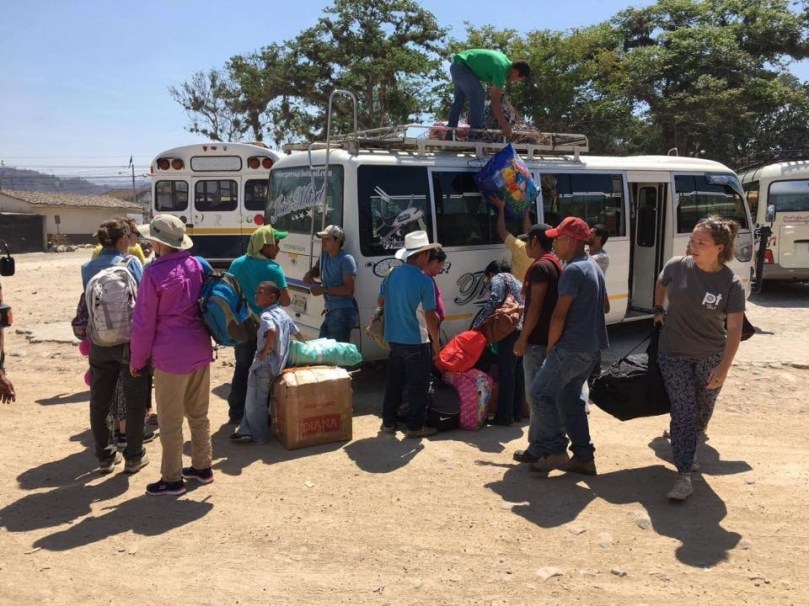
Trust the bus men throwing your bags on top of buses (and in public buses in general).

There are some private shuttles that you can take from the more touristy destinations in Honduras, from the islands to Lago de Yojoa or Copan Ruinas, or to the main cities like Tegucigalpa and San Pedro Sula but they’re expensive and if you want to venture further afield, more than likely you’re going to have to trust in public buses. There’s not a nationwide bus network, instead there are a collection of bus companies in each city running specific routes to another city. There’s no app or website in most cases so your best bet is to turn up at the bus station and ask around! There are times when someone will grab your bag and run off with it but they’re not stealing it (probably) – the men who work on the buses are very helpful but not always the best with instructions. Follow your bag and you’ll find the bus you need to get on. What looks like chaos on the surface is actually a well oiled machine.
Cold showers are the standard.

Unlike at home where hot showers are the norm, almost no matter the weather, you’ll have to get used to bracing yourself for freezing water. If you go around expecting this, hot showers become a welcome luxury which is nicer than constant disappointment. Your hair maybe won’t be as nice but take it as an opportunity for some cold water meditation and focus on your breathing. It’s hot enough anyway that you might welcome the cold water!

Women will most likely get catcalled.

Honduras has a strong culture of ‘machismo’ which is defined as an exaggerated sense of masculinity. This manifests itself as Honduras being a very male dominated culture. Men are the heads of the households, the primary breadwinners and much more visible in public and high-level positions. In day to day interactions, one of the ways the macho culture manifests is in catcalling. When I was living there, I had to get used to walking around with the background noise of whistles, kissing noises and various comments. Honduran men have yelled ‘I love you’ in English at me more times than I can count. Usually it’s harmless and ignoring it works. As a tourist, it won’t usually go further than this catcalling although that is unfortunately not the case for many Honduran women who suffer from high levels of violence, both in the home and in society at large.

Go to the local restaurants (comedores).

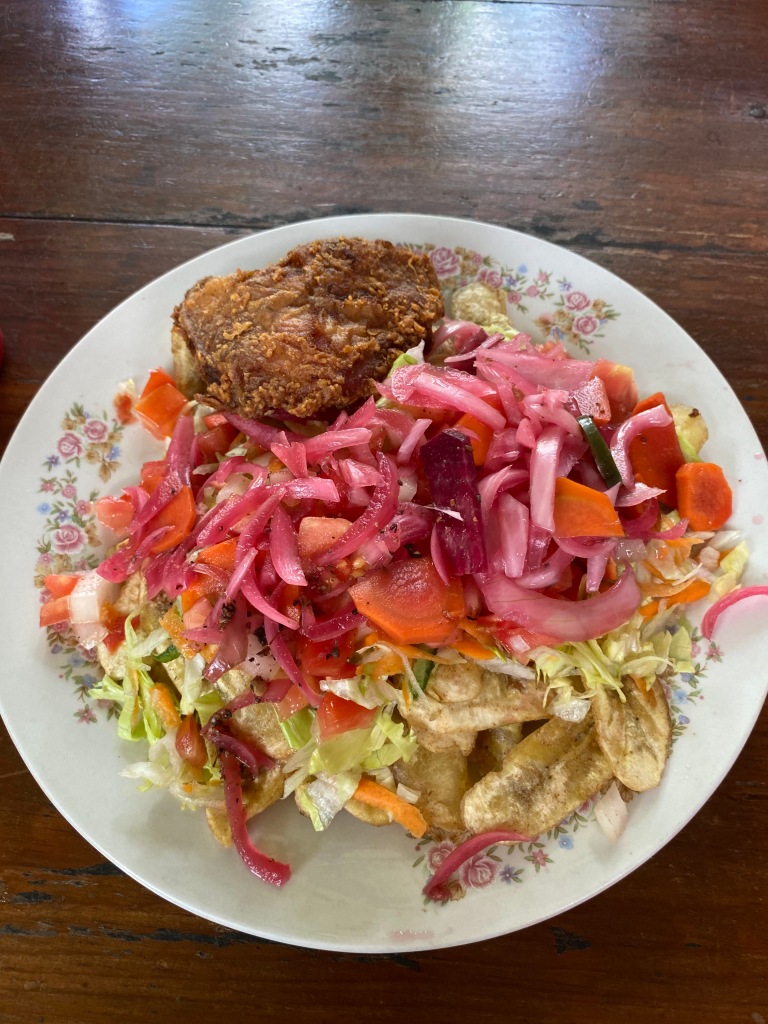
From the outside they don’t look like much, sometimes a bit more like someone’s living room than a restaurant. It might be tempting to go for more aesthetic choices and of course there’s always times when you just want some pizza but you’d be missing out if you don’t give the comedores a chance. You might be wary, particularly at the beginning of the trip, about the cleanliness or hygiene of a place but there’s usually signs to tell if the place is safe, the main one being if it is popular with locals. Try some of the classics like baleadas, fried chicken or a typical dinner. Big plates of food can cost up to around 120 lempira (£4) so it’s a cheap option too. But still trust your gut if something looks too dodgy.
Things will go wrong but they’ll all work out.

A good motto for visiting Honduras is ‘go with the flow’. The phrase ‘organised chaos’ comes to mind but embrace it. Particularly when it comes to transport, things don’t usually go to plan (add at least an extra hour on to the supposed length of any bus journey). Everything is a bit more relaxed in Honduras though, especially timekeeping (although I wouldn’t recommend turning up late for buses). Being open to new experiences can lead to some amazing things! Talk to people and you never know what might happen, you might end up in the most incredible situation that you wouldn’t otherwise have experienced. There is magic in the chaos.

Seven Years Later…

Of the whole two and a half months that I was travelling, these next few days were my absolute favourites, not that I expected any different. After a few days relaxing in Gracias and a night in Hannah’s old project in Yamaranguila, I was returning to Candelaria, a town that feels like home. It had been seven years since I first stepped foot there as a fresh faced 18 year old, although I did go back for a week in 2019. Travelling to new places is exciting and there is much to be learnt but I have found that nothing makes me more reflective than returning somewhere I’ve been before, especially somewhere that means so much to me and had such an impact on the person I am today. It was also really special to share this experience with Hannah because while I had visited her project during our original time in Honduras, she had never made it to Candelaria (awkward bus schedules are mostly to blame).

From Yamaranguila we had to take the bus from La Esperanza towards Mapulaca, a border town with El Salvador, and get off in Candelaria. We were waiting for the bus to take us from our hotel down to the station while simultaneously trying our luck at hitchhiking (a very common practice in Honduras) and we ended up getting a lift with two policemen! The bus journey was easy enough, about five hours in total and much smoother than our bus ride from San Pedro Sula to Gracias. As we were coming around the last few bends before arriving into town, I could barely contain myself! It already felt like coming home, even if I was already noticing a lot of changes.

And now comes the real reason that I was so excited to be coming back. My family met me off the bus! When I lived in Honduras in 2016-17, I stayed with a host family – Saida, the mum, Jaime, the dad, and three girls, Daniela, Jamie and Antonella. Antonella was actually born while I was there! Unfortunately the dad Jaime passed away in 2019, just before I came back to visit for the first time, but I’ve remained close to Saida and the girls. I had the loveliest big hug from Saida and I immediately couldn’t believe how big the girls were since I last saw them. Daniela and Jamie are fully teenagers now and Antonella has started school! Mind blowing. They don’t actually live in the same house as they did when I lived there, right on the main square, because they rent it out as a shop now but they’re only one block away and right opposite two of my friends. I introduced Hannah to everyone, we got the grand tour, including meeting the new cat called Sushi, and settled in a little.

For our first evening we went to the pool which is definitely something new, one of the many developments around Candelaria! I would have loved it if this was here before so I could have run some actual swimming lessons (I used to be a swimming teacher and I would teach my host sisters how to swim in the river!). Finca Don Jorge is so cute and definitely would be a good spot when it’s super hot. At this point the sun was going down so it was getting dark and cool but it was still nice to get in the water after being on the dusty bus. Not everyone got in but I enjoyed splashing about with Jamie and teaching Antonella how to blow bubbles and kick her legs. She’s already so confident in the water which is good but it was one of many moments over the next few days that made me wish I was staying much longer. Antonella didn’t remember me from last time because she would only have been about two years old but apparently she was the most excited for me to come, asking when her hermana was getting here… I’m not crying, you are.

On our second day, we went with Saida to the nearby village of San Lorenzo where she works. They were having their elección de la india bonita , an event that happens just before Lempira Day, a national celebration that would be happening on the final day of our stay. The girls make and wear these incredible dresses using natural materials like beans, seeds, corn, leaves, moss, flowers and more. They have very intricate designs of their town, of Honduras, of national symbols like Lempira or the scarlet macaw. We were helping some of Saida’s students finish their dress and get ready for the presentation which involved braiding a lot of hair! The actual ceremony was really interesting to see, the dresses were absolutely incredible but it was a long afternoon in the hot sun. Hannah, Antonella and I ended up getting a lift back to Candelaria a bit early while Saida stayed on.

We had a chilled evening in the house because everyone was tired after a long day. This was actually one of my favourite evenings though. Over dinner, Saida, Hannah and I had an interesting conversation about various political and social issues which are conversations that I enjoy anyway. This conversation happened in Spanish though so was a bit more challenging. I was very pleased and a bit surprised with how well I’d been able to keep up my Spanish before this trip and how quickly it bounced back even more after arriving in Honduras. Hannah has a pretty good understanding of Spanish but won’t mind me saying that she struggles a bit more with speaking. She absolutely held her own in this discussion though and was participating fully in it. It was so nice for me to see her and Saida getting along and communicating together. After dinner, we helped finish a sign for Lempira Day that involved hot glueing beans to outline letters. While we were doing so, I had a conversation with Daniela, the oldest of the girls, in English. It was simple and short but had full sentences and used the past tense. When I was first here, I taught Daniela English when she was in second and third grade plus some extra bits and pieces in the house. Seeing the progress she’s made and her continued interest in English made me so proud that I was genuinely holding back tears.

The following day was packed full of catching up with as many friends as possible. I’ve already written about the complicated feelings I had after I left about not having made any lasting friendships and this being proved wrong the moment I was back in Candelaria. (While re-reading the blog from my last visit while writing this one, I found that what I had written still resonated a lot and I was very proud of that piece of writing and the reflections in it so it might be interesting for you to have a look at it too if you haven’t already.) It was the exact same this time. From the start of the day until the end I was catching up with people. It started with picking Antonella up from school mid-morning as there were only a few classes in preparation for Lempira Day. It was a bit of a shock that the only students I still knew in the primary school were the sixth graders who I had taught while they were in Kindergarten! A group of them gathered around to talk to me and there were lots of questions about Amy, my project partner (not my twin sister!). Hannah, Antonella and I walked back into the centre of town with our entourage and ended up going to play with them in the park and then being introduced to minutas, like a snow cone topped with flavoured syrup, condensed milk and candy belts.

After a brief air conditioning break in the house (a new but welcome addition since I lived there), we headed out for lunch with my friend Nayely. Her family has a comedor, a typical Honduran restaurant, so we ate there which was absolutely delicious (food pictures are further down)! We were very hot and very full after our pollo frito and tajadas so we went home to chill before I got called out to meet up with another friend, Enedina, for a cold frappé. Hannah was tired so she stayed behind but Saida and Antonella came with us.

The final stop of the day was dinner with Lety and Victor who were like my second host family back in the day. They were the organisers of the project so we spent a lot of time with them and their four kids. Three of them are much more grown up now, including the eldest who is off at university, but Hannah and I got to spend some time with the youngest, Samuel, while waiting for dinner. He was only a toddler when I was here the first time so didn’t really remember me. This time he took us through all 60+ Youtube shorts of something called Skibidi Toilet (if you’re lucky enough not to know what that is, don’t look it up). As painful as it was, it was nice to spend some time with Samuel so that next time he’ll remember me more, the same as with Antonella.

And now for the main event, Día de Lempira! Lempira Day was my favourite national holiday when I was first here, and there are a lot to choose from, so I specifically planned this trip and it’s itinerary around that. Lempira is the national hero in Honduras who led the Lencan people, an indigenous group, against the Spanish in the 1530s. The name comes from two Lencan words that mean ‘señor de la sierra‘ or ‘señor del cerro‘, both meaning ‘lord of the mountain’. Today he is remembered on 20th July every year. The national currency is named after him as well as one of the departments of Honduras (where you’ll find both Gracias and Candelaria).

The first step is the parade! Before that however, everyone has to get ready in their various outfits. My contribution to the morning was plaiting all three girls’ hair plus Saida’s. Hannah and I walked Antonella to the meeting point for the parade, which is a couple of hundred metres shorter than in my day (not that I’m complaining). The whole primary school and high school are part of the parade, dressed up in different styles. There are the indias bonitas, the girls in handmade dresses decorated with beans, corn, flowers and leaves like we had seen in San Lorenzo. There are the caciques, the warriors, the campesinos, the peasants, and those in the traditional folkloric outfits.

The second part of the day is in the main square where there are different kinds of performances and speeches, starting with the national anthem sung by my former students. Next up was traditional dancing, again with my former students, mostly those I taught when they were in fourth and fifth grade (now they’re in eleventh grade!). The final and most important event of the day is the reenactment of the death of Lempira. One student from the high school is chosen to play Lempira (another one of my old students, Josue Maria, was chosen this year!). It is said that Lempira died when he was lured to peace talks with the Spanish who then shot him from horseback in an act of betrayal. There is another telling of events that says he dies in battle and the Spanish cut his head off to prove he was dead but that’s a bit harder to reenact!

After being in the sun for several hours, we went back to the house before going out for lunch with another friend, Karen. We actually ended up back at Nayely’s comedor, today for pollo asado. A common theme throughout my visit was that I wasn’t allowed to pay for anything. It was lovely that all my friends wanted to invite me out but I wanted to contribute to the town and I wasn’t expecting everyone to pay for me. Especially when it came to supporting my friends, like at Nayely’s comedor or buying coffee from Victor (at my dad’s special request), I tried to insist but after a certain point it becomes rude to refuse. Part of the Honduran culture is their generosity, looking after guests and feeding people!

The morning had been a busy one, as had the last few days which caught up to us so we spent the afternoon resting in the house. In the evening, as a last hurrah for our last night, Hannah, Saida, the girls, Saida’s cousin Miriam and I went out to a Mexican restaurant that is also new since I lived here. We had a nice meal and then spent the evening watching a film on a projector in the house. It was a lovely way to wrap up our few days there.

It’s still somewhat of a challenge to put into words how much this little town and its people mean to me. Being back here is like using a time machine – I feel 18 again but at the same time I’m able to see how far I’ve come. And I’m not the only one who has changed. More so this time than the last time I was here, I noticed the differences in the town. In most cases, the changes are positive. There are lots of new businesses and restaurants which is encouraging to see after the economic challenges of the last few years during the pandemic. Coming back to Candelaria feels like coming home and a lot of that is about coming home to my family, particularly my mum Saida. The love I feel for her and from her cannot be described as anything else. The girls are growing up so fast, as are all of my former students, and it is a privilege both to have known them when they were younger and see them transforming now into the strong, independent, intelligent people I always knew they would be. Sharing this experience with Hannah was also really special and I know she saw at least some of what I see in this amazing town and these amazing people. They opened their arms as much to her as they do to me and I’m so grateful for that. Now that I’m in Costa Rica for the foreseeable future, I hope it won’t be four years until my next visit!

Gracias Guide

Gracias is one of my favourite places in Honduras but it could easily slip under the radar behind the more popular and well known Utila or Copán Ruinas. In this guide, I’ll share some of my favourite parts of Gracias and a little bit more about my time there this summer.

A bit of background first, Gracias is the capital of the department of Lempira and was founded in 1536. It is said that the name of the city, which means ‘thank you’ in Spanish, comes from when Spanish explorers arrived through the mountains and exclaimed ‘gracias a Dios, hemos llegado a tierra plana‘ meaning ‘thank God we have arrived at flat land’. A top tourist spot amongst Hondurans, Gracias is home to the highest point in Honduras and also its largest cloud forest.

WHERE TO STAY

Guancascos

It could only be Guancasos! This is as much the attraction to me as anything else in Gracias because it feels like a haven. Not just because it was my home away from home while I lived in Honduras and where I spent a lot of weekends but the hotel itself is blissful. The hotel has its own compound meaning that once you are inside it feels really safe, private and peaceful. There are so many plants and flowers as well which means there’s also lots of birds and other things to see while walking from the restaurant to your room. Another thing I love about Guancascos is that it’s really sustainable and supports the local community. There is an onsite restaurant and bar, breakfast is included in some rooms and they have hot water (not always a given in Central American accommodation!)

WHAT TO DO

Hot Springs

The hot springs are definitely one of the highlights in Gracias. You might think that it’s far too hot in Honduras to go to a hot spring and you would be right, most of the time. This is why they are a popular way to spend an evening. There are a couple around Gracias but the one I like is El Presidente. They are a couple of kilometres out of town but worth the journey so grab a mototaxi from anywhere in town. Mototaxis within Gracias are about 20 lempiras per person (65p) but out to the hot springs it will cost 80L total (£2.65) or 150L at night (£5). It can be hard to find a mototaxi there when you are done so arrange for whoever takes you to come back later.

Entrance to the pools themselves cost 50L (£1.65). Most of the pools are between 36º and 38º and they’re open until 11pm so you can really enjoy the warmth of the water! There’s a little restaurant where you can buy meals or snacks or you can bring your own. We opted to bring some snacks, a bag of lychees for me, and had dinner later. Many Hondurans will wear a t-shirt and shorts into the water and while you can wear whatever you like, you might feel more comfortable doing the same.

Celaque National Park

Celaque National Park is home to Honduras’ highest peak, Cerro Las Minas, but has plenty of hiking for all levels. The park was created in 1987 after a campaign by locals in the town of La Campa, aiming to stop logging that was harming biodiversity. The park has 21% of Honduras’ biodiversity, six of the seven pine species in the country, 256 species of fern and 75 species of moss. There are also 24 plants and 14 animals endemic to Celaque, meaning they aren’t found anywhere else in the world. Celaque means ‘box of water’ in the local indigenous language, Lenca. This could be due to the fact that the park’s nine rivers supply water to 120 villages nearby and the city of Gracias (including Guancascos hotel!).

We paid 120L (£4) entrance fee and arranged for our mototaxi to come back for us at 3pm, when the park closes. I would recommend this unless you want to walk for almost two hours back to town. We were a bit late getting started but the park is open from 8am if you want to spend more time there. There are a few routes you can take in Celaque. There is one that is only an hour long, one that takes you to a waterfall and back in 4-5 hours or the main hike to the highest point in Honduras which takes 12 hours over two days. There are a few off-shoots you can add to the shorter routes as well. We had about four hours but weren’t in a rush to get anywhere so we just started walking until we needed to turn around. We saw lots of cool mushrooms, insects, butterflies and even a cool little lizard.

Fuerte San Cristobal

Fuerte San Cristobal sits above Hotel Guancascos and gives you some gorgeous views over the city and out to Celaque. Admission is about 60 lempiras (£2) and although there isn’t much to see up there other than the tomb of Juan Lindo, former president of both El Salvador and Honduras, it’s still worth the short walk and small entrance fee to see the views across Gracias and over to Celaque.

La Campa Zipline

This isn’t something that I did on my most recent trip to Honduras but I went three times in the year that I lived there and it was one of my favourite experiences. La Campa is a town about an hour away from Gracias where you will find Central America’s most extreme zip line! Thrill seekers, this one’s for you. Six zip lines of 3.6km in total zig zag across a valley 700m deep! This is still one of my favourite things I’ve done in Honduras. The town of La Campa itself is also known for its beautiful Lencan pottery.

WHERE TO EAT AND DRINK

Guancascos

Again I have to start with Guancascos restaurant. Breakfast is included daily with a great desayuno típico, a traditional Honduran breakfast of blended beans, scrambled eggs, plantain and mantequilla (like sour cream) with tortillas on the side of course! Another favourite is the yoghurt and granola bowl piled high with fruit. Their fresh juice never misses, particularly the maracuyá (passion fruit) and you can’t go wrong with the chicken nachos.

Kandil

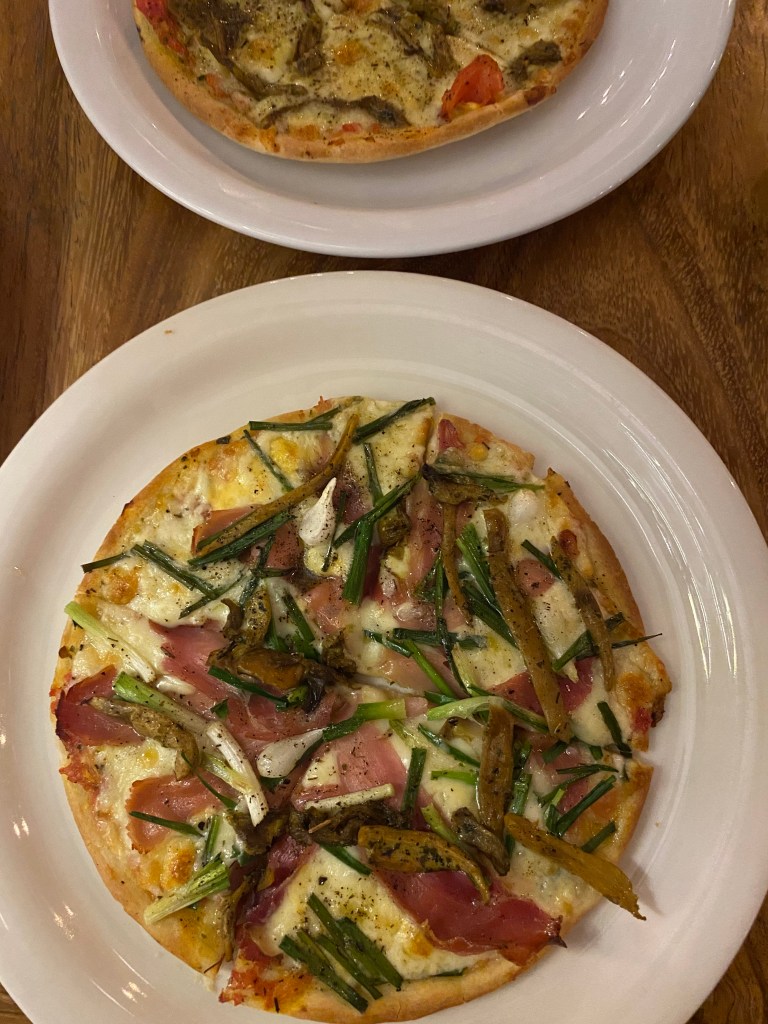
Kandil is a more modern spot, great for pizza, chicken wings and cocktails. A little pricier than the local comedores but worth it if you want a break from tortillas and frijoles. There’s a really nice atmosphere inside and a new courtyard since I was last there.

Plaza Cafe

The best spot in town for a coffee and some people watching, Plaza Cafe is a kiosk at the centre of the main square. My personal favourite is the granita de cafe, like a sweet, coffee-flavoured slushie. It makes a good place for a break while exploring the centre of the city.

Main Square

While I was in Gracias there was a feria (a cross between a market and a fair) happening in the main square where we stopped for lunch. On the menu: pupusas! These are basically stuffed tortillas, ours with quesillo (cheese) or pollo (chicken) but they are also often filled with beans, chicharrón (fried pork rinds) or loroco (an edible plant found in several Central American countries). They are actually a traditional dish from El Salvador but are often found in the west of Honduras that borders El Salvador. We ate it with a tomato sauce, curtido (fermented cabbage relish) and fresh jamaica (hibiscus) juice.

In the evenings, the main square fills with vendors and food stalls. It’s fair to be wary of places like this in terms of hygiene but it’s also where you’ll get some of the best local food like baleadas, pupusas, tacos flautas, fried chicken and more for pennies!

3 Weeks in Honduras

At this point, you must have been living under a rock not to know about my connection to Honduras. In case you have been, when I was 18 I moved across the world to Honduras, right in the middle of Central America, to volunteer as an English teacher in a rural town in the mountains. If you want to read more about it, you can here, here or here.

Bringing it back to this year, I knew I was going to be finishing my job in France in May, or at least I was going to finish teaching classes in May. However my contract was until August which meant I would get paid until then, including an overtime payment in July. I began thinking about what I wanted to do with what was essentially four months of paid time off and the obvious answer was travel. I joked about going back to Honduras but then I thought about it some more and realised that I actually could! The last time I visited Honduras was in 2019 after being in New York with my family. I only went for a week which was just enough time to have four days back in my project in Candelaria but not much more.

Visiting Candelaria in 2019

A plan started to form in my head, starting with giving myself enough time in Honduras to visit my project and to go back to some of my favourite places in the country. I figured that while I was over that way, I could tick off somewhere else that has been at the top of my list for a long time – Colombia. The more I thought about it, I realised this could also be an opportunity to visit the last country in Central America that I had yet to go to, Panama, which would be perfect as a stop on the way from Honduras to Colombia.

Originally I was planning on going by myself. I feel very at home in Honduras plus I can speak Spanish well and am used to making friends in hostels or just doing things alone. I also don’t like to stop myself from going somewhere just because I don’t have anyone to go with. However, as this plan was starting to come together at Christmas time last year, I was talking to my friend Hannah about it and she invited herself along! I was more than happy to have her. Hannah and I went to university together in Edinburgh but we actually know each other because Hannah was also a volunteer in Honduras in 2016! That meant that the first three weeks of the trip were going to be as special for her as they would be for me and I was glad to have someone to share them with.

In this blog, I’m not necessarily going to be giving specific details about the things we did. There are guides coming for places like Gracias and Utila with recommendations for where to stay, what to do and where to eat. When it comes to my time at home in Candelaria, there will also be a very special blog coming about what it was like to be back there. So without further ado, let me share (a little bit of) those three weeks with you! Buckle up for a bumpy ride (and it’s not just because of the state of Honduran roads!).

2 days travelling UK – Honduras

The journey to get to Honduras was a bit brutal and made me glad that we wouldn’t have to do the return journey for another 10 weeks. We started by popping down from Edinburgh to London which went by in a blink. From there it was onto our flight to Mexico City, long but uneventful. Next we had what felt like the longest five hour layover in the world before the flight to Honduras. It was only 2.5 hours but ended a little unexpectedly! We had started the descent and were pretty close to landing when suddenly the plane started to climb again and we spent another 20 mins circling over San Pedro Sula before attempting to land again. It’s one of the only times I’ve actually been scared in a plane because they didn’t explain it at all so we had no idea what was going on!

We landed in San Pedro Sula, Honduras’ second city after travelling for about 30 hours. We weren’t planning on staying there so after getting a lift from the airport to the bus station from a friend, we were heading to Gracias, a city in the west of Honduras. I have made this journey more times than I can count (albeit seven years ago) and when things go smoothly it should be a four hour journey. But in Honduras things rarely go as planned (a ‘tranquilo‘ attitude is definitely required) and it took us seven hours instead! There was unfortunately an accident just outside San Pedro Sula that resulted in one of the longest traffic jams I have ever seen (that we somehow managed to skip by driving down the wrong but empty side of the road!). More traffic later on and a tropical storm (or at least a very heavy rainstorm) slowed us down a lot so we didn’t arrive at our hotel until 9pm. They were so kind to two very tired and fed up travellers, bringing us fresh juice and bananas because the restaurant was closed and we were too tired to leave in search of food.

3 nights in Gracias

We were so tired that we slept right through the night and might have managed to immediately kick any jet lag. When I lived in Honduras, Gracias was the nearest city to my small mountain town (only 37 miles/60 km but four hours on a bus) so I spent a lot of weekends here with other volunteers and it was a bit of a home away from home (away from home!). Gracias is a popular tourist destination within Honduras because it has a lot to do! There is a fort to visit, hot springs, a beautiful national park and great places to eat. (A Gracias guide is in the works with more information about everything we did!)

We had a very relaxed first proper day in Honduras, doing some of our favourite things from seven years ago. After chilling a bit, we wandered down to Gracias’ main square where they have a statue of Lempira, the national hero who the currency and one of the regions are named after. It was pretty hot, up to 30º, and very humid so we sat down in the kiosk at the centre of the park for a cold drink. There was a feria (a cross between a fair and a market) going on in the main square with lots of stalls so we went for lunch at one. Later in the afternoon we went to the hot springs and ended up at an old favourite, Kandil, for pizza and frozen mojitos for dinner.

For our second full day, we headed to Celaque National Park, just a short mototaxi ride from Gracias. The drive up was incredible but the taxi wouldn’t have made it up the road to the tourist centre so we got dropped at the gate, about 2 km away. We spent a lovely couple of hours wandering leisurely around the trails before heading back to town. After being out all day, we ate in the restaurant at our hotel but this was something that we had both been looking forward to. Guancascos nachos are a thing of dreams!

1 night in Yamaranguila

We were off to somewhere very special next – Yamaranguila, the town where Hannah lived and worked when we both lived in Honduras seven years ago! When we arrived, after about two hours on the bus from Gracias, we did a quick loop of the small town, passing by one of the places she used to live, whilst looking for our hotel. That was until we discovered that it was actually a few kilometres down the road! We took a mototaxi there and were pleasantly surprised by the place, clean, peaceful, surrounded by trees and with lots of birds to see (Hannah was very happy!).

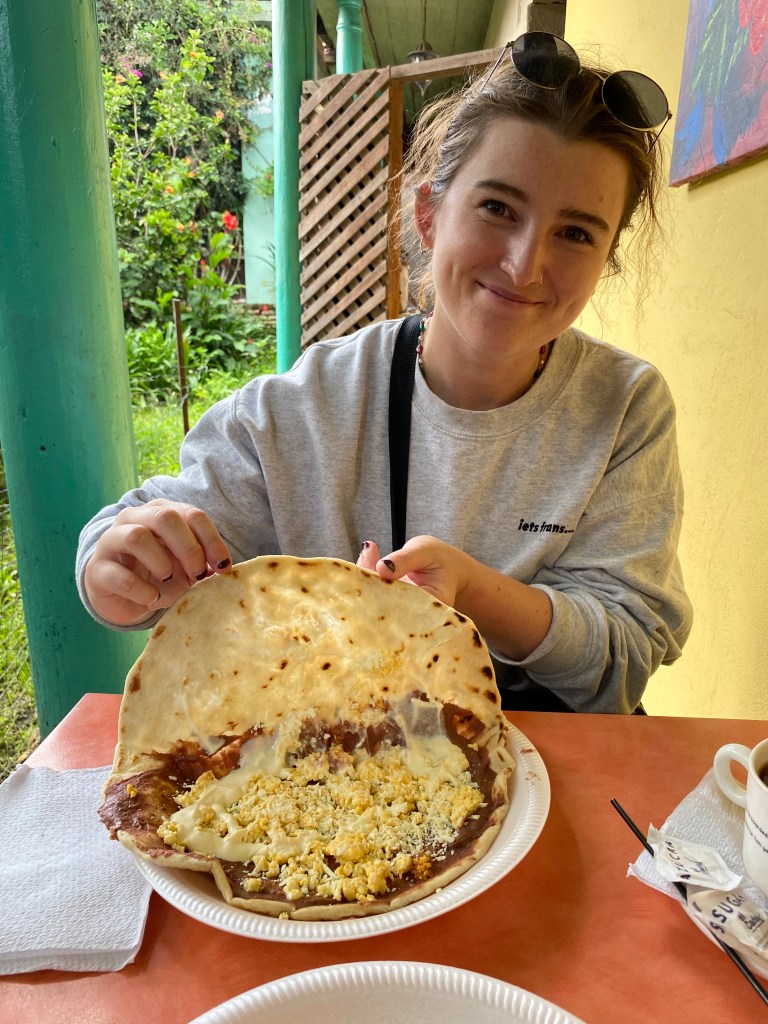
We headed into La Esperanza, the big city just twenty minutes away, in search of food. It was finally baleada time! Baleadas are the national dish in Honduras and absolutely delicious in my opinion. It’s a flour tortilla traditionally filled with refried beans, mantequilla (like sour cream) and crumbled hard cheese, sometimes with scrambled eggs but really you can add anything! We wandered around town a little more including up to a viewpoint over the city and then went back to the hotel.

4 nights in Candelaria

We left Yamaranguila after one night. We were waiting for the bus at the side of the road but also trying to get a lift in the back of somebody’s truck (a very normal practice here) and we ended up getting a lift with two Honduran policemen! They even took us all the way to the bus station!

Our next stop was very special to me. I went back to Candelaria, the town where I lived for a whole year in 2016-17. I got to see my host family, my friends and see how the town has changed (a lot). It’s a pretty small town, about 1000 people, but easy to walk around and see everything in the few days we had here. I was excited to introduce Hannah to my town because while I visited her many times in Yamaranguila, this was her first time in Candelaria.

It really is a bizarre experience to go back to somewhere that means so much to me and see people that I love and miss so much. I had a fabulous four days there, catching up with friends, eating a lot of delicious food (none of which I was allowed to pay for!), celebrating Lempira Day, my favourite holiday, and reflecting on the past seven years. Writing about everything that happened in those few days would make this an immensely long blog so you’ll just have to come back and read more about it in it’s own post!

1 night San Pedro Sula

On our way from Candelaria to our next destination, we stopped in San Pedro for the night to break up the journey. It was about 10 hours to get there but overall, it was a pretty easy journey. We even made it in time to go see a 4pm showing of Barbie which had just come out! We got Chinese food in the mall food court after the film which in itself was a throwback to being 18 because this was a regular activity whenever I was in San Pedro back then.

San Pedro Sula has never been my favourite city. It’s also the one that most people have heard of in regard to Honduras’ dangerous reputation. I don’t think there’s that much to do in San Pedro as a tourist so it’s unlikely that you would spend much time there other than at the beginning or end of a trip or in transit like we were. There are areas of the city that are best avoided, it’s true, but that’s the case if you go to Glasgow or London or any major city in the world. My advice while passing through is to take taxis rather than public buses and stay somewhere trusted. Here I’ll shout out our absolute go to – Hotel Dos Molinos. I have never stayed anywhere else in San Pedro. Blanca and her family make you feel so at home, the perfect start or end to your trip. You can also arrange transfers to the airport or bus station with Blanca.

7 nights in Utila

Our last stop was another very exciting one (although I could say that about all of them!). After a bus from San Pedro Sula to La Ceiba and then a ferry, we arrived in the Caribbean paradise of Utila! Honduras has three islands collectively known as the Islas de la Bahía or the Bay Islands, Utila, Roatán and Guanaja. During my year in Honduras, I visited Utila three times (including once for Christmas with all the other volunteers and once with my mum and twin sister) and Roatán once, when my dad and younger sister were visiting. Utila is known for pretty much two things – scuba diving and partying! My twin sister Amy had actually been working on Utila for the previous five weeks, gathering data for her tropical marine biology masters thesis and leading undergraduate dissertation students in dives. It just so happened that we crossed over! (Or maybe it was planned this way…)

Once again, there is a Utila guide coming so for now I’ll do a little summary of how we spent our whole week there, including a few highlights that won’t be in the guide. We had a very chilled first day, recovering from the two days it had taken to get there. However, in the evening we went along to Amy’s dive centre where she was holding a ceilidh (a traditional Scottish dance) for her students! It was so fun and they picked it up really quickly. It was nice to be able to hang out with Amy at various points during the week. Hannah and I went to visit her, she came down to Underwater Vision and we spent her day off together. We had been able to spend a few days together at home after I moved back from France and while she was up from Essex but before that, the last time we spent any more time together was at Christmas.

The rest of the week was filled with a handful of dives, including a refresher because Hannah hasn’t dived since she was last here in 2017 and I haven’t brushed up on the skills in a while. We were staying and diving at another favourite from seven years ago, Underwater Vision, which is where Hannah and I both initially learnt to dive. Some of the highlights of our dives were seeing lionfish, a stingray, a cow fish, some shrimp, lots of flamingo tongues (a type of sea snail) and a moray eel. From the start of one of the dives, we had a little remora swimming around our legs and it was with me for almost half of the dive. It’s one of the little fish that hangs around a shark but had gotten lost. To be honest, even when you ‘don’t see anything’ (meaning anything bog like a ray or a shark for example) with the coral and the wee fish that live there’s always enough to look at. Utila is on the second largest coral reef in the world which is what makes diving there great! As if the dive wasn’t good enough, we had the most special experience during our surface interval. If the conditions are right, between dives Underwater Vision will take you dolphin spotting! We were lucky to find a school of 15 or 16 rough toothed dolphins (I think) but they were swimming really deep. A few stayed around for longer and were curious about us so they got really close. We were in the water snorkelling with them for about 45 minutes!

Because we were in Utila for a whole week, the longest we stayed anywhere during our whole trip, by the end of our time there we had built a lovely little group of friends. Underwater Vision is a really friendly and welcoming environment so it’s really easy to start talking to people, whether they are staying there too or are just visiting the bar and restaurant. In fact, I got talking to two Irish brothers and somehow we stumbled upon a family connection! Not on my Northern Irish side as you might expect but through my family on Lewis! It turns out their uncle, who I happened to have met in the Uig museum the last time I was in Lewis in 2022, is related to the Morrisons of Geshader (that’s us!). What a small world!

A final highlight that I’ll include here happened on the way back from a night out. Hannah and I stopped at a street stall to get her a baleada and I started talking to the girl making them. I told her that I wanted to learn how to make the tortilla so I could make baleadas at home. She invited me around to the stove to make one myself! She showed me how to flatten it in my hands first which was hard and then using a bit of tin foil. She made it into a baleada and gave it to me for free! I can confirm that baleadas taste even more delicious when you’ve made it yourself.

We got up to so much more during our time on Utila but you’ll have to wait until that blog comes out!

3 nights to get to Panama

And that brings us to the end of our time in Honduras. Utila was our last real stop in Honduras and from there we began our epic journey down to Panama. It took four 10-12 hour days on buses with stops in Tegucigalpa (Honduras), Managua (Nicaragua) and San José (Costa Rica) before arriving in Bocas del Toro, Panama. There will be many blogs about Panama eventually but for now, there’s still a string of Honduras posts to come!

Surprise! I Moved to Costa Rica

I won’t bury the lede with this one – as the title suggests, I’m writing this from my new home in Costa Rica! How I got here is a bit of a wild ride and I still can’t quite believe it. I will say that this feels like a very full circle moment after coming here for the first time in 2015, falling in love with the country and travelling in general, and now being back long term in 2023. It all happened very quickly so writing this blog is as much to process it a bit more myself as to explain it to anyone else!

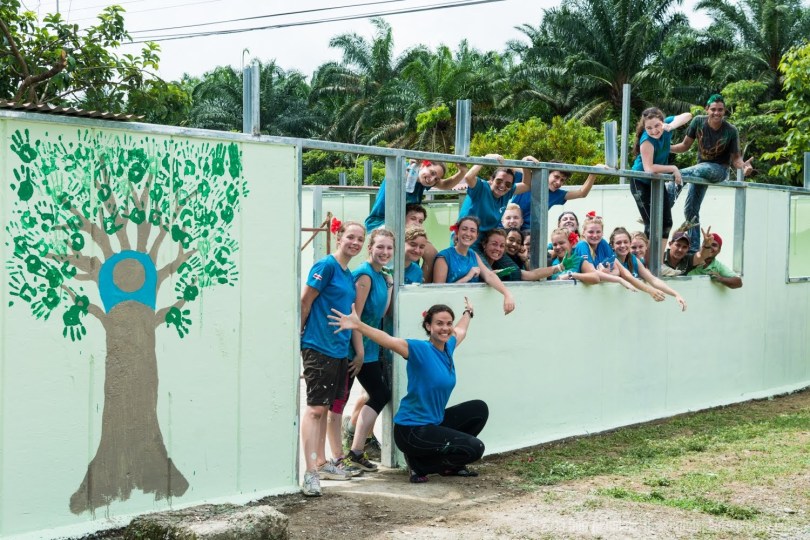
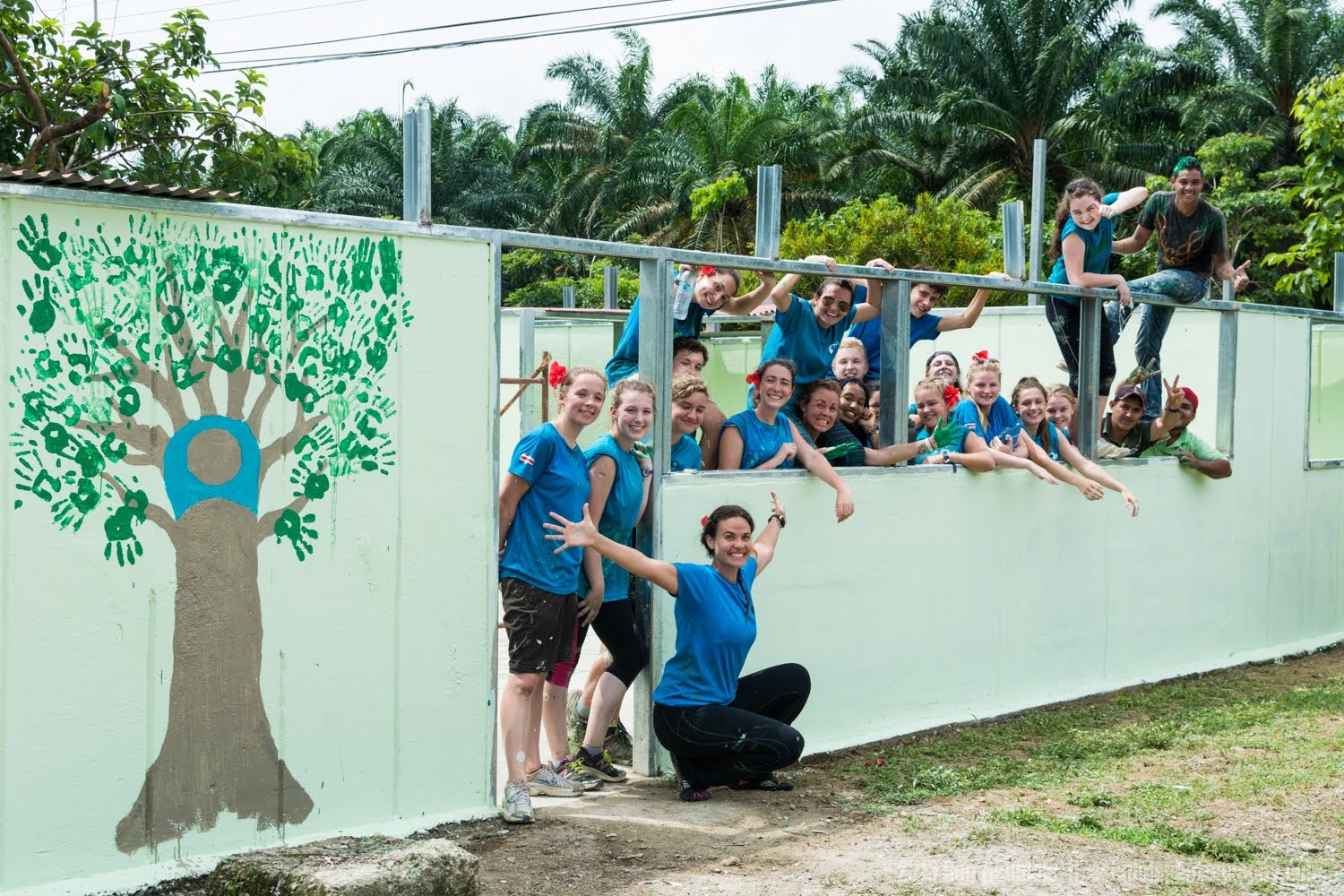
Before I get into the job and the application process, let me give a bit of background. I have history with Costa Rica that goes back to when I was 17. During the summer before my final year of high school, I spent a month in Costa Rica as part of a culture and volunteering programme with an NGO called GVI. I spent a week living with a host family and taking Spanish lessons, two weeks helping to refurbish a primary school and one week doing adventure activities like canyoning, ziplining and white water rafting. The whole experience had a profound impact on me. I think this experience inspired my love of travelling and my desire to see the world. It is also responsible for a large part of who I am now, or at least starting me on the path to becoming that person. I came back much more sure of the person that I wanted to be, independent, adventurous, confident. Below is a quote from a blog that I wrote just after getting back that is still very poignant today:

This trip has ignited a desire to travel in me, one that was already there but has now been sparked. It has also shown me the way I want to spend the rest of my life – seeing the world and helping as much of it as I can. So until next time – ¡pura vida Costa Rica!

I was able to go back to Quepos, the town where I stayed during the first three weeks of my GVI programme, the following year. I was living in Honduras and I had a couple of months off from teaching. A group of six volunteers were travelling together and this was one stop that I insisted on. I visited my host family who were very impressed with my much improved Spanish. I was also able to visit the GVI base, a different one from where I had volunteered but interesting all the same. It was nice to still feel like I was connected to GVI and step back to the past.

Fast forward eight years later, I’m very happily living the life that I’ve worked hard to make for myself. I’ve just finished teaching in France for two years, I’m travelling in Central America and Colombia for two and a half months over the summer and I’m looking forward to returning to Scotland after my trip and finding a job in the tourism industry. This is what I had planned for myself and I was really looking forward to it. Then I got hit with a very unexpected curveball.

I was sitting in a bus station in Cartagena in the north of Colombia, waiting to head to Tayrona national park. I was killing time and checking my emails when one came in from GVI. Back in May I went to an online careers day with them so they had my CV on file. I had also spoken briefly to someone from the recruitment team in June but wasn’t available for any roles because of my trip. I also didn’t really see it as something that would be on the cards for the immediate future but more something I would be interested in further down the line. I wasn’t expecting to open the email and have an offer to interview for my dream job!

GVI Costa Rica Under 18s in 2015

The position was as Education Coordinator at their community base in Cartago, Costa Rica. They were looking for someone who spoke Spanish and reading through the job ad, it was like it had been written for me! It wasn’t as a full time English teacher, something I wanted to move away from, but still working in a school, supervising volunteers that would be doing the teaching, helping them with lesson planning, building the curriculum and generally supporting volunteers through their experience. This kind of job has always been something that I’ve been interested in doing and if you look at my job history, you can see that interest permeating through. From my most recent work as an English teacher to working with young adults who want to volunteer with Project Trust, the organisation I went to Honduras with, even to staying involved with GVI as an ambassador, it felt like it had all lead, albeit accidentally, to this moment.

I immediately said yes to the interview but because of our travel plans, I was away from the internet for a few days and didn’t really think about it. When we arrived in Minca, a small, very relaxed town in the mountains of northern Colombia, I really started to prepare for the interview which would be at the end of our few days there. However, as well as getting ready, I was also deciding if I actually wanted the job! The idea of moving to Costa Rica at the end of that trip was such a wild departure from the picture I had painted in my head of moving back to Scotland. There was no easy way to get around the hard feelings so as is my way when I’m a bit stressed, I went for a swim in the hostel pool. At one point, my friend and travel buddy Hannah looked over to see me leaning against the side of the pool staring off into space, looking as if I was having a bit of a breakdown! I probably was but at the end of the swim I had figured out how I felt.

It came down to two things. First of all, this wasn’t the plan! For 8 months I had been determined that I was going to go back to Scotland, be near family and friends, in a country and culture that I am comfortable in and start working in an industry that I thought would suit my interests and skills very well. I found that hard to get over initially. But you know what they say, when you make a plan, the universe laughs. This being unexpected didn’t feel like a good enough reason to say no. I was also in a perfect position to take the job and move across the world – no house, no car, no partner or dependants to worry about. There’s no guarantee that this opportunity would come again or that if it did, I would be in as good a situation to take advantage of it. The second thing was that I wanted to make sure that I wasn’t taking the job because I felt like I should. I knew this was a great opportunity and it is literally the kind of job, maybe even the literal job, that I’ve wanted to do since I was 17 and on a GVI programme myself. I won’t take you through all of the mental gymnastics that got me to the other side of this one but by the time I got out of the pool I had decided – I wanted this job. And I really wanted it.

Not a bad place to prepare for a job interview!

Thus ensued the first interview – it went pretty well despite extremely spotty hostel wifi – and the second – ten minutes long in a hostel co-working space, still with spotty wifi – until one fresh and sunny morning in Medellín when I received an email offering me the job! Fast forward to the end of my trip three weeks later and I was flying back to Scotland for a whistle-stop, week-long visit home. I was originally thinking of heading straight from Colombia to Costa Rica to save the money on the flight from Scotland, even if I lost out on my already booked flight home from Bogotá. However, when I said goodbye to my friends and family, particularly my 96 year old grandad, at the start of my trip, it was for two and a half months, not for potentially a year! With a bit of encouragement (read pleading) from my parents and sisters, I decided that even a brief visit would be worthwhile.

A week of quality time at home was good for the body, mind and soul. I spent five days running around, catching up with friends in Edinburgh and Glasgow, spending time with my gran who had come over from Northern Ireland for the weekend, getting another tattoo, cuddling my dog, meeting my two new cats and visiting my grandad before spending the last two days packing and preparing for another move across the world. You’d think I’d be used to it by now but packing still always takes longer than I expect. One 3am start later and I was off to San José via Paris!

I’ve now been here for a week, I’m settling into life on base and getting into the routine of it here. On the whole, I do feel well prepared for Move Across the World: Part 4812596. Some of the more difficult things about starting over somewhere completely new – the isolation, lack of routine – are already abated by virtue of the job I’m doing and I already know and love Costa Rica, even if the area I’m living in is new to me. Some of the shock of being quite suddenly on the other side of the world from my friends and family when I’d been planning on the exact opposite has been abated by the fact that my sister is soon moving to the British Virgin Islands (a series of islands next to Puerto Rico in the Caribbean) and a Christmas there together might be on the cards!

I’m not sure how much I’m going to share about this job here moving forward. There will definitely be lots of general Costa Rica content and maybe one more post explaining a bit more about my responsibilities and day to day life (let me know if you have any specific questions!). Beyond that (and once I’ve gotten through my hefty backlog from this summer), you’ll have to stick around to find out!

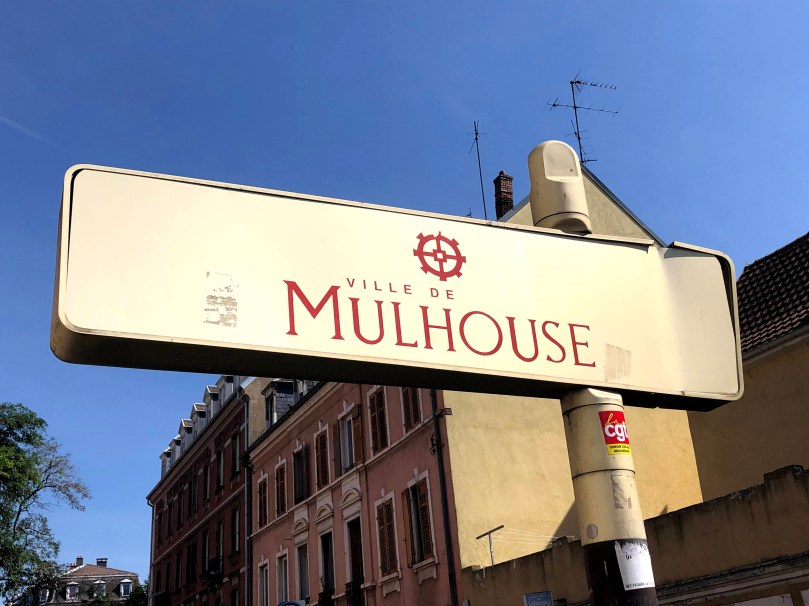
J’adore Mulhouse

I am finishing off this blog in Charles de Gaulle airport in Paris, on the way to start my next adventure and the next chapter of my life. It’s not in France but it does feel nice to be starting something new via somewhere I’ve just left. As I straddle these two periods of my life, I find myself looking back at where I’ve come from but also trying to appreciate where I am. It’s often the little things that make me happy so below you’ll find some of my favourite wee things about Mulhouse.

This post is also fulfilling a long time goal of mine – to write a bilingual blog! This one in particular is in English and French as this feels like the perfect time for that. Having recently moved home from France, my level of French is pretty much as good as it’s going to get for a while, it can only go downhill from here! I’ve always wanted to write a blog in Spanish and the time to do that would have been right after coming back from Honduras (six years ago!) but I never got around to it and my Spanish level dropped. I would still consider myself fluent but I’m definitely much more comfortable speaking it than writing it. But after two months in Latin America, who knows, maybe a blog in Spanish is in the not so distant future?


Je termine ce blog dans l’aéroport Charles de Gaulle à Paris, sur le chemin de ma prochaine aventure et du prochain chapitre de ma vie. Ce n’est pas en France, mais c’est agréable de commencer quelque chose de nouveau à partir d’un endroit que je viens de quitter. Alors que je suis entre ces deux étapes de ma vie, je me retrouve à regarder en arrière pour voir d’où je viens mais aussi à essayer d’apprécier où je suis. C’est souvent les petites choses qui me rendent contente donc je vous présente ci-dessous une liste des choses quotidiennes à Mulhouse.

Ce post m’aide aussi à remplir un vieux objectif – d’écrire un blog bilingue! Cela en particulier est écrit en anglais et en français parce que maintenant semble être le moment parfait pour en faire. Ayant venue de rentrer en Écosse de la France, mon niveau de français est à peu près aussi bon qu’il sera pendant un certain temps, à partir d’ici ça va se gâter! J’ai toujours voulu écrire un blog en espagnol et le moment de le faire aurait été juste après mon retour de Honduras (il y a six ans!) mais j’ai jamais trouvé le temps j’ai un peu perdu mon niveau d’espagnol. Je considérais que je pouvais encore le parler couramment mais je suis beaucoup plus à l’aise en parlant qu’en écrivant. Mais après deux mois en Amérique Latine, qui sait, peut-être qu’il y aura un blog en espagnol dans un avenir pas si lointain!

The little sounds on the trams 

Starting with the smallest but maybe one of the most endearing things. For each stop on the tram network in Mulhouse, there is an individual sound effect. I genuinely don’t know why this is a thing but they were composed in 2006 by Pierre Henry, who is by all accounts a successful and recognised composer (his Wikipedia page even refers to him as one of the fathers of electroacoustic music). Despite their potentially superfluous nature, the repetitive squeaking sound that accompanies the arrival of the tram at the Daguerre stop, nearest my apartment, came to signify home to me as much as anything else.


On va commencer avec mon coup de cœur le plus petit mais le plus charmant aussi. Pour chaque arête dans le réseau de tramway à Mulhouse, il y a une annonce sonore différente. J’ai aucune idée pourquoi ça existe mais elles étaient composées en 2006 par Pierre Henry, qui, d’après ce qu’on dit, est un compositeur accompli et connu (sa page Wikipedia le désigne même comme l’un des pères de la musique électroacoustique). Malgré le fait qu’elles ne sont pas forcément nécessaires, le son aigu et répétitif qui accompagne l’arrêt Daguerre, le plus proche à mon appartement, est devenu une signe que je suis presque chez moi.

The Fraenkel signs 

This is something very special about Mulhouse in my eyes. Dotted around the streets like little secrets, spray painted onto pavements, stuck onto the back of street signs or occasionally as a full mural, Mulhouse is adorned with the clever words and wit of artist Pierre Fraenkel. A lot of this specific part of his work (he is a bit of a jack of all trades) uses plays on words and double entendres. For example, a mural that welcomes you onto the UHA campus where I worked reads a prendre par coeur which literally translates to ‘to take by heart’ but when spoken aloud sounds like apprendre par coeur, meaning ‘to learn by heart’. Another example – sois belle et t’es toi, literally meaning ‘be beautiful and you’ll be you’ but it sounds like sois belle et tais-toi which means ‘be beautiful and shut up’. I am such a fan of Fraenkel’s work that I actually have one of his phrases tattooed on my arm! I have four tattoos so far and each one is linked to a place that I have lived. I was starting to think about what I was going to get in honour of Mulhouse as I was starting my second year there. I knew I wanted it to be something specific to the city rather than France more generally. I first spotted this particular phrase around that time as it was not on a route that I usually walked so I hadn’t seen it before. It stuck with me, especially as I was going through a slightly tumultuous, soul-searching period to figure out what I wanted to do after leaving Mulhouse. The phrase is tout naît pas fini, literally meaning ‘everything is born unfinished’ but also sounds like tu n’es pas fini or ‘you are unfinished’ (or any combination of the two phrases).


C’est un aspect de Mulhouse qui me tient particulièrement à cœur. Caché partout dans les rues comme des secrets, peint à la bombe sur les trottoirs, affiché sur le fond des signes des rues ou parfois une peinture murale entière, Mulhouse est décoré avec les mots et l’esprit astucieux de l’artiste Pierre Fraenkel. Beaucoup de cette partie spécifique de ses œuvres (il est une homme touche-à-tout) utilise des jeux de mots et des sous-entendus. Par exemple, il y a une peinture murale qui s’accueille sur le campus UHA où je travaillais qui dit a prendre par cœur mais lorsqu’il est prononcé à haute voix, il ressemble à apprendre par cœur. Un autre exemple – sois belle et t’es toi qui ressemble à sois belle et tais-toi. Je suis une si grande fan du travail de Fraenkel, j’ai même une de ses phrases tatouée sur mon bras! J’avais déjà quatre tatouages et chacune est liée avec un lieu où jai habité. Quand j’ai commencé ma deuxième année à Mulhouse, je commençais à penser de ce que je voulais pour honorer Mulhouse. Je voulais quelque chose de spécifique à la ville plutôt qu’à la France. C’est à cette époque que j’ai repéré pour la première fois cette phrase particulière parce que c’était pas sur mon itinéraire habituel et je ne l’avais donc pas vue auparavant. Elle m’est restée en tête, d’autant plus parce que je traversais une période un peu tumultueuse et de débat intérieur pour décider ce que je voulais faire après avoir quitté Mulhouse. La phrase est tout naît pas fini qui ressemble à tu n’est pas fini (ou n’importe quelle combinasion des deux phrases).

Les trompe-l’œil 

Walking around Mulhouse, you’ll notice a certain kind of street art decorating the walls. Or maybe you won’t, as is their intended effect. Trompe-l’œil are a type of mural meant to trick your eye into thinking that it’s real. The illusion can see the side of a building painted with windows and sometimes people leaning out of them, posters that reveal themselves to be part of the wall or even, as is the case in Place de la Réunion in Mulhouse, give official buildings an extremely ornate facade but for a fraction of the price. You could spend a day wandering around Mulhouse seeking them all out but even just going about your shopping in centre ville, you can easily spot plenty. The most impressive is definitely the old hôtel de ville but my favourite is actually one just behind it off Passage de la Démi Lune.


En promenant à Mulhouse, on peut voir une sorte spéciale d’art urbain qui décore les murs. Ou peut-être pas, qui est l’intention. Trompe-l’œil est une type de peinture mural qui veut créer l’illusion d’être réel. L’illusion peut voir le côté d’un bâtiment peint avec des fenêtres et parfois des gens qui s’y penchent, des affiches qui se révèlent d’être partie du mûr ou même, comme dans le cas au Place de la Réunion à Mulhouse, donner à des bâtiments officielles une façade très ornée mais pour une fraction du prix de la gravure. Tu peux facilement passer une journée à Mulhouse en les recherchant tous mais même en faisant tes courses dans le centre ville, tu peux facilement en repérer beaucoup. Le plus impressionnant est assurément l’ancien hôtel de ville mais en fait mon préféré est celui qui rétrouve juste derrière, sur le Passage de la Demi Lune.

Liking Mulhouse is like having a secret

One of the first things I heard about Mulhouse is that it’s not a great place to live. At the time I was applying for the job there I was working at a small French bakery in Edinburgh. I asked my boss, a woman from Paris, about the cities that were on offer and she said ‘don’t go to Mulhouse!’. I didn’t have much of a choice in the end and when I was placed in Mulhouse she told me that I would at least get street cred from French people for living there! This is because Mulhouse has a bit of a reputation for being unsafe and unpleasant. According to my friends that are from there, that was the case about ten years ago. Nowadays, it’s a city full of greenery, there’s always something interesting going on and on the whole it’s pretty safe. A lot of that reputation still exists though, whether you ask someone in Strasbourg or in Paris or even in Mulhouse. Right from the very beginning I’ve been a big fan of Mulhouse and tell everyone I meet that! I will admit that if you’re visiting, there might not be so much to do but if you live there, I think it has everything you need. Being a fan of Mulhouse is like being part of an exclusive club but one that I want everyone to join!


Une des premières choses que j’ai entendu de Mulhouse était que ce n’est pas un endroit idéal pour vivre. À l’époque où j’ai posé ma candidature, Je travaillais dans une petite boulangerie française à Édimbourg. J’ai demandé à ma patronne, qui vient de Paris, des questions sur les villes proposées et elle m’a dit ‘n’allez pas à Mulhouse!’. À la fin, je n’avais pas vraiment le choix et quand j’ai été placé à Mulhouse elle m’a dit qu’au moins les français me respectent pour avoir y vécu! Le raison est que Mulhouse a la réputation d’être un peu dangereuse et désagréable. Selon mes amis qui y sont nés et grandis, il y a dix ans c’était vrai. Actuellement, c’est une ville verte, il y a toujours quelque chose intéressant à faire et en général c’est sûr. Cependant, cette réputation existe encore, que l’on interroge quelqu’un à Strasbourg, à Paris ou même à Mulhouse. Dès le début, j’ai beaucoup aimé Mulhouse et je le dis à tous ceux que je rencontre! J’avoue que si tu visite, il y a peut-être pas trop des choses à faire mais si tu y vis, je pense qu’il y a tout ce qu’il faut. Être fan de Mulhouse est comme faire partie d’un club exclusif mais un club que je veux que tout le monde rejoigne!

Being very intentional about building my life there

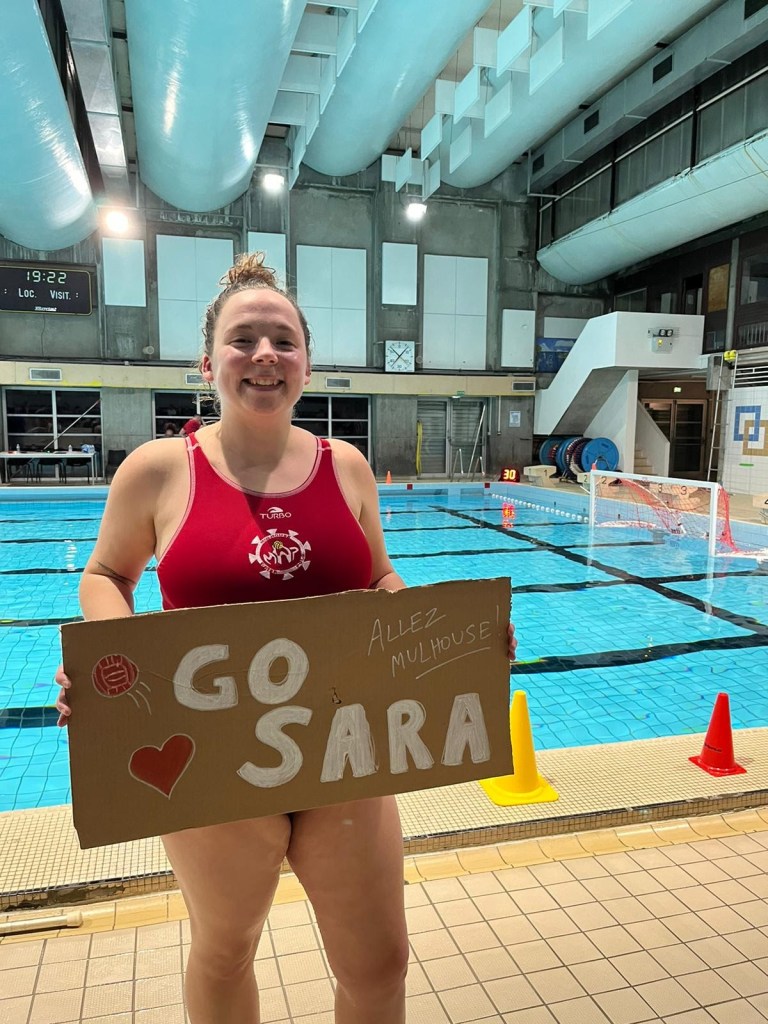
Even though I’ve started fresh in a few different places at this point, moving to Mulhouse felt like the first time I was alone in it. When I moved to Honduras, I had other Project Trust volunteers around me and when I moved to China, there was another student from my course in Edinburgh in the same city as me. This time, I knew no one. I was living with strangers in an apartment and most of my colleagues were much older than me. But then, slowly, piece by piece, I started to build something. Strangers became flatmates became friends (even as some left and others moved in). I met the other English lectrice who became one of my best friends and a big support system for me. I joined a water polo team who welcomed me from the beginning and who made training, particularly with the girls team, the highlight of some weeks. I got to know the best spots around town, my favourite coffee shop, my favourite happy hour, my favourite tarte flambée as well as where is open on Sundays and I became someone that people would ask for recommendations. I was very intentional about building my life in Mulhouse, making sure that it included things and people that made me happy. It makes me excited to do it again, someday, somewhere else (and someday might be sooner than I was expecting! More on that soon…)


Même si j’ai pris un nouveau départ dans plusieurs endroits différents, j’ai eu l’impression, en déménagement à Mulhouse, d’être seule pour la première fois. Quand j’ai déménagé au Honduras, il y avait d’autres volontaires de Project Trust autour de moi et quand j’ai déménagé en Chine, il y avait un autre étudiant de ma licence à Édimbourg dans la même ville que moi. Cette fois-ci, je ne connaissais personne. Puis, lentement, peu à peu, j’ai commencé à construire quelque chose. Des inconnus sont devenus colocataires et sont devenus amis (même si certains sont partis et d’autres se sont installés). J’ai rencontré l’autre lectrice d’anglais qui est devenue une de mes meilleures amies et un système de support important pour moi. J’ai rejoint une équipe de water polo qui m’a accueilli dès le début et qui on fait l’entraînement, surtout avec l’équipe des filles, le point fort des certaines semaines. . J’ai mes coups de cœur à Mulhouse, mon café préféré, mon happy hour préféré, ma tarte flambée préférée en plus qu’où est ouverte les dimanches et je suis devenu quelqu’un à qui les gens demandaient des recommandations. J’ai eu à cœur de construire ma vie à Mulhouse, en m’assurant qu’elle inclut des choses et des personnes qui me rendaient heureuse. Cela me donne envie de recommencer, un jour, ailleurs (et ce jour pourrait bien arriver plus tôt que prévu ! J’y reviendrai bientôt…).

Liechtenstein

Liechtenstein? Where in the world is Liechtenstein? This is what I imagine you are asking yourself as you click on this blog and I can’t blame you. Saying this, I have actually wanted to go to Liechtenstein for ages! Just like when I went to Andorra last year, there’s something about the fact that I know nothing about it and that it’s this tiny little country sandwiched between other countries that fascinates me. This has been near the top of my list of destinations for a while because it’s closer to Mulhouse than you might think! (You do have to cross pretty much the whole of Switzerland but it’s not that big a country.) I have nothing against taking a trip by myself, I’ll never let lack of company stop me from going anywhere, but I thought it would be fun to have a partner in crime for this one so I invited Aine from Une Bouchée A Day, a treasured friend and colleague. Turns out we are also great travel companions! (You can read Aine’s account of our weekend in English or in French!)

Liechtenstein is bordered by Switzerland to the west and Austria to the east and is a semi-constitutional monarchy headed by the prince of Liechtenstein. The official language is German (I tried my best but I was pleased to have Aine’s slightly more advanced level of German with me!). It covers an area of just 160km and has a population of just over 38,000. Before we continue, here’s a few fun facts so that you can ace the Liechtenstein round on your next pub quiz:

  • Liechtenstein is the fourth smallest state in Europe (after the Vatican City, Monaco and San Marino) and the six smallest in the world (add in Nauru and Tuvalu at third and fourth respectively).
  • It is the richest country in the world in terms of GDP per capita income.
  • It is one of only two double-landlocked countries in the world, meaning that it doesn’t border an ocean and neither do any of the other countries that it does border. The other double-landlocked country is Uzbekistan.
  • Liechtenstein is the world’s largest producer of false teeth.
  • Switzerland once invaded Liechtenstein by accident! In 2007, its army got lost in the mountains and Liechtenstein only realised when they got a letter of apology.

From Mulhouse we basically had to cross Switzerland to reach Liechtenstein. We were only staying for one night so we had an early start! Trains in Switzerland can be expensive so to minimise this we took a Flixbus at 5am(!!!) to Zurich. This was about two hours and then from there it was a train to Sargans, the closest town in Switzerland to the border with Liechtenstein. Liechtenstein is not in the European Union but it is part of the Schengen Zone, meaning you can move freely across its borders, and part of the European Economic Zone. From Sargans, it only takes 30 mins on the bus to get to Liechtenstein’s capital, Vaduz.

With a bit of forward planning and research we had found out that Liechtenstein has something called the Adventure Pass (AP). This gets you admission to 30 different attractions in Liechtenstein as well as some other bonuses. You can get a one day pass for 25 Swiss Francs (CHF), about £22.50, a two day pass for 29 CHF (£26) or a three day pass for 35 CHF (£31.50). Wanting to make the most of the little time that we had, we bought the two day pass and I think it was very worthwhile! Liechtenstein is generally expensive (imagine prices comparable with Switzerland) so we were also hoping it would save us some money! But don’t take my word for it, I’ll let you know whenever something we did was covered by the Adventure Pass and I’ll show how the costs work out and how much we saved at the end.

Our first stop on arrival was the tourist centre to check how the passes work. We also got a novelty passport stamp in the tourism office which was included in the Adventure Pass. It’s not strictly necessary because, as I said, Liechtenstein is in the Schengen Zone but it was still cute! You’ll find the tourism office on one end of the main street in Vaduz, Städtle. It is pedestrianised and is where you’ll find most of the museums. The castle also sits on the hill above the street and can be accessed from the far end of the street. After our early morning, we really wanted a coffee so we found a bakery and got a snack and a coffee each. My German is almost non-existent but I tried really hard to order in German and everyone was really patient!

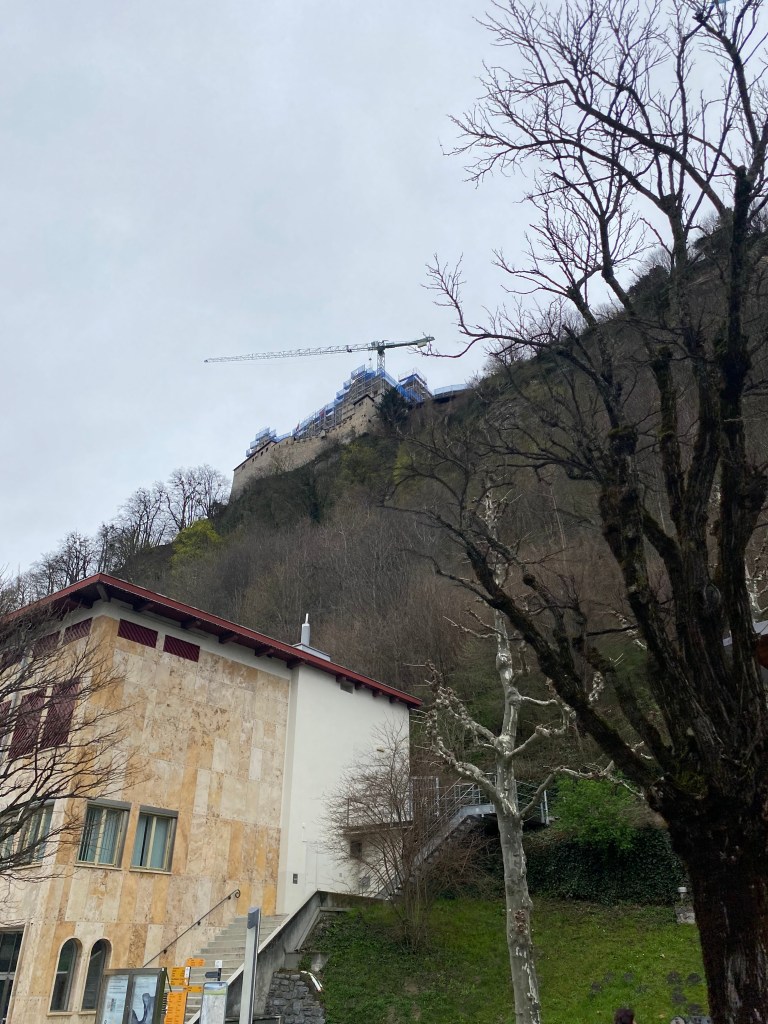
The weather was not supposed to be the best for most of the weekend but it was looking a little brighter when we came out of our coffee so we decided that would be the best time to head up to the castle. And when I say up, I really mean UP! The castle is situated on the hill right behind Städtle so it’s really not far but most of the distance you have to cover is vertical. Even if you take it slow and steady with plenty of stops to enjoy the view and take pictures, it will only take you half an hour to get up there. I would absolutely recommend it because the views are incredible, even if there’s actually not that much to see when you get to the top. As we were climbing, we kept seeing a lot of the same tourists that had either been on the bus with us or in the tourist centre which was funny. Liechtenstein is (literally!) a small world. The castle was under construction when we were there but even if it wasn’t, you still can’t go into the castle because it is the official residence of the prince of Liechtenstein. The only exception is on the National Day of Liechtenstein on 15th August when all residents are invited into the castle for drinks and fireworks! If you want to learn a little more about the castle, the alte kino (old cinema) has daily showings of a film about the castle. We didn’t go because the timings didn’t work out but the Adventure Pass gets you in for free. 

We had a quick (but not cheap) lunch at a restaurant called Engel’s where the menu was 50% traditional, 50% Chinese dishes. In general we had noticed that a lot of places, mostly restaurants and shops, weren’t open even though it was a Saturday. We later learnt that this is because most places are there for the workers so are open during the week but not at the weekend because there’s also not that much tourism. I’m still a bit confused about whether tourism is a major industry in Liechtenstein or not. I’ve read in some places that it is but judging by the amount of other tourists we saw (not many) and after speaking to some locals, it seems like maybe not.

Vaduz is home to a number of museums so after lunch we wanted to tick off the first one – the Kunstmuseum. It’s a modern and contemporary art gallery which isn’t really my speed (a lot of it goes over my head) but there were a few things I liked! My favourites were actually the doodles on the wall leading down to the temporary exhibition, including my favourite poem ever ‘Ma back ache / Ma bra too tight / My booty shake / from left to right’, and a statue outside the museum, ‘Reclining Woman’ by Colombian artist Fernando Botero. After we finished in the museum we went right across the road to a souvenir shop called Hoi (that seems to be a word like hi) where our AP got us a free magnet and a tasting of a wine.

After that, we walked over to the Hofkellerei, the Prince’s wine cellars, where the AP would get us two tastings of wine. Liechtenstein is the world’s smallest wine producing nation but the tradition of viniculture goes back two thousand years. We walked through the vineyards which were gorgeous with the mountains in the background. When we got there, we discovered that it was actually a wine tasting event going on and we could go around and try as many wines as we wanted! Different rooms had wines from different regions although the majority of wines we tried were from Liechtenstein. My favourite was a sparkling Riesling from Liechtenstein. Riesling is common in Alsace as well but it’s not my favourite although adding bubbles changed everything! Towards the end we got talking to a Dominican woman who has been living in Liechtenstein for 15 years. I ended up speaking Spanish with her and Aine would try to understand then respond in French which Severina would then do her best to understand. It was a fun little bilingual experience. She also gave us some great recommendations, a few of which we actually did the next day.

After that we decided it was time to head to our accommodation for the night. We were staying in the Jugendherberge, the Youth Hostel International hostel like I stayed at in Innsbruck. It was similar in feel, a bit more modern and stylish but still in the middle of nowhere. It was also the cheapest option we found, although that’s not to say it was cheap. Choosing this youth hostel rather than a hotel, even just for one night, was our attempt to save some money (and also my attempt to convert Aine to being a hostel lover like me!). It was a little outside Vaduz, on the edge of Schaan which is the next town over. It only took 20 minutes to walk from the Princes Cellar’s but another great thing about the Adventure Pass is that it includes free public transport! This even includes the bus from Sargans to Liechtenstein, although we didn’t realise that until after we’d already bought tickets.

After our early start and a lot of walking and exploring, we were both pretty tired so no big night out on the town for us. We wanted to try some traditional Liechtenstein food for dinner so we asked for a recommendation at reception. We ended up going into Schaan to a restaurant called Scanaua. I think something got lost in translation at reception (even though we were speaking English) because it definitely wasn’t traditional, it was actually quite trendy and modern! Neither of us were that hungry so we got a few smaller dishes to share, wee wagyu meatballs, bruschetta with cream cheese and mushrooms and wild garlic pesto ravioli. By this time the early morning and the busy day were catching up with us so we didn’t hang around long. We went back to the hostel and were in bed by 10pm. 

Our second and final day in Liechtenstein started with a great continental breakfast that was included in the price of our beds that filled us up ready for the day. The weather was drizzly, as the forecast had promised, but we didn’t let that rain on our parade (boom boom). We got the bus back into Vaduz (thank you AP) and took a quick detour past the iconic Rotes Haus, the Red House, before heading back to the main street of Städtle to hit a few more museums.

We started with the Treasure Chamber which contains a collection of paintings and objects owned by the prince and other private citizens. These include the apple blossom Fabergé egg (Google it) and lunar rocks from the Apollo 11 and 17 missions! These, and a flag of Liechtenstein that actually travelled to the moon, were presented to the country in recognition of the contribution of Liechtenstein company Balzers AG, specialists in vaccines technology, to NASA. Unfortunately you couldn’t take pictures but it was very impressive! It’s just one room attached to the postal museum and is included in the AP. We did a quick lap of the postal museum afterwards but it’s not something that interests me that much so we didn’t stay long. Again, included in the AP so why not?

The final museum of the day was the Landesmuseum, the national museum. I was really looking forward to this one because I was interested in learning more than just the snippets of Liechtenstein’s history that I’d picked up already. However, I was actually really disappointed because the signs and plaques were entirely in German, with only a few in English, so all I could do was look at things. Obviously German is the official language but for a country that relies on tourism as one of its principal industries (maybe) and considering that the postal museum had all of its signs in German, English AND Chinese, I think the Landesmuseum can do better. Saying that, there was a temporary exhibition on Chinese calligraphy, of all things, which did have English signs. I really enjoyed looking at them and reading some of the poetry (or trying at least). There was also a little station where you could try doing a little calligraphy yourself and it took me back to the calligraphy class I took when I was studying in Dalian.

After a quick coffee, we got on the bus up to another town, higher up in the mountains, called Malbun. We wanted to see another side of Liechtenstein and were still in search of more traditional food to try. Severina from the wine tasting the day before had given us the name of a restaurant in Malbun that we wanted to try. It took half an hour on bus 21 that left from the main road near the tourist centre, winding its way up the mountains to end in Malbun. We had a walk around in the snow, eyeing up the chairlifts that take you to the ski slopes in the area before heading to Hotel Turna, our lunch recommendation. I had been after a Hugo spritz all weekend which I finally got and then Aine and I shared a käsespaetzle (heavy egg pasta with cheese and fried onions) and wienerschnitzel (breaded veal) with chips and a side salad. For dessert, I had to go for the apple strudel!

The hotel was right beside a chairlift that was included in our AP so we decided to take it even though the weather had closed in and it was a bit cold. It was fun but it was pretty high and I remembered that I’m a little scared of heights! There’s something about being on a chairlift without skis on my feet that felt a bit weird. It was a bit of a bizarre activity to do but that kind of fit the theme of the whole weekend. We laughed our way up and back down again in less than ten minutes. And that was pretty much it! We left on the reverse of our journey there, the bus back down to Sargans, train to Zurich and finally the Flixbus back to Mulhouse.

Much of the weekend was structured around what we could do that was included in the Adventure Pass and as promised, here’s a breakdown of the costs and savings –

2 day Adventure Pass – 29 CHF

  • Passport stamp – 3 CHF
  • Kunstmuseum – 15 CHF
  • Glass of wine from Hoi – 6 CHF
  • Magnet from Hoi – 6 CHF
  • Two wine tastings at the Hofkellerei – 12 CHF
  • Landesmuseum – 8 CHF
  • Coaster from the postal museum – 6 CHF (admission is free)
  • Treasure Chamber – 8 CHF
  • Malbun chairlift – 10 CHF
  • Free bus travel – 20 CHF (based on our journeys)

According to my calculations (which should be taken with a healthy pinch of salt) all the things we used the Adventure pass for added up to 94 CHF each. Some of the costs are estimations, such as the price of the shorter bus journeys or the free coaster we got. So having paid 29 CHF each for the pass, we saved around 65 CHF. My verdict is that the adventure pass is definitely worth it!

My final thoughts on Liechtenstein are mixed, in all honesty. I had a great time, don’t get me wrong – it’s somewhere that I’ve wanted to visit for a long time, I loved travelling with Aine and having that experience together plus Liechtenstein has a breathtaking quality to the landscapes, especially from Vaduz in the main valley, with vineyards sitting in front of incredible mountains that all look like a postcard. However, I’ve already said that I’ve seen conflicting things about the importance of tourism in Liechtenstein but having been a tourist in Liechtenstein, I don’t think it’s particularly set up for us. There are good things like the Adventure Pass and the ease of public transport but the fact is that accommodation options are limited, or at least restricted to a certain, higher budget. I agree with Une Bouchée A Day’s assessment of the food, that if you’re going to have Swiss prices, you should also have Swiss quality and I don’t think that was always the case. For it being a weekend, there also wasn’t a lot of choice available. I also can’t forgive the lack of accessibility of the Landesmuseum in comparison with the other museums.

If you are interested in visiting Liechtenstein, I think tempering your expectations is important. Unless you want to go hiking through the country’s many trails, two days, one night is more than enough time. If you are particularly interested in wine and viniculture, it’s somewhere you might enjoy, or if like me, you have a slightly strange fascination with visiting places that most people have never even heard of. Aside from those, I think there are other places to visit first. If I compare it to my time in Andorra, I left knowing that I want to and will be back, whereas I feel satisfied having seen Liechtenstein once and only once.

It’s Not Au Revoir, It’s À Bientôt

Literally and emotionally, I’ve already said goodbye to Mulhouse. Or as the title suggests, I’ve at least said ‘see you soon’ because I’m sure I’ll be back in the not-so-distant future (the benefits of only being 1500 km away and not 8000 km!). However, I’m lingering in France on the blog for a little while longer. My last two weeks before leaving were packed with trips and fun things so let me catch you up one final time!

First up, two weeks before leaving, I headed to Paris for a girls trip with my university flatmates. Since leaving Edinburgh two years ago, we’ve kept in touch and see each other in smaller groups where we can but it’s more difficult since we’ve been spread between Edinburgh, Bristol, London, Paris and Mulhouse at various points. We did manage a group trip to Croatia last year and wanted to repeat the feat this year. Seeing as three out of the five of us have ‘big boy jobs’ (traditional 9-5s), we arrived in dribs and drabs to Paris. I got there on Thursday with Georgia and found our Airbnb in Boulogne-Billancourt, a suburb in the west of Paris near where one of our number, Lizzie, was working as an au pair. We had a chill night in our apartment with raclette for dinner before we were joined by Pippa who got in just after midnight.

Because of the aforementioned big boy jobs, Friday was a work day but still more fun in each other’s company. I wasn’t working but I kept myself busy while the others worked from home. We popped over the road to a small restaurant called Ma Cuisine Privée for some delicious Chinese food for lunch. My yuxiang pork took me right back to being in China. Once the work day was done we headed out to a nearby bar for a couple of drinks. We were actually in the same area where I went to Rock en Seine last year and the bar we went to was one that I passed every day walking to the festival grounds. After a couple of drinks we headed back to the apartment to cook dinner again and were eventually joined by Dina, completing the group!

With everyone together, we were ready to start the weekend for real! However, that was slightly foiled by the fact that Lizzie had to work on Saturday morning. The rest of us still made the most of the glorious day by heading into the centre of Paris. We wandered around Notre Dame and the Hôtel de Ville and along the Seine, stopping at a little Italian place for some lunch. We enjoyed the sun by sitting in the Tuileries playing cards for a while before walking further along the Seine. After that, it was time to go home and chill a bit before a big night on the town.

Lizzie had chosen one of her favourite restaurants for dinner, Le Petit Bouillon Vavin in the Latin Quarter. A bouillon is a traditional Parisian restaurant that serves quick, simple French food. In general, our meal was great and our server was lovely. We headed further into the Latin Quarter to find a bar after our meal but a few drinks at Café des Arts turned into a few more and some dancing at nearby Le Violon Dingue and eventually saw us make our way to a club called La Rotonde in the north of Paris. If you want to impress a Parisian, apparently telling them you’ve been to La Rotonde will do the trick. It was a super fun, if slightly unexpected, series of events that saw us getting some of the first metros home for a few hours of sleep before checking out of our Airbnb!

The damage of the night before meant that none of us were up to much on our final morning together. We managed to pull it together enough to get brunch at a place called Cafe Mericourt before wandering around the Marché des Enfants Rouges, a bustling flea market, and locating a Ladurée shop for some macaron souvenirs. We were all really tired so we found a cafe to sit down in for a while and then said goodbye to Pippa. It was a lovely day again so Dina, Georgia and I settled in a park next to the Saint-Martin Canal.

At this point it was time for me to leave but not back to Mulhouse, not just yet! I was heading over to Rouen to visit my friend Anna. She has been over to Mulhouse a few times in the past few months so it was my turn to return the favour. I had already been to Rouen last year and I felt like I’d seen the city enough so we planned a few trips nearby instead. We started off with another round of raclette with some of Anna’s friends and then an early night to catch up on my lack of sleep!

I had two requests of Anna while I was visiting, one of which was something that she had also been wanting to do for a while. I wanted to go to Giverny, home to the house and gardens of the one and only Claude Monet! The famous impressionist painter lived and worked here for 43 years until his death in 1926. From Rouen it was only 40 minutes by train and would only be 55 minutes from Paris. From the train station in Vernon-Giverny, there is a shuttle bus that will take you to and from the gardens for €10. The gardens are only open from April to October and cost €11. We didn’t buy tickets in advance but it was a gloomy, random Monday so we only had to wait in line for a few minutes. I can definitely imagine that this wouldn’t be the case on a nicer day, in the height of summer or at the weekend so consider buying tickets online in advance.

The gardens were glorious. Even in the grey weather it was beautiful. It was more on the wild side but that’s what I like in a garden. There are two main sections to the gardens, the one with the house and the lily garden on the other side of an underpass. The lily garden is where Monet took inspiration for many of his most famous paintings like The Japanese Footbridge and Water Lilies. It was quite cramped walking around the pond which made me glad that we weren’t there at a busier time. It was raining a little but that was actually quite atmospheric. After we had seen the garden, we went through the house where you can see a few original Monet paintings as well as paintings by some of his friends like Cézanne, Renoir and Manet. We had a great time but got stuck in Vernon train station for a while on the way home.

My second request was to go to the coast, anywhere, I just wanted to see the sea. Anna proposed a few places like Honfleur or Deauville but I ended up choosing Etretat, a small town known for its impressive cliffs. Getting to Etretat involved a 30 minute train to Beauté-Breville and then a bus to Etretat. Public transport seems to vary depending on the day and there was only one bus in and one bus back on the day that we wanted to go. When we arrived we walked straight to the boardwalk and the view was just incredible. The beach is pebbly but beautiful and sandwiched on either side by the great white cliffs. Taking the strategy of divide and conquer, we decided to head up the cliffs on the right first, a steep but relatively short climb. We wandered along for a bit, just taking it all in and then headed down to find somewhere for lunch. 

We settled on a restaurant on the esplanade along with other retirees enjoying the blazing sunshine. It wasn’t very French of me but I had fish and chips (although I did accompany it with a pichet, or pitcher, of white wine so it’s all about balance). We walked it off after by dragging ourselves up the other side of the cliffs, a still steep but longer climb than before. After another little wander, a nap on the beach and a coke in a cafe, it was time to get our bus back to the train station and home to Rouen. Etretat was gorgeous and we couldn’t have had better weather for it but I think that the seven hours we had there, dictated by the bus times, was a bit long. It’s only a small place!

It was finally time to go home to Mulhouse, the last time that I could say that. So began my final week in Mulhouse. There was obviously a lot of packing and cleaning to be done but I managed to fit in a few nice goodbyes. For example, my first evening back I had one of my last water polo training sessions. The water polo team in Mulhouse has been such a big part of my two years here. I remember getting in contact with them in my first week and they’ve been a constant throughout my whole time there. After training, we had a little apéro in the meeting room at the pool, a few drinks, some snacks and some chat. Funnily enough, the girls that had organised it wanted it to be a surprise for me but had accidentally added me to the WhatsApp group!

For my final weekend I met with a few friends at Gambrinus, my favourite bar in Mulhouse that also has my favourite tarte flambée. I also bumped into a few colleagues there as well! I saw another colleague and friend the following evening at Shamrock, the Irish pub near my apartment. That brought me to my final day in Mulhouse. I had a few errands to run, the final bits and pieces of packing to do but I also wanted to get out and do some of my favourite things. It was a nice sunny day so I headed into Mulhouse’s centre ville which I think is cute even on a grey day but you can’t beat it when the sun is out. I walked around and got my errands done and then headed to my favourite spot – the terrace of Omnino, my favourite coffee shop. My usual order is a flat white because I’ve found that even though France doesn’t always do milky coffees as well, Omnino has cracked the flat white. However, it was rapidly approaching mid-20s in temperature so I opted for a cold brew while I finished off the first French book that I’ve read since uni. It’s ironic timing that I’m finishing it right as I leave France but it has taken me a while to get over the association of reading in French with university work. This book was ‘La Tresse‘ by Laetitia Colombani and it was a lovely reintroduction. I bumped into a friend there and had a little chat before heading home to tackle the last bit of cleaning with the welcome interruption of another friend popping by for a last minute goodbye.

My final evening was one to remember. I headed to Astronome, Mulhouse’s one and only rooftop bar, for an apéro with my flatmates and colleague-turned-bestie Aine. Despite Astronome having my favourite cocktail in the world, their pineapple mojito, I opted for my favourite French spritz, a Hugo. After a couple of drinks in the sunshine there, Aine and I headed over to Tandem, a restaurant that I’ve been wanting to try since I moved to Mulhouse! Tandem is a wine bar and restaurant whose menus are locally sourced, seasonal and change frequently. There was a selection of smaller plates so we got a few to share between us. We were brave enough to try bone marrow for the first time (verdict – very fatty, glad I tried it but not something I’ll be jumping to order again). The star of the show was the special, beef tongue with curry gnocchi. It was absolutely delicious, so tender and tasted just like fancy kebab meat! We had a selection of local wines alongside the meal and I even drank a glass of pinot noir by choice (I’m not normally a red wine drinker). As I expected, it was the perfect way to end my last day.

And that was it. After a 3am wake up call, I was back in Scotland for 9am, picked up by my sister and unpacking at home before lunchtime. When I first got home it just felt like I was back in Scotland for a holiday but I think it’s starting to sink in now that this is it. But as I said, it really is just à bientôt, not au revoir because I’ll be back in Mulhouse sooner or later!

Lectrice No More

I’ve been putting off starting this blog because I don’t really know what to say. Never mind what to say, I don’t really know how I feel which is what this post is all about. After two years as the English department’s lectrice at the Université de Haute-Alsace in Mulhouse, France, I am now back in Scotland. If you’re wondering what a lectrice is or does, I’ve got you covered. At this point I don’t think I’ve quite processed that this chapter of my life is closing because it doesn’t feels like it has. This isn’t the first time I’ve been back in Scotland since moving to France, nor the first time that I’ve spent an extended period of time away before going back. Even though I know that is not the case this time, that reality is still to sink in. However, writing this blog is often how I figure out more how I’m feeling and synthesise into more concise thoughts so let’s give it a go.

First things first, why am I actually leaving France and more specifically Mulhouse? When I was coming to the end of my university degree in spring 2021, I was trying to decided what to do next and stumbled across the option of becoming an English lectrice in France. My university in Edinburgh has a partnership with a number of universities in France and does the recruitment for these positions from within their final year French students. To cut a long story short, I was chosen for the position in Mulhouse and arrived there at the end of August 2021. There is a limit on how long you can be a lecteur, with the option to extend the contract for a second year but not beyond (I’m still not exactly sure why). When I arrived, I wasn’t entirely sure if I was going to stay for one year or two but I quickly settled into the position and into Mulhouse. I made the decision to stay without even really noticing. The head of my department asked me in February or March of my first year if I would like to stay and I realised that I had already made the assumption, maybe a bit subconsciously, that I would be! Thankfully they were happy to have me.

Colmar, October 2021

And thus began my second year! After a few months away from Mulhouse, travelling to Germany, Austria, Tenerife and Croatia I came back and actually had a pretty hard couple of months. A lot of this came from uncertainty around what I was doing after this second year as a lectrice and unfortunately that took away from some of my enjoyment of being back. I won’t go into that any more here because, of course, there’s already a blog where you can read more about that. If you can’t be bothered and to cut a long story short, I still don’t fully know what I’m going to do now that I’ve left but I have decided that it’ll be back in Scotland, for a little while at least.

If I had wanted to stay in France, I probably could have made it happen, although it might have been difficult. There are other teaching positions such as a contractuel or a vacataire that could see me staying at UHA or working at another university. I could have decided to start a masters programme, gotten a job as an au pair or some other local teaching job. Aside from the fact that I don’t want to be a teacher and a masters is not in my (imminent) future, I didn’t actually want to stay in France beyond this year. I originally wanted to move to France so that I could get my French to a level that I was happy with. Learning French has been a long journey for me, starting at the age of 11, through my exams in high school where it got usurped by a newfound love for Spanish and into my university degree where it was overshadowed by Chinese. This was finally my chance to give French the time and attention it deserves.

But at this point, after almost two years there, France has done everything it needed to do. Improving my French was always the goal and I’m very happy with where I am. Fluency is such a subjective concept but to me it is about being able to communicate. I feel like I reached a level that I would consider fluent after my first year in France – I could do everything I needed to, always get my point across, navigate anything I didn’t understand and speak without having to translate things in my head first. This year I’ve reached another level, adding things that make me feel more fluent, more comfortable and allow me to be myself in a language that isn’t my own. I’ve felt more confident making jokes (and sometimes people even laugh at them!). At times, it has been easier to find the word I’m looking for in French rather than English or I end up thinking or dreaming in French without realising it. I can even swear pretty comfortably in French! It might sound like it shouldn’t be a priority but I think swearing properly in another language indicates that you’re at ease in it. You won’t necessarily notice when someone speaking another language swears ‘well’ but you’ll notice if they do it wrong!

I also feel like I’ve had my fill of France. I am satisfied with my time there, the experiences that I’ve had and the connections that I’ve made. I feel like I’m leaving Mulhouse in a bit of a golden window. I’ve been lucky enough to live in places around the world but leaving has never felt like this. After a full year in Honduras, I was still not ready to leave. In my own words:

Even after a year, I feel like I had just settled in properly and then it was time to go. I could easily have stayed another year which made it even more frustrating that we had to leave. I wouldn’t change a single thing about this year though. The people I’ve met, the places I’ve been, the kids I’ve had the pleasure of teaching and the country that I’ve fallen in love with, I will be back. 

Sara Somewhere – No Se Vaya!
Clearly overjoyed to be home after a year away in Honduras

China was similar, if slightly more extreme. I was having a great time, studying hard, getting ready to travel the country in my holidays, living life and loving it, when all of that was ripped away in January 2020. That was particularly unsatisfying because not only was I not ready to leave, I wasn’t actually supposed to be leaving! I still feel like I haven’t had any closure on that experience which calls for a trip back in the future. Thankfully I’ve yet to outstay somewhere, although I think I got l close with Edinburgh at the end of uni. I say this even though I actually want to move back to Edinburgh after the summer but I think it was the intense cocktail of the final year of university, stressful enough anyway, with the addition of the covid pandemic. I think it was more of a case of being tired of university and not actually of Edinburgh. Either way, I got out in time to preserve my love for the city. I think being in this golden window, being ready to leave but not having stayed too long, actually makes the leaving easier and means I can still appreciate it. Leaving too early hurts, staying too long taints the memories.

When I came to France, the plan was never to be here long term. It was initially for a year and if I liked it, which obviously I did, I would stay for a second year. I enjoyed being somewhere for two years in a row which I’ve not had since my first two years at university. It gave me enough time to build a life in Mulhouse that I really enjoy. I had my job, a great group of friends, my water polo team, favourite cafes to work in and enjoy a coffee, favourite bars for a drink en terrasse, at happy hour or on a Saturday night. But at the end of the day, nothing is tying me to France. That is a life that I can build anywhere. I’m very independent, I’m fairly outgoing, I don’t find it too hard to make new friends and I will always seek out the things that I enjoy. These put me in pretty good stead to go and replicate, at least in part, the experience that I’ve had in Mulhouse.

The one thing I can’t take with me are the friends that I’ve made in Mulhouse. I want to take a moment here to thank some special people. I’ve been lucky enough to live with some incredible people turned friends over the two years. I knew I wanted to live in a colocation, a flatshare, mostly as a ploy to live with French people so I could speak French. Instead, my flat has consistently been very international. With only one French person last year, I did mostly speak English but I wouldn’t trade that for the friendships I made. Andy from Montreal, the most introspective soul, profound soul I think I’ve ever met, and Becca, who has become my German postcard penpal. Last year I also had a group of friends that were on their Erasmus year during their university degrees, some of who were studying, some of who were teaching in high schools. Emily, Ciara, Charlie, Ellie, Aaron and Matt, thank you for being rowdy, British mates whose banter and kindness brought a little bit of home to my first year in France. This year, my flatmates have also been great. Alexis, you’re so French. Mahmoud, such a genuine and authentic person. Soukaina, it was short but it was sweet. And Lilly, the reason that our flat spoke French almost 100% of the time, which definitely accounts for a lot of my progress, and who might be my flatmate soulmate. It was a pleasure living with all of you. I’ve become much closer with my water polo teammates this year, particularly through the forming of the girl’s team and the away weekends. There was also the surprise friendship with Sam, in Mulhouse supporting her hockey player boyfriend, who is a ray of sunshine. I can’t wait to see where you go and what you do next. Finally, I couldn’t end this section without a big shoutout to the person who has kept me sane (or accompanied me into insanity), my enabler in chief and my twin flame – Aine, I think it’s hard to express how much you and our friendship has grown to mean to me. You have been my go to person for food recommendations, for support and commiseration, for gossip and complaining, for hype and celebration and I hope that doesn’t end. When I say you’re stuck with me now, that’s a promise.

Saying goodbye to the people that I care about is always difficult. Instead of being present during your final moments together, it’s easy to get caught up in the fact that you’re leaving. Saying that, I don’t tend to get too emotional over goodbyes anymore because my philosophy is that if I care about you enough to cry when we say goodbye, it means that I will definitely see you again in the future. Therefore there’s no need to get upset about it. This is definitely easier said than done and easier in some situations (France is a lot closer than Honduras or China) but I’ve shown over the years that I’m willing to put in the effort, do what I can and go out of my way to see people that I love. To all the people mentioned above, you’ll be seeing me again (if you haven’t already!). It helps that Mulhouse is my only home around the world that I can easily pop back to – there are direct flights from Edinburgh to Basel!

This isn’t the last you’ll hear from me about France. There’s still at least one more post coming about my last two weeks before moving home and a few more bits and pieces like lesson plans, a long awaited (at least by me) introduction to Mulhouse and hopefully something about Alsace as a region and Alsatian. If there’s anything else that I’ve not covered in the past two years in France that you want to know more about, feel free to let me know!

(Almost) Finished in France

Coming to you for the final time with various shenanigans from Mulhouse! It’s bittersweet writing that, as everything is at the minute. Things are quickly wrapping up here and I am taking it in turns to procrastinate packing by writing this blog and vice versa! I’m still in the process of gathering my thoughts and feelings around the end of this era but for now, let’s wrap up the goings on of the last few months.

First up, not even a week after getting back from Paris with my dad and sister, I was back! My friend and fellow lectrice Anna was running the Paris half marathon and I was roped in as the support crew. Anna and I were together in Porto so it hadn’t been that long since we’d seen each other. There also just so happened to be a comedian that we both really like who had shows that weekend so we thought, two birds with one stone! Paul Taylor is an English comedian who has been living in France for years, married a French woman and speaks perfect French. We went to see Bisousbye which is his third bilingual comedy special after Franglais and So British, Ou Presque. Both Anna and I remember watching clips of his comedy in high school and I’ve discovered from my students that they also know him from high school English class. I even used clips from his specials in a lesson I did on humour in December! The show was Paul Taylor saying goodbye to a lot of parts of his life, this being his last bilingual comedy special as well as various other things coming to an end. There was a lot to relate to in terms of the French language, as always with his specials, and just in general was really funny.

When it came to the marathon, Anna was starting around 9.30 but we were at the start point at Place de la Bastille much earlier. I saw her off and then found a bakery where I craftily turned a large FNAC paper bag into a sign! I had been instructed to position myself somewhere around kilometre 18 where Anna tends to have a little dip in motivation so a friendly face goes a long way. After I saw her pass and cheered her on, I raced back to Place de la Bastille and almost by chance saw her again with 300m to go. She absolutely smashed it and got a new personal best time by 5 minutes!

Not long after, one week to be exact, I saw Anna again when she came to Mulhouse to do the half marathon here! Not just that but as she was also training for a marathon, the madwoman ran a 10k before even starting the half marathon! While she was in Mulhouse we also went for a lovely brunch with some of my friends. We actually ventured out of Mulhouse to one of the neighbouring towns, an unfortunately rare occurrence for me because it’s a little challenging without a car. My friend Aine had chosen a place called Môme in nearby Habsheim. It was a cute little place and the mini pancakes (pofferts) were adorable!

Now onto my own sporting adventures, there has been more water polo of late! Back in the middle of March we had another weekend of matches at home in Mulhouse. Unfortunately I wasn’t able to play because I had burnt my hand really badly while cooking a few days before. However, I was still there to give my support to the girls! We got our second win that weekend, 20-6 against the team from Arras! Sadly the second game against Choisy didn’t go the same way. We had our final weekend more recently, away in Arras which is about halfway between Paris and Lille. I was excited to get back to playing games and even better, we won both of our matches! Our first match was against the hosts who were a little aggressive for my liking (I’m very aware that water polo is a physical sport, that is one of the many reasons that I love it but I dislike when players start being unnecessarily mean or try to purposefully cause someone pain). However, we didn’t let it affect us and we stayed strong to the end resulting in a 20-13 win! The morning after, we had our second match against Grainville. I got sent out twice which is out of the norm for me (and honestly I think both times were a bit of an overreaction) but we still won 12-6! Getting two wins was such a nice end to the season together , bringing us to four in total over the season.

Recently I’ve also played host to my family! At the start of April I had my first visitors, my dad and his wife. My dad came to visit last year with my sister but it was the first time for Olwyn. They were spending a few days in Mulhouse and then we were driving to the Alps for a few days of skiing. It was really nice to have their hire car while they were in Mulhouse because it made a few activities more accessible and we were able to tick a some things off my bucket list as well! We kicked things off with a lovely meal in a ferme auberge (a traditional restaurant found in the Vosges mountains that uses local products) near Thann called Auberge du Mehrbächel. We had a little crémant aperitif when we arrived and then I had canard à l’orange (orange duck) with spaetzle, Olwyn had choucroute and my dad had sürlawerla (liver in gravy) with spaetzle. It was a great, hearty meal that defeated us before we could finish but we still had room for some apple tart and black forest gateau for dessert.

Taking advantage of the car again, we headed to Eguisheim the following day, a small medieval village near Colmar that is a popular spot on the route des vins d’Alsace (the wine route). Since 2003 it has been officially classed as one of the most beautiful villages in France! The weather wasn’t really cooperating as it was grey and drizzly but the charm still shone through. Eguisheim is interesting because the old centre ville is encircled by walls, or at least the houses are organised into a twisty circle formation. We walked around the outer road which is the old rampart and has some of the most beautiful and colourful houses.

Dinner at Auberge du Mehrbächel

In a similar vein we also headed to the Écomusée d’Alsace near Ungersheim on the Sunday. The écomusée is a reconstructed Alsatian village and the biggest open air museum in all of France, covering 97 hectares. There are 80 buildings from the 15th to 20th century, 70 of which were saved from demolition around Alsace. There’s also staff members dressed up and dispersed around the place in roles like the blacksmith or baker and over 60 animals. The museum is also home to the biggest colony of storks in the region, the much loved symbol of Alsace, so the clacking sound of their beaks is the soundtrack to your visit. The museum functions in part as an actual farm and is also very important to the conservation of the local area. The site of the museum was originally an industrial wasteland that was previously a potassium mine and has since been transformed into a biodiverse haven.

We worked our way through the map and stopped for some tartines flambées and a cheese bretzel. Just beyond the boulangerie there was the Maison des Goûts et des Couleurs where we found a baker making traditional Alsatian recipes. He had a herb soup and a lamala which is an Easter cake made in a mould shaped like a lamb. He explained to us that the cake was made during lent because of the overabundance of eggs. During lent, Christian’s wouldn’t eat eggs but it was also just as the chickens started laying eggs after the winter. He had actually used duck eggs in his lamala instead of chicken eggs because they have them readily available in the écomusée. We carried on around the village and found a large fortified tower that was originally from Mulhouse! We were lucky to have glorious weather and spent three or four hours wandering around.

After enjoying the weekend together, I still had to work at the start of the week so I left my dad and Olwyn to their own devices either around Mulhouse or heading off to Colmar one day. We were still able to do things together in the evening so one day we went straight from work over to Badenweiler in Germany and visited the thermal baths. We also sampled a selection of local wines at my favourite wine bar, La Quille, and caught some of the live trad music that happens once a month at the Irish bar, Shamrock.

And then it was time for skiing! I went to Switzerland last year with my dad and sister which was my first time skiing since I was 16. It was great but Switzerland was, as expected, very expensive so we headed to the Alps this year and back to Les Gets, the first place my family ever went skiing when I was 10! It was bizarre being back 15 years later. Obviously a lot has changed but there were still some places I recognised like the Black Bear Canadian bar and Bar Bush (we always liked this bar because at the time the street we lived on was called Barbush!). We arrived pretty late but got sorted with equipment the next day and got out on the slopes! April is the very end of the ski season so it wasn’t ideal conditions when we got there, the snow was thin in some places, particularly on lower slopes, and icy in others. However we were lucky to have fresh snowfall on our second day! This gave us our best afternoon and morning of skiing, after it had stopped snowing but when the snow was fresh on the ground. It started melting by the end of our third and final day. Olwyn was taking some lessons to build her confidence so I was mostly skiing with my dad. We stuck to a mixture of blue and red slopes to keep us both happy (his preference would be blue to work on his technique and mine is easy reds because I like to go fast and more difficult reds because I like a challenge). Neither of us are bothered about pushing ourselves outside our comfort zone and onto black runs. We went out for dinner on our last night to Brasserie Centre we sampled some of the cuisine of the Haute Savoie region, tartiflette for my dad and Olwyn (potatoes, reblochon cheese, onions and lardons) and I tried croûte alpage which is layers of bread and ham covered in cheese and with a bit of white wine. It was so good but I might have found the limit of how much cheese I can take!

After saying goodbye to my dad and Olwyn, I had a few days to myself and then my mum arrived in Mulhouse! This was her first time visiting me and there’s nothing like leaving it to the last minute! I’m glad she got here though because, as is the case when my family have visited me anywhere I’ve been living, it’s always nice for them to be able to picture the people and places I talk about. My mum actually arrived just in time to sit in on my last two classes EVER! Then I welcomed her to Mulhouse the best way I know how, with happy hour cocktails at Nomad and tarte flambée at Gambrinus!

Her first full day here was a strike day so I didn’t want to risk trying to get the train somewhere and deal with disruption so we just explored Mulhouse! After a slow start we had sandwiches at Petit Marcel for lunch and got some patisseries from Le Boudoir de Léa before visiting the Musée des Beaux Arts (the fine art museum). It was nice for a little wander and free entry, though it was pretty small. After that, we went to the textile printing museum which I think is really interesting but I enjoyed it more last time I went when there was a temporary exhibition on fashion. In the evening we went out to my go-to Alsatian restaurant in Mulhouse, Le Cellier, where my mum had the best fleischnackas I’ve ever tried and I went for the classic choucroute.

Over the next two days, we did the full tour of Alsace. First we went to Colmar where we had gorgeous weather to wander around the Petite Venise area. We stopped by the marché couvert and got some pastries from Boulangerie L’Enfariné (escargot à la cannelle, cinnamon snail, and kougelhopf, a traditional cake similar to a Bundt cake) and then wandered around an Easter market near the Koïfhus. After lunch we headed back to Mulhouse because my department at the university were having a combined end of semester and goodbye drinks for me. It was so nice that my mum was able to come and it was a lovely way to round out my time at UHA.

Next up was Strasbourg, my mum’s only request while she was here. We started with a drink at the foot of the cathedral which really is quite impressive. It’s even more impressive when you climb the 332 steps to the platform at the top! After wandering along the river a little more, we found somewhere for lunch and then headed into the Petite France area. Unfortunately I started to feel unwell so we headed home earlier than expected to rest a little bit. We wanted to make sure we had some energy left for the evening because we had tickets to see Mulhouse’s women’s volleyball team! My mum used to play so she loved getting to watch the girls who are fantastic! Mulhouse is very proud of the team, as they should be seeing as they got all the way to the final making them one of the two best teams in France! They won this match, which was the quarterfinal, in three straight sets.

I’m going to leave it there as my last few weeks in Mulhouse, or should I say France seeing as I was away from Mulhouse for one of those weeks, have been pretty packed and deserve their own time and space. Next up is most likely a post reflecting on my time in Mulhouse and as a lectrice because being in my final few days here has me feeling very introspective. Hopefully coming to a screen near you soon!