Utila Recommendations

If there’s one place that entices travellers off the beaten path (you know, the one that usually skips Honduras entirely), it is the 45 km2 island of Utila. The smallest island of the Islas de la Bahía, Utila is known for two things – diving and partying. This is the place that I learnt to dive and I’ve indulged in it’s other pastime plenty as well! In the year I lived in Honduras I visited 3 times, once for Christmas and New Year with the whole group of volunteers, once for a random long weekend and once when my mum and twin sister were visiting. I was happy to be able to go back for a full week as part of this trip. Hannah was equally excited – she was supposed to come here to do research for her undergraduate anthropology dissertation but that was in the summer of 2020 so I’m sure you can imagine what happened… Anyway, we were finally back and ready to make the most of it. Our days alternated between diving, relaxing and good food, drinks and company! If you ever make it out there, I wanted to share a few of my recommendations though there are plenty more not included here!

WHAT TO DO

Scuba Dive

This (even above partying) is the number one reason that people go to Utila. It’s actually where I learnt to dive seven years ago and still where most of my dives have been. The Caribbean side of Central America is home to the world’s second largest coral reef which is a large attraction for scuba divers of all levels. Utila is also one of the cheapest places in the region to dive. There is incredible diversity on every dive – with most dives on the reef, there’s an abundance of coral to see (unfortunately not always healthy) and a large variety of fish. It’s also common to see larger marine life such as rays, sharks and dolphins. Even if you don’t see them on your dive, you can go dolphin hunting on your surface interval! This is what I did during the summer and we ended up having over an hour in between dives because it was so incredible. There were 15 or 16 swimming at a greater depth to start with and then three came up to the surface and swam right next to us for a while.

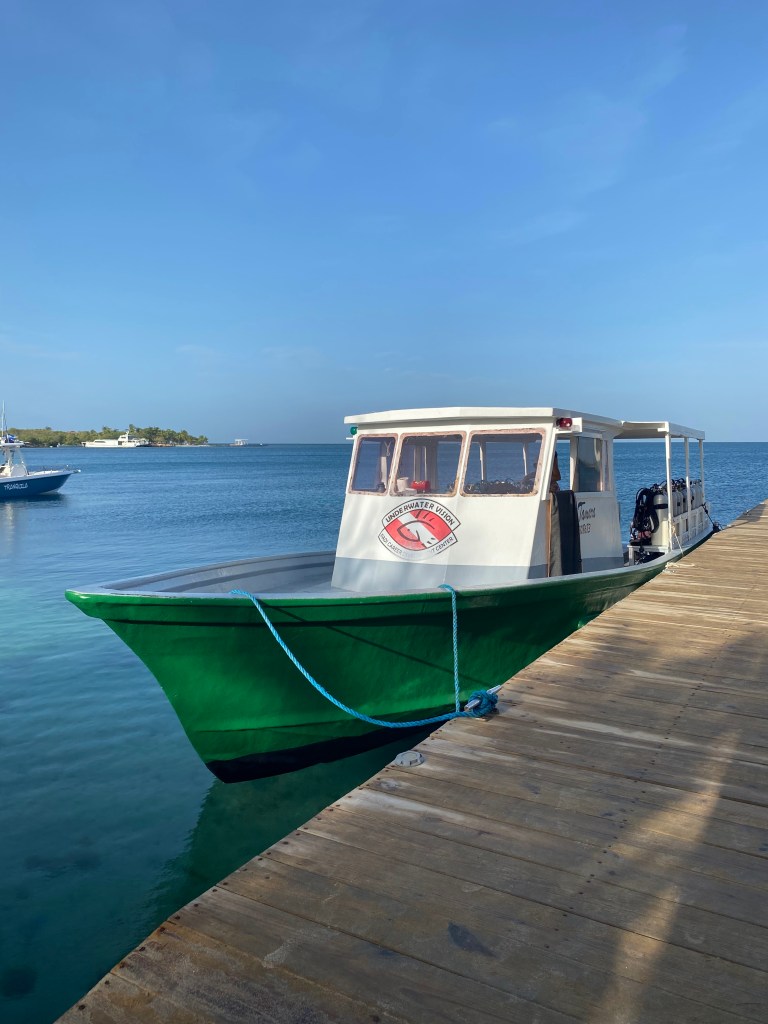
My go-to in terms of a dive shop has always been Underwater Vision. A friend recommended this place to me before I even went to Honduras, I ended up learning to dive there over Christmas 2016 and it’s the only place I’ve ever gone since. They have always had great instructors and divemasters that I’ve felt safe and comfortable with. Some other places that I’ve heard good things about are Utila Dive Center (right next door to Underwater Vision) and Alton’s Dive Center but I can’t vouch for them myself. 

See whale sharks

I don’t have much that I can personally add to this one because I’ve never been lucky enough to see one but Utila is one of the best places in the world to see whale sharks. Despite the name, whale sharks are actually the largest species of fish, known for their distinctive patterns of white spots. They can be found in Utila’s waters all year round but the best chance is between February and April. You’ll still need a lot of luck though!

Neptune’s Beach

While Utila is a bit of an island paradise, it’s not lined with beautiful beaches all the way around. Bando beach is a small private beach at one end of Utila Town and Chepes beach is a small public one on the other side of town but if you want an idyllic beach day, head to Neptune’s. When I visited in the summer, my twin sister Amy happened to be working on Utila at the same time, leading a coral research team. Their base, Coral View Dive Center, was right next to the dock where you can take a 50 lempira (£1.60) boat through the mangroves to Neptune’s. Technically the beach is called Coral Beach and the restaurant is called Neptune’s but everyone just refers to the whole place as Neptune’s. You don’t have to order from the restaurant or bar but I would recommend it – definitely get the onion rings!

One side of the beach has live corals that come right up to the shore so you can’t swim there but on the right side of the jetty the shore is just sand so it’s safe to get in. Further out on this side there are also coral reefs that you can swim to and snorkel over. This is one of the best snorkelling spots on the island! One of my favourite dive sites, Black Coral Wall, is also just off shore around here.

Rent bikes

One thing I’ve never done, the previous times I’ve been to Utila, is explore outside the town much. To remedy this, Hannah and I rented some bikes to see some new places! You’d think it would have been too hot but the movement actually created our own breeze which was really refreshing. We stopped at a few places like Scott’s Driftwood Beach which has incredible sculptures, a random spot with a beautiful view out to the ocean and later at a little pulpería for a nice cold drink. I’m not a goal oriented hiker or cyclist it turns out, so when we wanted to stop to take pictures, look at animals or drink emergency electrolytes (true story), we did it! It was nice to get out of the traveller bubble of Utila town. What we saw reflected a little more of the Honduras that we know from the mainland. We rented our bikes from Golf Cart Rentals along Main Street for $10 for 24 hours though they are also available for just a couple of hours at a time. The bikes weren’t in great shape and it took us a while to figure out the brakes but Utila is pretty flat other than the hill going into town from the back so they got the job done.

Jade Seahorse

A bit of a hidden gem, both due to the fact that it’s under appreciated in my opinion and also somewhere you could walk past without really noticing, is the Jade Seahorse. While technically a hotel with rooms that you can stay in and home to the Treetanic bar (slightly random opening hours mean I have never been there for a drink), Jade Seahorse’s real attraction is the mosaic garden. The 50 lempira entrance fee is well worth it (the owner will most likely be sitting somewhere in the garden and will ask for it as you’re walking around). There is so much to take in that you won’t know where to look. Take your time and enjoy all the little details.

WHERE TO STAY

Trudy’s

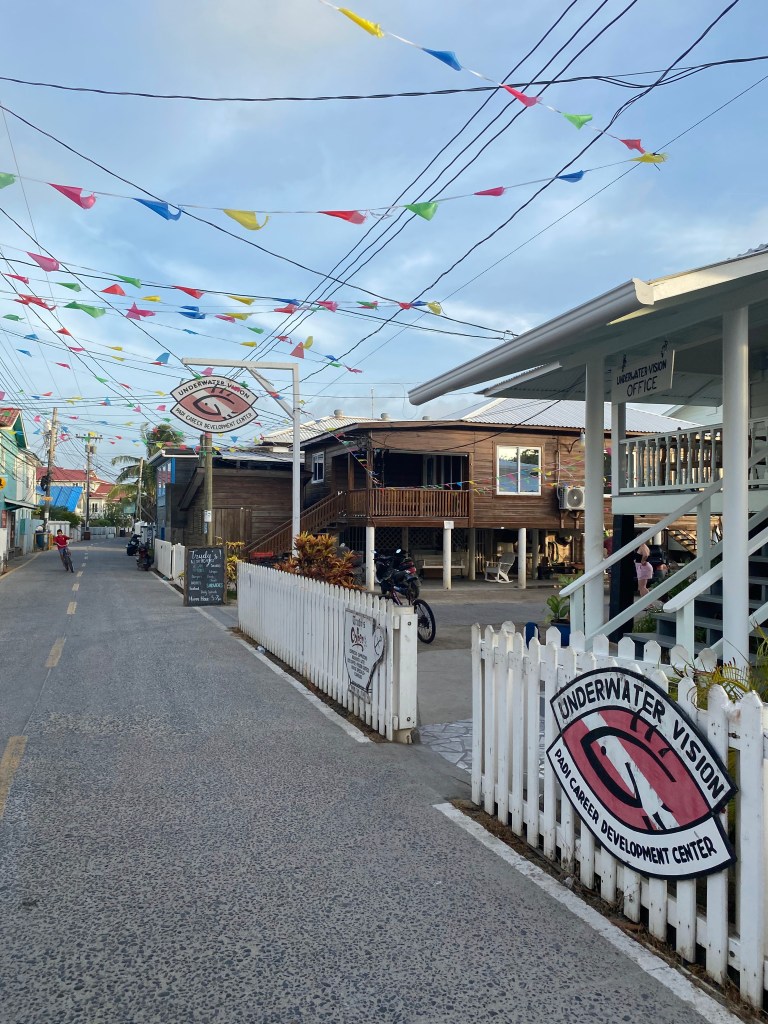
Just like Underwater Vision is the only place on the island that I’ve ever dived, Trudy’s, the hostel attached to Underwater Vision, is the only place I’ve ever stayed. I find the rooms to be clean and comfortable, whether that’s a dorm or a private room. There is a restaurant with great food, particularly breakfast, and nightly specials like pizza or wings and a bar that has various events throughout the week like karaoke and quiz nights. These are a great way to get to know other guests but also draw people from elsewhere on the island so it’s a really social place. It’s not, however, a party hostel and most nights things quieten down around 10pm or 11pm (the exception being for divemaster graduation ceremonies but these are a spectacle in themselves). While there’s not a beach, Trudy’s is right on the water with it’s own dock where you can swim and where the dive boats leave from. There is a large sandy area that is perfect for sunbathing (with lots of suncream on!), playing beach volleyball or chilling in a hammock in the shade. If you stay at Trudy’s and take a course with UV, there are discounts on the accommodation prices which is an added bonus.

I’ve stayed there in a big group, a small group, with my family and this summer just as a pair and I’ve always had a great experience. It’s easy to get talking to anyone, whether it’s on a dive, swimming by the dock or having a drink in the bar. All of the instructors and divemasters get involved with the guests and are friendly faces around the place. This summer, Hannah and I built a great wee group, a trio of girls from Germany, Austria and Norway, one of the divemasters and the first of two great Dutch T(h)oms of the trip. I also, absolutely unbelievably, managed to find a few long lost cousins from the Isle of Lewis by way of Ireland! That’s a story for another day but it still baffles me not just that we met on this tiny island in the Caribbean but that we managed to figure out the connection!

Other options

As I’ve said before, Trudy’s is the only place I’ve stayed but I have heard bits and pieces of other places. Mango Inn is the name of the hostel attached to Utila Dive Center which is supposed to be nice. Whereas Underwater Vision and Trudy’s are in the same spot on the waterfront, UDC and Mango Inn are separate. UDC is right next door to Underwater Vision but Mango Inn is about a 15 minute walk away, in the centre of Utila Town. You could also stay in cabins at the Jade Seahorse that I mentioned above, each room with a different theme. There are a lot of options to choose from around the island and anywhere in Utila town is not very far from anywhere else.

WHERE TO EAT

Mama Rosa’s

Due to its proximity to Underwater Vision, cheap prices and large portions, this is a go-to spot of mine in Utila. Baleadas are great anywhere really but Mama Rosa’s are huge and you can get them all loaded up with chicken, beef, avocado, salad and more. They also have massive pupusas, large stuffed tortillas that are a favourite of mine. They also have things like burritos and quesadillas as well as great fresh fruit juices.

La Casita

What drew me to La Casita was initially the bright colours of its exterior but also the amazing smells every time I passed by. It has all kinds of things on the menu from baleadas and burgers to pasta and seafood. I had the special of the day when we went which was birria tacos and they were delicious.

Camilla’s Bakery/Pizza Nut

A very versatile spot, Camilla’s Bakery serves breakfast and lunch during the day and then reopens at night as Pizza Nut. As far as Camilla’s Bakery goes, they have a great selection of bagels that have saved me on more than one worse-for-wear morning over the years. I have actually never been to Pizza Nut but hear nothing but good things!

The Pelican 

The Pelican is right opposite Underwater Vision but was new since I was last on Utila. Hannah and I figured that we should check it out one night but it was actually completely full when we first tried to go! It’s a pretty small space but is very popular so it’s actually somewhere that I would recommend booking if you want to make sure you get a table! We booked for the following day and enjoyed an incredible meal. I went for the Thai yellow curry which actually wasn’t on the menu but had been the special the day before. The server remembered that we hadn’t been able to get a table then and offered us the option of the curries that were on offer the previous day. It was absolutely delicious and I was very grateful for the chance to enjoy it! As good as most of the other options around Utila are, having some lighter food made a nice change from the heavier Honduran and American options.

Pink Flamingo 

I met my sister here on her day off to have a wee brunch and it is such a stunning spot. You could be forgiven for missing it because it’s hidden from the road and is very inconspicuous. Once you enter, you are greeted with a wooden structure that stretches out into the most stunning turquoise water that surrounds the whole of Utila. Pink Flamingo really leans into the aesthetics of its surroundings, making it a very Instagrammable spot. It was a place I could have quite happily stayed for several hours, enjoying my book in one of their hammocks or swing chairs. The food was good too, I had a Mexican style brunch option but their salads, bowls and sandwiches had me wanting to go back and work my way through the menu! It’s a little more expensive and with smaller portions than some other places but I think it’s worth a visit for the vibes!

The Point

On the recommendation of a new divemaster friend we met at the start of the week, we had a spare day with no plans and decided to head to The Point. It’s a restaurant and bar looking out onto the water that also has a small chlorinated pool. I love being in the ocean but there’s just something about being in a chlorine pool that makes me feel so clean and so at home. On the menu are American staples and I enjoyed a great buffalo chicken burger. Hannah and I enlisted a couple of our new friends to come along with us and we spent most of the day there, playing cards, reading and chatting in the pool.

WHERE TO DRINK

Ask around for the best place to go depending on the night!

There are endless options on an island that is known for its party scene and it mostly depends on the night. Talk to people at your hostel or around town and ask where will be good that night. Back in the day, Tequila Tuesdays at Tranquilos and Ladies Night on Thursdays at Vinyls were the place to be and still to this day. Hannah and I have fond memories (if a little fuzzy in places) of both of these nights when we were 18 and we did actually go back to Tequila Tuesday this summer. I don’t know if it was my advanced age of 25 or just not being in the mood on the night but it didn’t hit quite the same.

La Cueva

Something that I did love and the thing to do on Monday nights is karaoke at La Cueva! My sister and a lot of her research students plus Hannah and I and our group from the hostel (and pretty much everyone else) were packed into the bar. I’m not a big karaoke singer but I am an avid and enthusiastic audience member. There were lots of great performances, Taylor Swift from Amy and her friend, some Patti Smith from Hannah and someone sang the Cha Cha Slide which I’m definitely stealing in the future.

Utila Brewing Company

This was more of a one off experience or at least monthly rather than weekly, but we happened to be on the island for one of Utila Brewing Company’s big jungle parties. The brewing company was actually set up by the instructor I had for my Advanced diving course seven years ago! Normally it’s only open at the weekends but the jungle parties are usually Friday nights. It was 100 lempira (£3.20) to get in and there was a great DJ, and even though it was mostly techno music which isn’t usually my thing I really enjoyed it!

Top Tips for Visiting Honduras

Despite how much I love Honduras, I recognise that it’s not top of most people’s list of must-see destinations. However, it feels like a personal mission to change people’s minds about that. With everything I’ve written and will write, I hope I can show people that Honduras is definitely a country worth your time. At the same time, Honduras has a certain reputation that precedes it that I don’t think is representative of the country as a whole. It is safer and easier to navigate than it might appear. That’s not to say that there aren’t things to watch out for and you also shouldn’t expect the same level of tourism infrastructure as somewhere like Costa Rica. With that in mind, there are a few things that I think are important to know before you visit so that your expectations are in line with reality.

Take what you might have heard with a pinch of salt.

Back in 2015 when I was first embarking on the journey that would take me to Honduras (the selection and fundraising process started a year before I would actually leave), the prolific BBC investigative presenter Stacey Dooley had just released a two part documentary about the worst places in the world to be a woman and guess where one of those places was? This meant that many of my first interactions with people when I told them that I would be moving to Honduras for a year was shock and horror. This was quickly followed by questions or comments about how bad it is for women there and generally how dangerous it is. At the time, I had no idea how to respond and usually just laughed somewhat awkwardly before moving the conversation along.

Now, I’ll say that while Honduras still doesn’t have the best reputation among international travellers, a lot of the problems (gangs, violence, drugs) are localised to specific areas of bigger cities and visitors are rarely affected or the targets. Outside of the large cities of San Pedro Sula and Tegucigalpa, I have never felt unsafe in Honduras. (Saying that, still don’t take any unnecessary risks.)

Don’t flush toilet paper.

The pipes in Honduras are not what you will be used to at home. It sounds like it’s going to be really annoying and it will definitely take a few days to get used to this but it’s the same throughout most of Central America. You’ll get the hang of it eventually and if not, I hope you’re good with a plunger!

Cash is king.

To be on the safe side, I would assume that nowhere takes card so always have lempiras (the Honduran currency) on you. Most larger towns and cities have ATMs but sometimes these are out of service or there’s an unexpected problem with your card so stock up when you can. In general when it comes to using your bank card, Visa and Mastercard are widely accepted. I personally use my Monzo card when I travel because they have pretty good travel rates and won’t block your card if you change countries without telling them. Back to cash, dollars are not really used (other than in very touristy places like the island of Roatán) but can be good to have for emergencies. In smaller shops or restaurants it might be hard to break a 500 lempira note (~£15) for smaller purchases.

Dress a little more conservatively.

If you’re anything like me, you’ll spend the whole time wondering how Hondurans are going about their business in jeans in up to 40° heat! I’m not saying you have to follow suit but Honduras is generally a pretty conservative place so keep that in mind in your clothing. Especially if you travel to a smaller town, somewhere like Candelaria for example, I wouldn’t wear shorts and I would have more coverage on the top, no crop tops or low cleavages. In the cities and on the islands which are used to more tourists, you can be more free with what you want to wear.

Visit the mainland!

So often people travelling Central America will skip Honduras entirely or only visit the Bay Islands of Utila and Roatán. I’m not saying they aren’t worth visiting (I love Utila and have been four times, watch out for the next blog post) but the mainland has so much to offer too! Copan Ruinas are in the northwest of Honduras, near the borders with Guatemala and El Salvador and are most well known for their Mayan ruins. These are the most southern Mayan ruins and my favourite of the handful that I’ve visited. I feel like they are the ones that I could most imagine being full of life and I could still see how everything fit together as a city. The town itself is really cute and there’s also a scarlet macaw sanctuary that’s worth a visit. In central Honduras, you’ll find Lago de Yojoa which is a hot spot for outdoor activities. It’s popular with bird watchers, kayaking out into the middle of the water gives you incredible views and you have to go to one of the many lakeside restaurants and try their specialty, pescado frito (fried fish). Nearby there is also the very impressive Pulhapanzak waterfall, 30 metres high. You can spend the day at the facilities there, go ziplining in front of the falls or go canyoning through them. And of course, there’s always Gracias for the hot springs and zipline.

Basic Spanish will help.

Obviously knowing the language of wherever you’re visiting is always a massive help, this almost goes without saying. But Honduras isn’t Costa Rica where so much of the economy relies on tourism that English is fairly widespread. Even in touristy areas like Utila, Roatán and Copán Ruinas but especially outside of it, a basic command of Spanish will go a long way. I think it’s polite and shows respect to the country you’re visiting to know a few phrases at least and people like it when you make the effort! Being able to have a basic conversation, ask for directions and order food are the most important things to learn but the more the better! Have Spanish downloaded on the Google Translate app as a last resort too.

People are generally kind, generous and willing to help.

You can’t generalise a whole country of people but I have found most Hondurans to be some of the most friendly and welcoming people. It’s hard to put into words how welcome I was made to feel when I lived there and am still made to feel every time I go back. I’m welcomed back into the home and the family that I lived with, my friends won’t let me pay for anything and I’ve had amazing interactions with strangers. This ranges from interesting conversations and lifts from bus stations to getting the best, authentic but otherwise unknown recommendations.

Trust the bus men throwing your bags on top of buses (and in public buses in general).

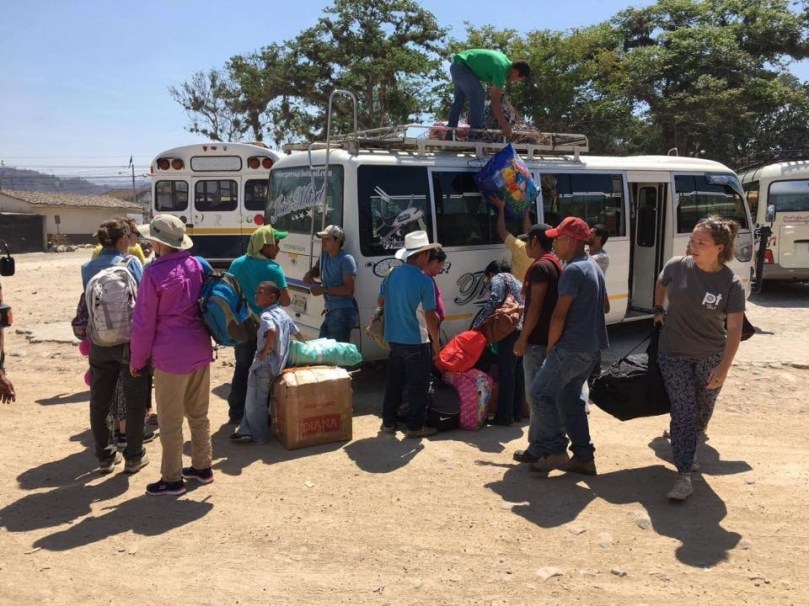
There are some private shuttles that you can take from the more touristy destinations in Honduras, from the islands to Lago de Yojoa or Copan Ruinas, or to the main cities like Tegucigalpa and San Pedro Sula but they’re expensive and if you want to venture further afield, more than likely you’re going to have to trust in public buses. There’s not a nationwide bus network, instead there are a collection of bus companies in each city running specific routes to another city. There’s no app or website in most cases so your best bet is to turn up at the bus station and ask around! There are times when someone will grab your bag and run off with it but they’re not stealing it (probably) – the men who work on the buses are very helpful but not always the best with instructions. Follow your bag and you’ll find the bus you need to get on. What looks like chaos on the surface is actually a well oiled machine.

Cold showers are the standard.

Unlike at home where hot showers are the norm, almost no matter the weather, you’ll have to get used to bracing yourself for freezing water. If you go around expecting this, hot showers become a welcome luxury which is nicer than constant disappointment. Your hair maybe won’t be as nice but take it as an opportunity for some cold water meditation and focus on your breathing. It’s hot enough anyway that you might welcome the cold water!

Women will most likely get catcalled.

Honduras has a strong culture of ‘machismo’ which is defined as an exaggerated sense of masculinity. This manifests itself as Honduras being a very male dominated culture. Men are the heads of the households, the primary breadwinners and much more visible in public and high-level positions. In day to day interactions, one of the ways the macho culture manifests is in catcalling. When I was living there, I had to get used to walking around with the background noise of whistles, kissing noises and various comments. Honduran men have yelled ‘I love you’ in English at me more times than I can count. Usually it’s harmless and ignoring it works. As a tourist, it won’t usually go further than this catcalling although that is unfortunately not the case for many Honduran women who suffer from high levels of violence, both in the home and in society at large.

Go to the local restaurants (comedores).

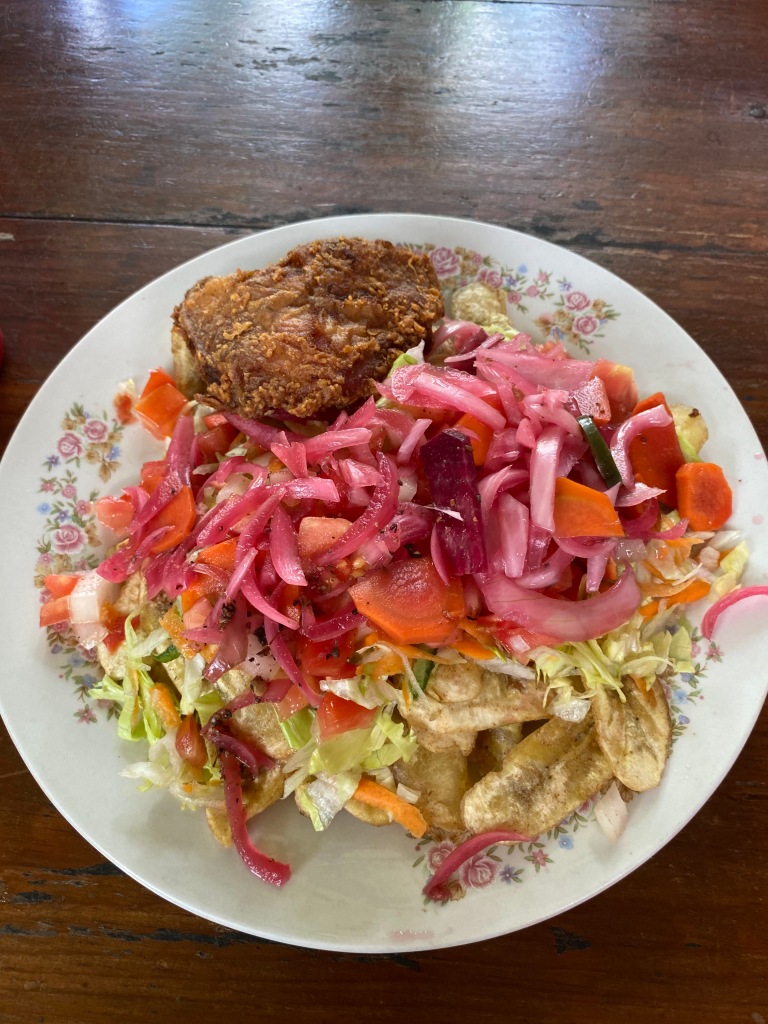
From the outside they don’t look like much, sometimes a bit more like someone’s living room than a restaurant. It might be tempting to go for more aesthetic choices and of course there’s always times when you just want some pizza but you’d be missing out if you don’t give the comedores a chance. You might be wary, particularly at the beginning of the trip, about the cleanliness or hygiene of a place but there’s usually signs to tell if the place is safe, the main one being if it is popular with locals. Try some of the classics like baleadas, fried chicken or a typical dinner. Big plates of food can cost up to around 120 lempira (£4) so it’s a cheap option too. But still trust your gut if something looks too dodgy.

Things will go wrong but they’ll all work out.

A good motto for visiting Honduras is ‘go with the flow’. The phrase ‘organised chaos’ comes to mind but embrace it. Particularly when it comes to transport, things don’t usually go to plan (add at least an extra hour on to the supposed length of any bus journey). Everything is a bit more relaxed in Honduras though, especially timekeeping (although I wouldn’t recommend turning up late for buses). Being open to new experiences can lead to some amazing things! Talk to people and you never know what might happen, you might end up in the most incredible situation that you wouldn’t otherwise have experienced. There is magic in the chaos.

Seven Years Later…

Of the whole two and a half months that I was travelling, these next few days were my absolute favourites, not that I expected any different. After a few days relaxing in Gracias and a night in Hannah’s old project in Yamaranguila, I was returning to Candelaria, a town that feels like home. It had been seven years since I first stepped foot there as a fresh faced 18 year old, although I did go back for a week in 2019. Travelling to new places is exciting and there is much to be learnt but I have found that nothing makes me more reflective than returning somewhere I’ve been before, especially somewhere that means so much to me and had such an impact on the person I am today. It was also really special to share this experience with Hannah because while I had visited her project during our original time in Honduras, she had never made it to Candelaria (awkward bus schedules are mostly to blame).

From Yamaranguila we had to take the bus from La Esperanza towards Mapulaca, a border town with El Salvador, and get off in Candelaria. We were waiting for the bus to take us from our hotel down to the station while simultaneously trying our luck at hitchhiking (a very common practice in Honduras) and we ended up getting a lift with two policemen! The bus journey was easy enough, about five hours in total and much smoother than our bus ride from San Pedro Sula to Gracias. As we were coming around the last few bends before arriving into town, I could barely contain myself! It already felt like coming home, even if I was already noticing a lot of changes.

And now comes the real reason that I was so excited to be coming back. My family met me off the bus! When I lived in Honduras in 2016-17, I stayed with a host family – Saida, the mum, Jaime, the dad, and three girls, Daniela, Jamie and Antonella. Antonella was actually born while I was there! Unfortunately the dad Jaime passed away in 2019, just before I came back to visit for the first time, but I’ve remained close to Saida and the girls. I had the loveliest big hug from Saida and I immediately couldn’t believe how big the girls were since I last saw them. Daniela and Jamie are fully teenagers now and Antonella has started school! Mind blowing. They don’t actually live in the same house as they did when I lived there, right on the main square, because they rent it out as a shop now but they’re only one block away and right opposite two of my friends. I introduced Hannah to everyone, we got the grand tour, including meeting the new cat called Sushi, and settled in a little.

For our first evening we went to the pool which is definitely something new, one of the many developments around Candelaria! I would have loved it if this was here before so I could have run some actual swimming lessons (I used to be a swimming teacher and I would teach my host sisters how to swim in the river!). Finca Don Jorge is so cute and definitely would be a good spot when it’s super hot. At this point the sun was going down so it was getting dark and cool but it was still nice to get in the water after being on the dusty bus. Not everyone got in but I enjoyed splashing about with Jamie and teaching Antonella how to blow bubbles and kick her legs. She’s already so confident in the water which is good but it was one of many moments over the next few days that made me wish I was staying much longer. Antonella didn’t remember me from last time because she would only have been about two years old but apparently she was the most excited for me to come, asking when her hermana was getting here… I’m not crying, you are.

On our second day, we went with Saida to the nearby village of San Lorenzo where she works. They were having their elección de la india bonita , an event that happens just before Lempira Day, a national celebration that would be happening on the final day of our stay. The girls make and wear these incredible dresses using natural materials like beans, seeds, corn, leaves, moss, flowers and more. They have very intricate designs of their town, of Honduras, of national symbols like Lempira or the scarlet macaw. We were helping some of Saida’s students finish their dress and get ready for the presentation which involved braiding a lot of hair! The actual ceremony was really interesting to see, the dresses were absolutely incredible but it was a long afternoon in the hot sun. Hannah, Antonella and I ended up getting a lift back to Candelaria a bit early while Saida stayed on.

We had a chilled evening in the house because everyone was tired after a long day. This was actually one of my favourite evenings though. Over dinner, Saida, Hannah and I had an interesting conversation about various political and social issues which are conversations that I enjoy anyway. This conversation happened in Spanish though so was a bit more challenging. I was very pleased and a bit surprised with how well I’d been able to keep up my Spanish before this trip and how quickly it bounced back even more after arriving in Honduras. Hannah has a pretty good understanding of Spanish but won’t mind me saying that she struggles a bit more with speaking. She absolutely held her own in this discussion though and was participating fully in it. It was so nice for me to see her and Saida getting along and communicating together. After dinner, we helped finish a sign for Lempira Day that involved hot glueing beans to outline letters. While we were doing so, I had a conversation with Daniela, the oldest of the girls, in English. It was simple and short but had full sentences and used the past tense. When I was first here, I taught Daniela English when she was in second and third grade plus some extra bits and pieces in the house. Seeing the progress she’s made and her continued interest in English made me so proud that I was genuinely holding back tears.

The following day was packed full of catching up with as many friends as possible. I’ve already written about the complicated feelings I had after I left about not having made any lasting friendships and this being proved wrong the moment I was back in Candelaria. (While re-reading the blog from my last visit while writing this one, I found that what I had written still resonated a lot and I was very proud of that piece of writing and the reflections in it so it might be interesting for you to have a look at it too if you haven’t already.) It was the exact same this time. From the start of the day until the end I was catching up with people. It started with picking Antonella up from school mid-morning as there were only a few classes in preparation for Lempira Day. It was a bit of a shock that the only students I still knew in the primary school were the sixth graders who I had taught while they were in Kindergarten! A group of them gathered around to talk to me and there were lots of questions about Amy, my project partner (not my twin sister!). Hannah, Antonella and I walked back into the centre of town with our entourage and ended up going to play with them in the park and then being introduced to minutas, like a snow cone topped with flavoured syrup, condensed milk and candy belts.

After a brief air conditioning break in the house (a new but welcome addition since I lived there), we headed out for lunch with my friend Nayely. Her family has a comedor, a typical Honduran restaurant, so we ate there which was absolutely delicious (food pictures are further down)! We were very hot and very full after our pollo frito and tajadas so we went home to chill before I got called out to meet up with another friend, Enedina, for a cold frappé. Hannah was tired so she stayed behind but Saida and Antonella came with us.

The final stop of the day was dinner with Lety and Victor who were like my second host family back in the day. They were the organisers of the project so we spent a lot of time with them and their four kids. Three of them are much more grown up now, including the eldest who is off at university, but Hannah and I got to spend some time with the youngest, Samuel, while waiting for dinner. He was only a toddler when I was here the first time so didn’t really remember me. This time he took us through all 60+ Youtube shorts of something called Skibidi Toilet (if you’re lucky enough not to know what that is, don’t look it up). As painful as it was, it was nice to spend some time with Samuel so that next time he’ll remember me more, the same as with Antonella.

And now for the main event, Día de Lempira! Lempira Day was my favourite national holiday when I was first here, and there are a lot to choose from, so I specifically planned this trip and it’s itinerary around that. Lempira is the national hero in Honduras who led the Lencan people, an indigenous group, against the Spanish in the 1530s. The name comes from two Lencan words that mean ‘señor de la sierra‘ or ‘señor del cerro‘, both meaning ‘lord of the mountain’. Today he is remembered on 20th July every year. The national currency is named after him as well as one of the departments of Honduras (where you’ll find both Gracias and Candelaria).

The first step is the parade! Before that however, everyone has to get ready in their various outfits. My contribution to the morning was plaiting all three girls’ hair plus Saida’s. Hannah and I walked Antonella to the meeting point for the parade, which is a couple of hundred metres shorter than in my day (not that I’m complaining). The whole primary school and high school are part of the parade, dressed up in different styles. There are the indias bonitas, the girls in handmade dresses decorated with beans, corn, flowers and leaves like we had seen in San Lorenzo. There are the caciques, the warriors, the campesinos, the peasants, and those in the traditional folkloric outfits.

The second part of the day is in the main square where there are different kinds of performances and speeches, starting with the national anthem sung by my former students. Next up was traditional dancing, again with my former students, mostly those I taught when they were in fourth and fifth grade (now they’re in eleventh grade!). The final and most important event of the day is the reenactment of the death of Lempira. One student from the high school is chosen to play Lempira (another one of my old students, Josue Maria, was chosen this year!). It is said that Lempira died when he was lured to peace talks with the Spanish who then shot him from horseback in an act of betrayal. There is another telling of events that says he dies in battle and the Spanish cut his head off to prove he was dead but that’s a bit harder to reenact!

After being in the sun for several hours, we went back to the house before going out for lunch with another friend, Karen. We actually ended up back at Nayely’s comedor, today for pollo asado. A common theme throughout my visit was that I wasn’t allowed to pay for anything. It was lovely that all my friends wanted to invite me out but I wanted to contribute to the town and I wasn’t expecting everyone to pay for me. Especially when it came to supporting my friends, like at Nayely’s comedor or buying coffee from Victor (at my dad’s special request), I tried to insist but after a certain point it becomes rude to refuse. Part of the Honduran culture is their generosity, looking after guests and feeding people!

The morning had been a busy one, as had the last few days which caught up to us so we spent the afternoon resting in the house. In the evening, as a last hurrah for our last night, Hannah, Saida, the girls, Saida’s cousin Miriam and I went out to a Mexican restaurant that is also new since I lived here. We had a nice meal and then spent the evening watching a film on a projector in the house. It was a lovely way to wrap up our few days there.

It’s still somewhat of a challenge to put into words how much this little town and its people mean to me. Being back here is like using a time machine – I feel 18 again but at the same time I’m able to see how far I’ve come. And I’m not the only one who has changed. More so this time than the last time I was here, I noticed the differences in the town. In most cases, the changes are positive. There are lots of new businesses and restaurants which is encouraging to see after the economic challenges of the last few years during the pandemic. Coming back to Candelaria feels like coming home and a lot of that is about coming home to my family, particularly my mum Saida. The love I feel for her and from her cannot be described as anything else. The girls are growing up so fast, as are all of my former students, and it is a privilege both to have known them when they were younger and see them transforming now into the strong, independent, intelligent people I always knew they would be. Sharing this experience with Hannah was also really special and I know she saw at least some of what I see in this amazing town and these amazing people. They opened their arms as much to her as they do to me and I’m so grateful for that. Now that I’m in Costa Rica for the foreseeable future, I hope it won’t be four years until my next visit!