Curaçao

For most of my adult life, the main thing that I thought of when I heard Curaçao was the liqueur, and I’m sure I’m not alone in that! That was until a friend from university spent a few months volunteering there in summer 2023 and loved it! She was trying to convince me to visit back then but I was travelling in Colombia and then starting my job in Costa Rica so it wasn’t possible. When I decided to move back to Scotland in September 2024, I knew it was something that I wanted to make happen before I left Costa Rica. Not just because the flights are definitely cheaper from Central America but also because when else am I going to go to Curaçao?!

Curaçao is part of the Dutch Antilles (along with Aruba and Bonaire, also known as the ABC islands) and is 65 km off the coast of Venezuela. It was a Dutch colony until 2010 and is now a country within the Kingdom of the Netherlands, meaning they still recognise the Dutch monarchy and the Netherlands handles their defence and foreign policy. Dutch is still the official language although Papiamentu (or Papiamento in Aruba) which is a Portuguese based Creole language, English and Spanish are all widely spoken. Tourism is an important industry as well as oil refining and international financial services. The currency is the Antillean Guilder (1ANG = $0.50). Willemstad is the capital and is a UNESCO World Heritage Site because it is a well preserved example of a Dutch colonial trading settlement.

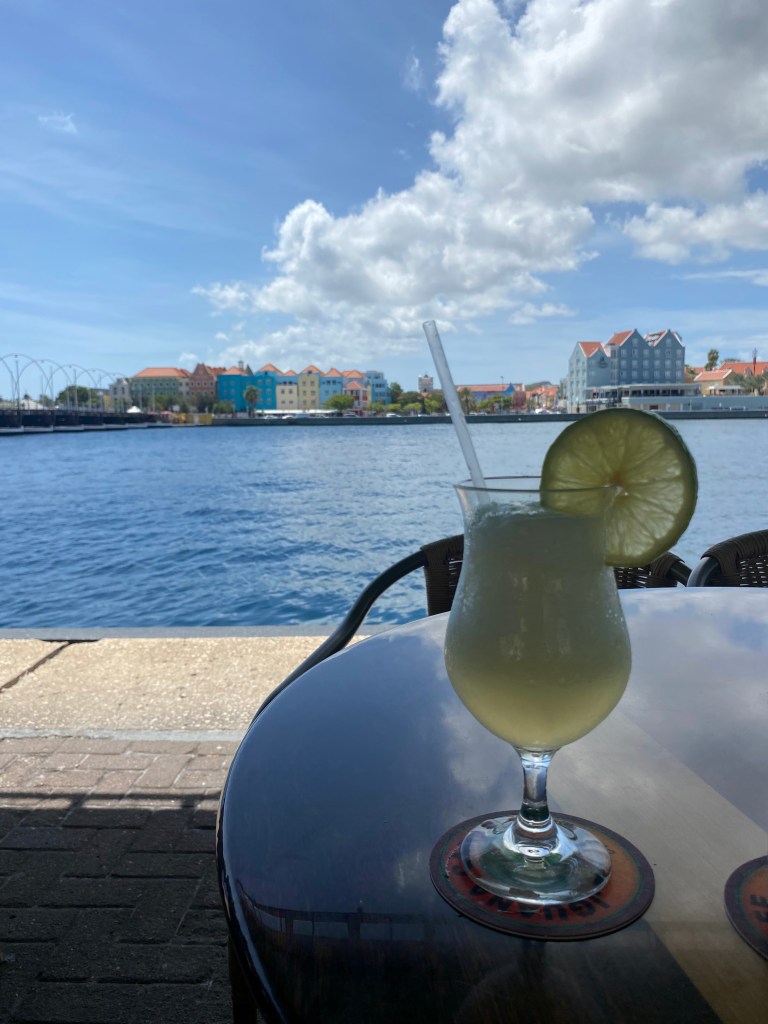
I flew in via Panama City from Costa Rica, the flights were short (1.5 hours and 2 hours) and I only had a 1 hour layover! However I did leave my house at 3.15am. Why do I always do this to myself? I mean, I know why I do it, that’s when all the cheap flights are. I was so tired and it was so hot when I arrived but immediately extremely beautiful. I had some time to kill before my friend Marta finished work and I didn’t feel like dragging all my stuff around to sightsee in the heat so I got myself a great spot on the water and a lemon frappé to keep me company while I read my book. My chosen spot was called Iguana’s and is right by the Queen Emma bridge that connects the neighbourhoods of Punda and Otrobanda. It’s a floating bridge that can be unhooked and propelled out of the way to let boats through. For smaller boats, it will only open as much as is needed but when it has to open all the way for larger boats, which can take 30 minutes in total, there’s a free ferry across that you can take from 50m down the esplanade. I had no idea what was happening the first time the bridge started to move but it was pretty cool to watch!
Once I was done with my drink and chips, I walked over to the Ronde Markt, a big circular market that is a great place to get souvenirs (I had to get the obligatory magnet for my mum’s fridge) and also has free wifi. Apparently there are some great spots around there, including one called Plasa Bieu, to try Curaçaoan dishes like pastechi (like an empanada or a pasty) or yuana stoba (iguana stew). Having just eaten, I didn’t visit it and I sadly didn’t get to try iguana but I did have a pastechi later in the trip. When Marta finished work, we met at Mambo Beach which is one of the most popular spots with the many Dutch holidaymakers. With the past and present relationship between Curaçao and the Netherlands, and direct flights from Amsterdam, there is a lot of Dutch tourism and many Dutch immigrants. It goes the other way as well – it is common for students from Curaçao to spend a year or two studying in the Netherlands, although the transition can be difficult, especially financially. The Dutch tourists to the island tend to keep to certain areas like Mambo. At the time we were there, just after 5pm, the sun loungers are free and the bars have happy hours! It was a great place to watch the sunset and catch up. I last saw Marta in February 2023 when I went to visit her at home in Madrid over my birthday!

Marta and I know each other from playing water polo together in the ‘Queens’ seconds team at Edinburgh University (once a Queen, always a Queen) and so when she had training on Saturday morning, how could I refuse? And is there any better place to play than turquoise blue water? Marta’s team trains in Pirate Bay where there are a couple of restaurants on the beach next to a pier where they put the water polo goals. This was my first time playing in the ocean and only the third time playing in an outdoor pool and it’s very different. It’s a lot easier to keep yourself afloat in the salt water but it also burns your eyes way more than chlorine and also stings your mouth by the end of it too! There are also waves to contend with, and even small ones can make a big difference. Don’t even get me started on the suncream logistics and awkward tan lines (see below)… Because my team in Costa Rica was quite small, we didn’t play a lot of full games so I was a little rusty playing one here but at least Marta and I were marking each other most of the time.

The plan for the afternoon was to go to a beach and I jumped out of my seat when we saw wild flamingos on the way! I love flamingos because they always make me think of my pappy (my mum’s dad) who died when I was young and was one of my favourite people. I’d never seen them in the wild before and was so jealous when my sister Amy, who is living in the British Virgin Islands, saw a flamboyance of them (yes, that’s the word for a group of flamingos!) there earlier in the year!

We spent a few hours at Daaibooi beach, sunbathing, reading, swimming and not much else and then headed back to Marta’s. On Saturday evening we managed to get last minute tickets to Kaya Kaya, a cultural festival celebrating the neighbourhood of Otrobanda. There was food, lots of live music, art exhibitions and more! It was so busy! We wandered around for a couple of hours, taking it all in. My highlight was finding salted caramel pecan ice cream for only $3.50 for a huge tub! As we were leaving, we watched some fireworks from the car park. They might have been from Kaya Kaya but they might have been from a random wedding that was happening at the same time, we’ll never know.

Sunday was for beach hopping. We were heading north-west along the south shore of the island where there are lots of beaches you can stop at. You would definitely need a car to do this. Willemstad is really the only major town in the island and there’s lots of public buses that are easy to use and cheap but going outside of town, I think public transport is a lot less frequent. Luckily Marta does have a car so she was my chauffeur for the day. After a lazy morning, we started at Santa Cruz which was nice because it wasn’t super busy and there were some covered picnic benches but it wasn’t a standout. Our next stop, on the other hand, might be one of my favourite beaches ever – Playa Lagun. It was a lot smaller but absolutely stunning. It was like a little cove with high, rocky sides and stunning blue water. It was already 3pm by the time we got here which was lunchtime for us. We both had a delicious pulled beef quesadilla at the restaurant overlooking the beach which was delicious, with a beautiful view and some iguanas for company!

Santa Cruz

While we were out and about between beaches or the day before, I had Marta teach me some Papiementu phrases and was trying to use them whenever I could. I found quite a lot of similarities with Spanish that made it easy to pick up certain phrases. Even though it’s a Portuguese-based Creole, it has been strongly influenced by Venezuelan Spanish as well as Dutch. Here are some of the phrases I learnt –

  • Danki – thank you (dankee)
  • Por fabor – please 
  • Mi por haña… – Can I have… (mee pour hanya)
  • Pa mi tambe– for me too 
  • Awa – water 
  • Ayo – bye 
  • Dispensa – excuse me (deespensa)
  • Bon dia – good morning
  • Bon tardi – good afternoon (tardee) 
  • Bon nochi – good night (nohchee) 

The last stop was Piscado which is known for having resident turtles! Earlier in the day, you can see them while just standing on the pier but we were there a bit late. We still took our goggles and went swimming in search of them. I wasn’t expecting to find one but after swimming around for a while, a couple of people who had a sea bob pointed us in the right direction of one sleeping under a boat chain! We also saw a giant remora and a spotted Moray eel. The fun was spoiled a little by a flat tire when we were trying to leave but thankfully Marta had a spare and a friend at the next beach along who came to help her change it. It was still a great spot to watch the sunset.

To end the day we went to a very popular type of food truck, known as a truk di pan, for dinner. Flakito’s Grill is Marta’s favourite so that’s where we went. Lots of truk di pan serve different variations of the same things, barbecued meat with peanut sauce over fries. I went for the lomito because Marta told me it’s a bit of a specialty and it was delicious!

For my last full day, Marta had to work but I was more than happy entertaining myself by her pool! I was enjoying soaking up more sun than there was in Cartago and definitely more than there would be in Scotland! In the evening we went up to the fort to try and catch the sunset but we just missed the best part while on the way. Marta went to training again but it was a swim session which I was much less keen to join than the water polo so I went for a walk around town. I wandered through a pedestrian shopping area behind the Kura Hulanda museum which was really cute and where I also found tiramisu ice cream! I saw the bridge all lit up as well as the Curaçao sign and some live music on the bandstand behind. I loved it when some girls got up to dance! I had a final meal, a local dish called karni stoba which was a ridiculously tender beef stew, fried yucca and a local beer called Brasa.

The next morning, I saw Marta off to work and left a little later to head to the airport. It was a quick but a really satisfying trip. Marta is one of those friends that I keep coming back to at different points in my life. Our friendship has come a long way from what I see as its starting point, tabling water polo matches together during our first year at university. I was glad that I could make this trip happen because she loves it so much in Curaçao that she might be there for a while so I don’t know when we’ll next be in each other’s vicinity. Also, because when else am I going to go to Curaçao?!

Christmas in the Virgin Islands

There’s still plenty to come from my big summer trip to Latin America, although it is getting further in the rearview mirrors. Panama is up next but while I’m on a little break from writing about that trip, I want to take the chance to tell you about another, slightly more recent trip. Christmas while living far from home, friends and family can be a difficult time but I have to say that this year I had a blast! The programme that I work for was closed for two weeks because the school that we work in was shut over Christmas and new year, thereby leaving us with nothing to do. In my eyes, that’s a great opportunity to head somewhere exciting!
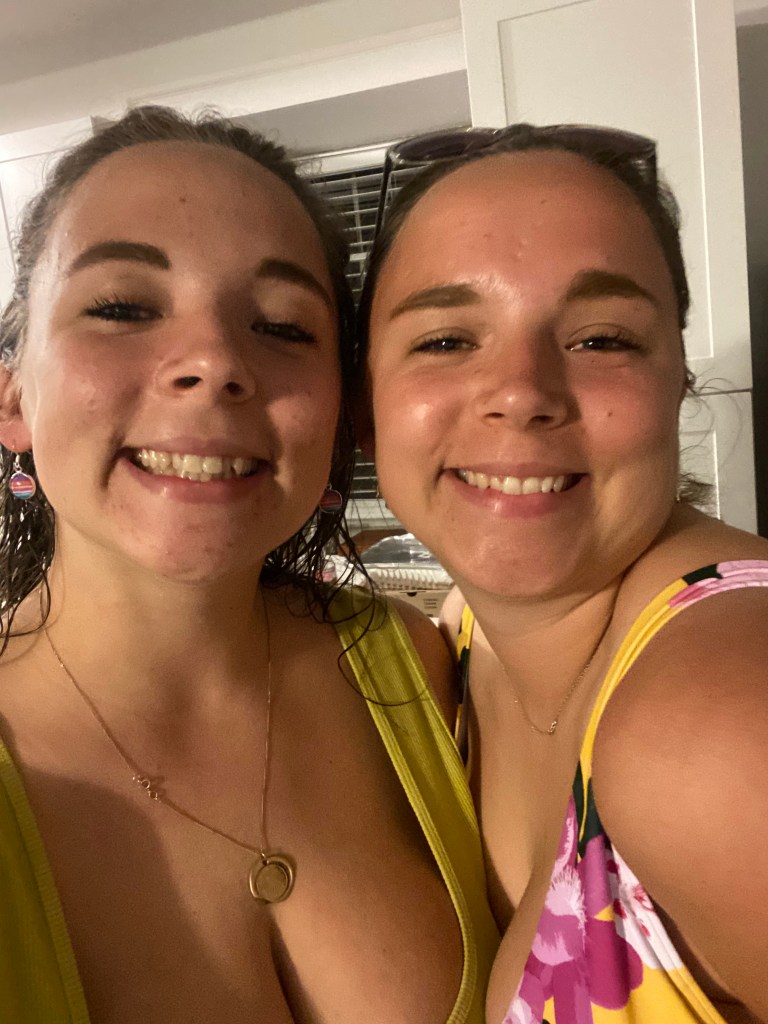
The exact same day that I got my job in Costa Rica, my twin sister also got her dream job! She had just finished a masters in tropical marine biology in Essex in the southeast of England but the last time I checked, there’s not many coral reefs in that part of the world. Instead she found herself a job in the British Virgin Islands, working for a dive shop and conservation organisation. For those of you reaching for your phones to look up where the BVIs are, I’ll save you the trouble. They are a series of more than 50 islands, alongside the US Virgin Islands, just to the east of Puerto Rico. Basically, island paradise.

Amy moved out there around the start of December so she hadn’t been there long when I went to visit. I wasn’t sure when else I would be able to get a couple of weeks off at a time so even though she was still settling in, I took the chance to go and see her. I had to work until the 23rd so I didn’t set off until the early hours of the 24th. Nearly a full day after I left my house in Cartago, I arrived at my final destination of St Croix. While Amy lives on Tortola, one of the four main islands of the BVIs, we were actually spending a few days over Christmas in St Croix which is one of the US Virgin Islands. After such a long journey, I wasn’t up for much so we just went out for a few drinks, some food and called it a night.

My first full day was Christmas day! And what better way to spend it than scuba diving. We went out on two dives and saw some Caribbean reef sharks, a sleeping nurse shark and lots of turtles, a few swimming and a few sleeping, which made Amy very happy. Whenever she sees a turtle while diving, she does a happy dance! When we were back on dry land, we were starving so went to a popular burger spot called Schupe’s. We had big dinner plans later so split a burger and some chips while we made some of the obligatory phone calls home. We were staying in Christiansted in the east of the island, one of the two main towns, but in the afternoon we went through to Frederiksted, the other main town, in the west. We had been invited to a beach barbecue with our dive shop from the morning through someone Amy knows who works there. It was a really nice atmosphere, a collection of other lost souls far from home in search of some kind of community to celebrate Christmas with. We enjoyed some great food, a beautiful sunset and then went back to our apartment for a few more drinks. Overall, not the worst Christmas I’ve had away from home (at least I wasn’t coming out of covid isolation…).

Boxing Day was exactly as it should be, a day for rotting, relaxing and recovering from Christmas Day. Albeit a lot hotter, sunnier and sandier than it would have been in the UK! We headed to Hotel on the Caye, a resort on a small islet in the bay of Christiansted. The beach is open to the public, you just have to pay $5 for the round trip boat to get there. This is actually a great spot because Christiansted doesn’t really have a beach otherwise. We ended the day at a very popular pizza spot in town called The Mill – big recommend.

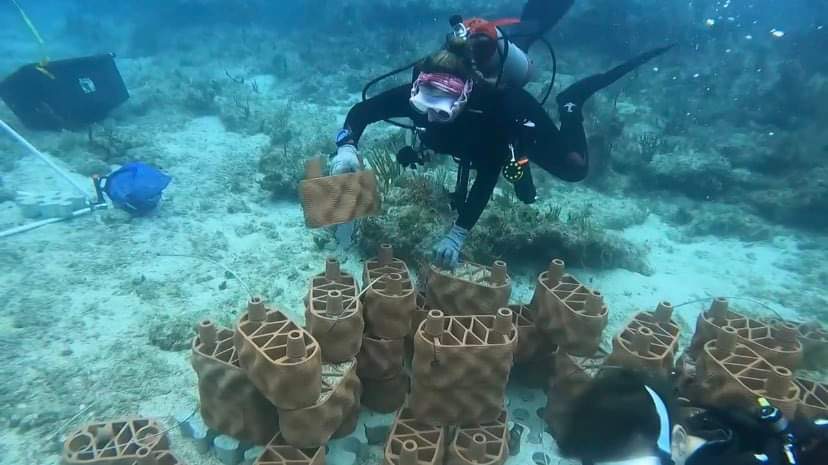
And that was our time in St Croix and the US Virgin Islands over. We had to take two ferries to get back to Tortola, the island in the BVIs where Amy lives, travelling via St Thomas. We arrived at Road Town, the main town on Tortola, just before the end of the work day so headed over to Amy’s dive shop to see who was around and could give us a lift home. Amy lives with some of her colleagues who all work for We Be Divin’, a dive shop who run private excursions, mostly for people coming in on cruise ships. All the girls who work at We Be Divin’ also work for Beyond the Reef, a marine conservation non-profit working on coral reef health, building artificial reefs, doing cetacean surveys, beach clean ups and community outreach. They work closely with another business of the same owner, Commercial Dive Services, doing things like ghost net retrieval. It really is amazing the work that Beyond the Reef does. Amy had only been there for a couple of weeks when I was visiting so she was still settling into her job but since then, she’s been regaling our family group chat with envy inducing stories and photos of the kinds of things she is doing every day. More importantly, this is the kind of work that she has always dreamed of doing and that she has worked so hard to get to do and she deserves this so much. I was so happy to see her in this environment, flourishing and thriving, living her dream.

Amy lives on the other side of the island from Road Town but it’s only a ten minute drive or so. We got a lift home with Buzz and Margy, Amy’s flatmates/colleagues, and Margy’s adorable dog Starboy. The bay where they live is absolutely insane, I can’t believe that’s where she lives. It was sunset as we were coming down the hill into the bay and the view was incredible. After a fairly long travel day, we were both tired so we made dinner, chilled out and Amy gave me some of the things she brought me from home! This included some toiletries top ups that I can’t get in Costa Rica, some photos and a chocolate orange that my mum sent me because she always gets me one for Christmas!

Amy was still having to work while I was there so there were some days that I had to entertain myself. My first day on Tortola was one of those days. I got a lift into Road Town with Amy and settled in a coffee shop for a while. After having lunch with Amy, I decided to try out these open air truck tours that are mostly aimed at cruise ship passengers. When it came to the truck tour, I paid $25 for the 2 hour version, deciding to skip the beach stop that adds an hour and an extra $5. This ended up being a good decision because the beach stop is right in front of where Amy lives so I could go there for free whenever I wanted! The tour itself was fine, there was some commentary from the driver but even with his microphone it was hard to hear. The views were of course stunning but it ended up being a loop down to where Amy lives and back to Road Town so I had driven most of it before. At the end of the day, it was something to do and I saw a bit more of Road Town as well but it wasn’t a highlight of the trip by a long stretch.

Instead of going with Amy the following day, I decided I wanted to have a beach day to myself. Who can blame me on such a beautiful island! One end of the beach is super touristy, full of cruise ship passengers most days, with sun loungers, umbrellas, bars and restaurants. The other end of the beach however, on the other side of a small pier, is an untouched stretch. Beautiful white sand, no big waves, a few palm trees for shade and barely ten other people there throughout the whole day!

One of the benefits of having a sister whose job it is to go diving? Sometimes you get to dive for free with her! In this case, I didn’t actually end up diving with Amy because she had gotten an ear infection after our dives in St Croix, but I got to go with some of her colleagues and some volunteers on Beyond the Reef’s coral health surveys. After a quick lesson on the boat, taking me through a few of the most common types of coral, it was time to dive and have a go at identifying them. I was surprisingly good! Unfortunately a lot of the coral is unhealthy, bleached or dead but a lot of Beyond the Reef’s work, and particularly Amy’s part of that, is to monitor and treat coral. We did two dives before heading back to the shop to find Amy and go home for an afternoon on the beach.

Amy was working on Hogmanay (New Year’s Eve for the non-Scots in the room) so I had another chill day in the flat, not so much on the beach because it was drizzling a little. I was fine with a relaxed day though because we had big evening plans! Jost Van Dyke, one of the other main islands, is apparently one of the best places in the world to celebrate the New Year. Along with Amy’s flatmates, we had bought tickets to the main celebration that happens at a bar called Foxy’s. The ticket was $70 which is a bit expensive but the specific ticket we bought included the return ferry ride from Tortola which is $40 so maybe not as bad as it seems. It also meant I got to see another island, even if only for a few hours and in the dark. Foxy’s is a great big bar but the party was in a large area out the back. There was a big stage and throughout the night there were various musical performances from DJs and notably a great band who had really committed to the vague Game of Thrones theme! I enjoyed their performance the most, lots of rock songs and the keyboard player was Scottish! Just before midnight, bottles of water were handed out so that we could welcome the new year in ‘carnival style’ in their words. That meant opening the bottles and spraying the water over everyone around you! The night was great but we headed home at 2.30am so that we weren’t stuck waiting for the next ferry at 5am. There’s not much to report from the first day of 2024 – our biggest achievement of the day was getting down to the beach for a swim!

I had one more beach day to myself while Amy was at work but she had taken my last full day off so we could spend it together. We were ticking off another island, heading to Virgin Gorda to meet up with Amy’s friend who works at a dive shop there and to visit the Baths. These are unique geologic formations and are in one of BVI’s national parks. A series of large granite boulders nestled in between two beaches harbour small lagoons beneath them. There is a one way loop that will take you down to one beach, then through the baths themselves and out onto another beach that is back near the entrance. We had a swim at the first beach and then got caught in a little queue to go through the baths but there were worse places we could have had to wait. Going through the caves involved a bit of clambering, ducking under rocks, wading through water, going down ladders. We had a bit of time at the beach on the other side and then got some lunch at a restaurant at the entrance. I had a Caribbean dish called roti which was a curry stew wrapped in a flatbread which was delicious.

Before I wrap this up, there’s a few random but interesting things I noticed while in the Virgin Islands (and a few observations from Amy as well) – in the Virgin Islands they drive on the left but most of the cars are American so the drivers are also on the left side. People are very friendly and saying hello to anyone you pass in the street, whether you know them or not, is common. It’s also common to use ‘good night’ as a greeting in the evening whereas it’s usually something I would say as a goodbye. Despite this friendliness, customer service is not great. Travel between the islands is expensive, $40 return for a 20 minute ferry to Jost Van Dyke or a 30 minute ferry to Virgin Gorda. There is obviously a large ‘expat’ community but particularly in Amy’s work, it’s overwhelmingly South Africans and Filipinos. In the BVIs, rum is not taxed so the pours are heavy!

Cruise ships are prevalent, I saw them both in Tortola and St Thomas. Tortola is a big cruise ship destination, there was only one day during my stay when there wasn’t a single cruise ship in port and even the girls that live there were surprised because it’s such a rare occurrence! It’s like an invasion on docking days and the people coming off are not necessarily my favourite type of tourists. I think the nature of cruise ship travel can be a little superficial, mostly because of the time constraints. Yes, you get to experience a range of places in a short period of time but you often only have a handful of hours to see a new place. I found that this made some of the cruise ship passengers very impatient and borderline rude as well as entitled. This is of course not the case for everyone but it’s always the worst ones that you remember.

Something that Amy has talked to me about is the levels of wealth that she has noticed the longer she’s been there. The relative remoteness of the islands makes it expensive to get there (I can attest to that!) and once you’re there, costs are high because a lot has to be imported. In terms of visitors to the islands there are different levels, ranging from those coming in on the cruise ships, people staying on the islands and day chartering a boat, those who charter boats for the duration of their stay, crewed charter boats and even mega yachts. There is also a large wealth disparity between the ‘expats’ that move there from the UK, US or elsewhere and the locals.

It was a jam packed two weeks but I was glad that we were able to make it happen. There was a short period of time when I wasn’t sure if Amy was going to get there in time because of the waiting period for her visa. Even though she had arrived so soon before I visited, I was glad to be there. Now I feel I have an insight into Amy’s life, her work and her new home and I feel like I can follow along with her stories. I also know exactly how hard she has worked to put herself into this position and the sacrifices that she’s made. Being able to see those be worthwhile was incredible and I’m enjoying watching her build her life there.

Morocco: The Sahara

Typing this is bittersweet but we are on to the final part of my Morocco series. The past few blog posts have been some of my favourite to write as I remember one of my favourite trips. I hope I’ve been able to impart at least some of my love for Morocco onto you and that you might consider Morocco for a future trip! If you do, let me know and I’m happy to talk to you about it, give you even more recommendations and hell, even go with you. Despite all my love for Morocco and the incredible time I had there, the fourth and final part of my week in Morocco is a little different in that I don’t have 100% positive things to say about it. I will preface what I’m about to tell you with the fact that none of that is Morocco’s fault. It comes down to trying to see as much as I could in the limited amount of time that I had and maybe pushing things a little far.

With all that out of the way, and as you can probably tell from the title, I spent my last few days on a trip to the Sahara desert! This was something that Hiba and I had decided on together as it would be something new for her as well. We looked at a couple of places but we were limited by the amount of time I had. When we were planning the trip, I only really had one night to spare for a trip to the Sahara if I was to fit in everything else that I wanted to do. This ruled out a few places such as Merzouga, a town deeper into the desert close to the Algerian border. We considered Ouarzazate, known as the Hollywood of Africa but it’s only really on the edge of the Sahara and we wanted something more immersive (more on Ouarzazate later though).

We had originally booked something through Tripadvisor but when we got to our riad in Marrakesh, Hiba and Rania got chatting to the guy checking us in who was able to get us a similar trip as we had booked but for a bit cheaper. I think we were reassured by being able to talk to someone about it, someone who was really welcoming to us in the riad and had already been super helpful. We were also able to see some pictures of the camp. We decided to go for it because we were getting good vibes from him and I’m all about listening to people in the place, in the hotel or hostel because they’re the ones that know. I’m sure he got something out of it as well but I can’t blame him for seizing the opportunity!

So Thursday rolls around, five days since I arrived in Morocco, and we had an early start – 6am to be exact. We had spoken to the guys in the riad the day before and they had said someone would be up to prepare breakfast for us and then take us out to meet the trip organisers. After a slightly stressful start because our contact in the riad overslept after a late check in the night before, we made it to our tour van and met our driver and the other people on the trip. It was a very German heavy group but there was also a French mother and daughter couple, a Portuguese and French couple, a half-Belgian half-Moroccan guy and an Argentinian plus this Scot and my two Moroccan companions.

We were heading out of Marrakesh by 8am and drove for a few hours until our first stop. By the time we stopped we were in the Atlas mountains, a mountain range that stretches for 2,500km across Morocco, Algeria and Tunisia. It was obviously a popular spot because there were a lot of other tour buses there but not much about other than a little cafe and a balcony with a gorgeous view. I took advantage of it because as soon as we were back off in the bus I was incapable of staying awake. I think the last few days were catching up with me and a year of travelling on chicken buses through Central America means that I’m pretty adept at falling asleep in moving vehicles, however uncomfortable. After another couple of hours of driving, we had another brief stop to stretch our legs at Tizi n ‘Tichka, a well known mountain pass that is 2,212m above sea level. Apparently Tizi n ‘Tichka means ‘difficult mountain pasture’ in Berber which is a fair enough designation. It had absolutely spectacular views though.

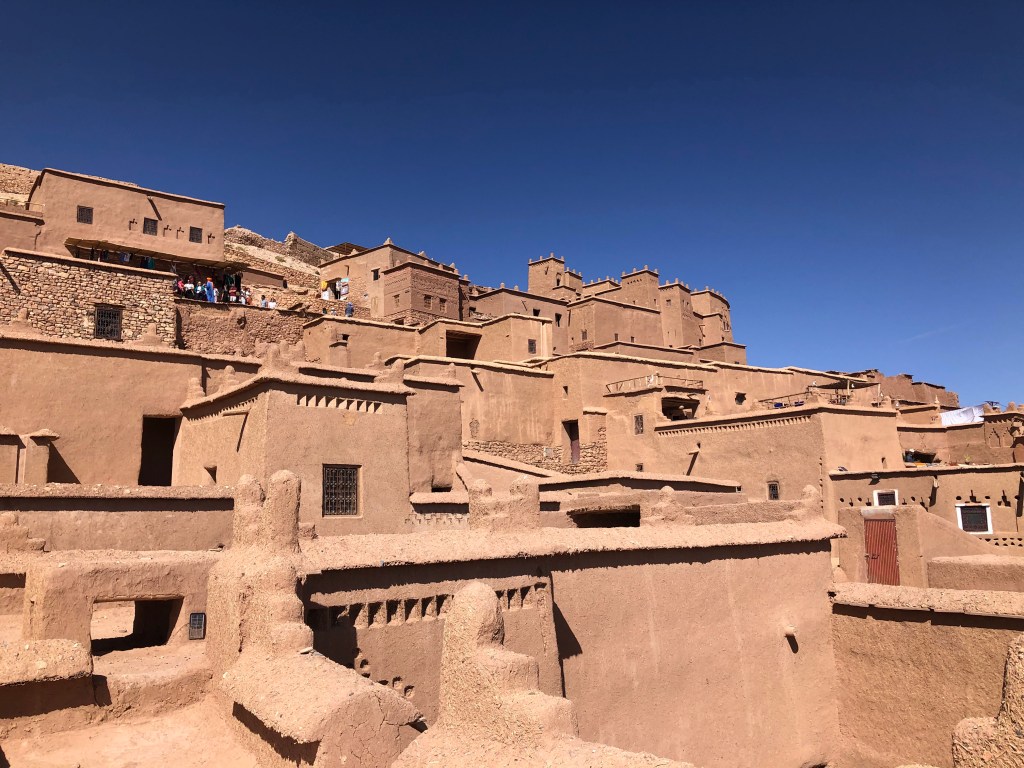
Around 12.30pm, so four and a half hours into the journey, we reached our first proper stop. Aït Benhaddou has been a filming location for many films and TV series including most recently Game of Thrones but also Lawrence of Arabia, Asterix and Obelix, Gladiator, The Mummy and Indiana Jones. At one point it was also a stop along the caravan route from the Sahara to Marrakesh. Traders would spend a few nights there before going on to traverse the Atlas Mountains via the mountain pass of Tizi n ‘Tichka, where we had passed through earlier. Nowadays the ksar (a fortified village) still has a few families that live there, benefiting from the tourism related to the film industry. The old village lies across the dried up bed of the Ounila river, across from the new town where most people live now. Included in the price of our tour to Zagora was a guide to take us around Aït Benhaddou. He spoke incredible English, French and Spanish as well as Arabic and some Berber, all of which we heard on our tour. We were taken into a traditional Berber house and able to look around and also stopped in at an artisan’s workshop. He was using saffron and tea to paint a barely visible scene onto the paper. This is then heated over a flame, bringing out and fixing the colours onto the paper. The pictures often depict kasbahs or ksars, desert scenery and camels. If you bought one you could also have your name added in Berber.

Aït Benhaddou

I’ve mentioned Berber a few times in the past few blogs, most notably when we visited the Berber museum in the Jardin Majorelle in Marrakesh. Berbers are the indigenous people of the Maghreb region in North Africa, covering what is now Morocco, Algeria and Tunisia, They are also known as the Amazigh as is their language. The Berber language is actually a collection of languages that is written using the Tifinagh script. An interesting crossover is that the indigenous people of the Canary Islands (where you’ll find Tenerife, 100 km west of Morocco), the Guanches, are believed to have spoken a now extinct branch of the Berber languages. Morocco has the largest number of Berber speakers with an estimated 24% of the population speaking at least one Berber language. Berber suffered during the post-independence years as Morocco and other North African countries tried to replace the influence of France and the French language with a policy of ‘Arabisation’ during which time all forms of Berber were oppressed. Berber is now an official language of Morocco. To give you an idea of what Berber looks like written down, this means ‘Morocco’ in Standard Moroccan Berber, also known as Standard Moroccan Amazigh or Tamazight – ⵜⴰⴳⵍⴷⵉⵜ ⵏ ⵍⵎⵖⵔⵉⴱ.

After Aït Benhaddou we carried on to Ouarzazate which we would come back to the next day. For now it was only a quick lunch stop. It wasn’t the best food that I had in Morocco, a bit of a tourist trap judging by the high price and lower quality than I expected. I did get to try couscous though and tick that off my Moroccan food list although I’ve eaten it before and it wasn’t my favourite, I have to say. After a quick lunch it was back in the van and a race to our final destination before sunset.

Moroccan couscous

We were running a little behind so we only saw the sunset from the van and arrived at Zagora in the light of twilight. I personally hadn’t realised this but the final stage of our journey was going to be made by camel! We could only take what we could carry so just what we needed overnight. We were able to leave our bigger bags in the van with our driver who wasn’t coming to the camp and would look after them. If you are going to do something like this, I would probably recommend leaving your bigger bags back at your riad or hotel in Marrakesh, especially if you are going back to the same place like we were. Everything was perfectly safe the way we did it but we had been given the option to leave it at our riad and I think that would have been easier in the end.

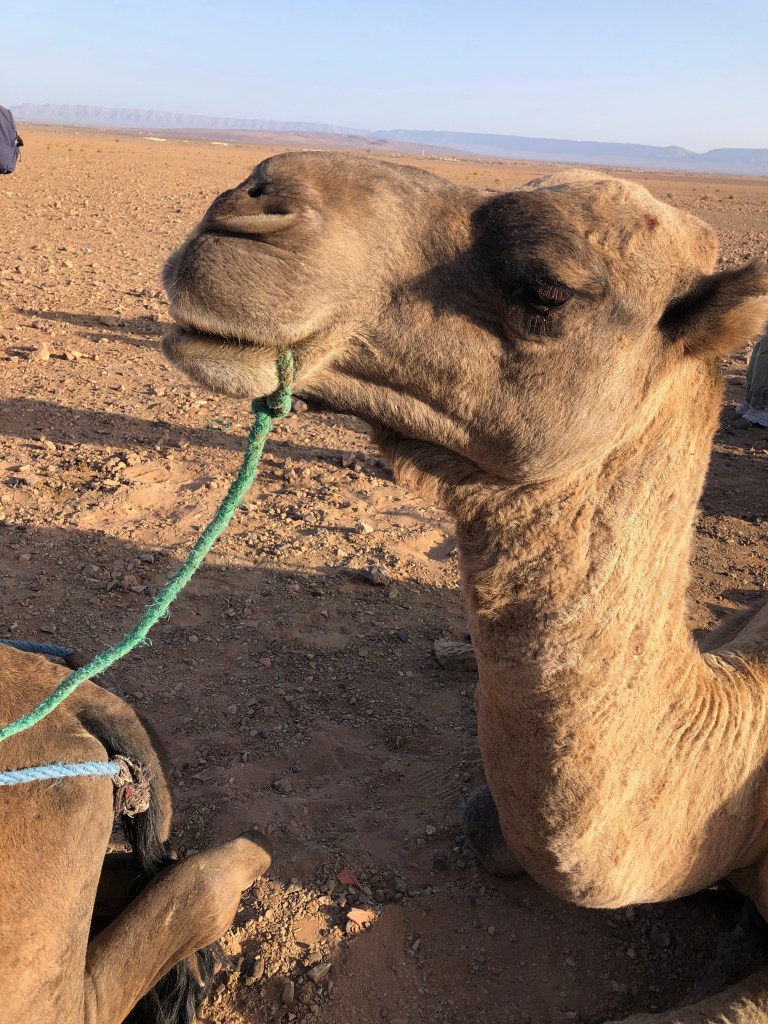
Here I have to admit that I’m not the biggest animal person. I have slowly come around to cats in the last few years after our wee girl Anna wormed her way into my heart and anyone that knows me or follows me on Instagram knows that I’m OBSESSED with my dog (and all dogs) but aside from them, most animals make me a little nervous. Enter a two metre tall Dromedary camel that was going to carry me to our camp. Getting on them was fine but the lurching movement when they stood up almost had me calling the whole thing off. The movement of the camel once we started moving was actually very jarring, nothing like what I remember riding a horse to be like from my (admittedly limited) experience. Juggling my hastily packed assortment of tote bags also proved difficult and I almost dropped them several times. In the growing darkness, I feel like that would have been the last time I would have seen them. I was so uncomfortable, borderline in pain, and then I heard someone ask how long it would take to get to camp and I genuinely thought it must be a joke when they replied an hour! No joke, but I was finally able to get my bags in a better position. Comfortable might be taking it too far but I was definitely more at ease.

We finally reached the camp after passing several others on the way, my hopes rising each time a collection of lights grew larger and then sinking again as we passed them and continued on. Finally we did approach our camp and we were able to get off the bloody camels. One of my knees had started hurting from just hanging there and my inner thighs were screaming from having to grip on. One of the things going through my head during the journey was that, for me, riding a camel was really a once in a lifetime experience – as in, I was only going to do this once in my life because there was no way I was ever going to get back on a camel ever again!

Our camp was simple but homely, a circle of tents for sleeping, a larger one for eating and a few carpets laid out in the middle where we could gather. The toilets were just outside of the circle. The group from our van were joining up with another tour group in the camp that were already sitting having some tea. We joined them and got to know each other a bit more as well as meeting the hosts of the camp. It was already 8pm by the time we arrived so it wasn’t long before we were all taken into the dining tent for some food. A Moroccan classic, we had soup to start followed by chicken and olive tagine with potatoes, vegetable and of course some bread. I’ll speak for myself, Hiba and Rania but after a 12 hour day, at least 8 of which were driving or riding a camel, we were very tired and getting a bit delirious. I won’t say it wasn’t fun, as we broke down in laughter over the smallest thing, the way only very fatigued minds and very close friends are able to. I was on the verge of going to bed when instead we were ushered outside to a bonfire and our hosts with their musical instruments. We enjoyed the music for a while and danced a bit before we got to have a go on the drums as well! We had a little walk outside of the camp to look at the stars away from the light before calling it a night.

Obviously it gets quite cold at night in the desert, at least compared to during the day, but I wasn’t too bad. I slept just in a t-shirt and shorts but still wrapped up in a big blanket and I was fine! I started to get cold just before we had to get up at 7am but I pulled on some trousers and a jumper and it was all good! Our group had breakfast, a little spread of bread, jam, cheese, boiled eggs, coffee and tea before packing ourselves up. Now the night before I had thought that I would never, ever get on a camel again but sleep had made the pain and discomfort more distant. We had been promised that the ride out of camp would be half the length of the night before, so only half an hour, and when else am I going to get to ride a camel? This time though, there was a camel with panniers where I was able to tuck one of my wee bags so that I could arrange myself more comfortably. I’ve already said that I would recommend leaving any big bags or suitcases in Marrakesh but for the bag you bring with you, make sure it’s a backpack! You need something that doesn’t require any hands to hold on to, unlike a tote bag, so you can focus all your energy on not falling off! Most people had had the same change of heart as me, after feeling the same as me the day before, although there were a couple of people that decided to take the journey on foot.

We rode back out to meet our driver and the van, ready to start the 8 hours of driving back to Marrakesh. We left around 8am again and were going for several hours with just a few short bathroom breaks before arriving back in Ouarzazate around 12.30. This time we got to see a little bit more during a short walking tour with a guide. Ouarzazate is known as the ‘Hollywood of Morocco’ because it is home to a number of film studios. It acts as a base for productions filming in Aït Ben Haddou for example. It also has the nickname of the Door of the Desert because of its position at the far edges of the Sahara and 70% of the population speaks Berber. It is a popular tourist destination, is known for the Ouazgita carpets made by Berber women and plays host to the ‘marathon des sables’, a gruelling 6 day, 250km race across the desert.

We wandered through the medina where the guide talked to us about the castle and the old town. We stopped in a women’s artisan association as well and had some tea. After our tea and being entertained by an absolutely adorable cat, we went down into the shop and got to see some of the carpet designs. Carpet weaving is a traditional Berber art made by the women. It takes hours and hours especially because they only do a couple of hours at a time because it’s bad for their eyes. I did think it was interesting that even in an association of and for women, the only woman we saw was the one that brought us tea. It was men that showed us the carpets and explained them to us. We had a look around the shop and the carpets were gorgeous and they had some really nice earrings as well but it was all pretty expensive.

It was back in the car and another hour or two before we arrived at our lunch spot. It was the same kind of place as the day before, definitely made to serve these bus trips with a set menu price. However it was a little better in terms of quality than the other place. Between the three of us we split a mixed kebab plate and a kefta plate. The kebab plate had two chicken skewers and some keftas which are basically little beef meatballs with chips and salad. Not the best and not the worst thing I ate during my trip. We were back in the bus with a few more toilet stops before getting back to Marrakesh around 7.30pm, about 36 hours after we left. We got dropped off first and hobbled our way back to Riad Chennaoui. After hours and hours in the van and with aching muscles from the camel riding, all we wanted was to lie down. It was our last night in Marrakesh and my last night in Morocco so we felt like we needed to make the most of it but once we got back, there was no way we were leaving again. Instead we ordered a pizza and called it a night.

In all honesty, I’m torn about whether this trip to Zagora was worth it. The experience of being in the camp in the desert and the stops we had in Aït Benhaddou and Ouarzazate were a lot of fun and very interesting. On the other hand, the journey on either side was SO. LONG. We left Marrakesh at 8am and arrived at camp at 8pm. We had stops but at least 8 of those hours were driving or on camel. And then the same to get back to Marrakesh. It was a lot. I think if we had stayed a day in the camp before going back it would have been better. There was also the option of going to Merzouga which is 300km or 4 hours further into the Sahara but that was a multi-day trip which I didn’t have time for. I already know that I’ll be back to Morocco and maybe then I can do a longer trip at a slower pace but I don’t think that trying to fit it into one night away really did it justice.

Sara in the Sahara!

After one more night in Marrakesh, it was time to go home. I had a slightly rushed final morning as I wanted to nip out and get a few souvenirs before my taxi to the airport that the riad had helped me organise. It was sad to say goodbye to Hiba and Rania because we’d had such an amazing week. It was so nice that me and Hiba were able to pick up where we left off and then me and Rania have formed such a good friendship in such a short amount of time.

My return journey was via London with a pretty long layover but it was surprisingly nice to be back in an English speaking country, however briefly. I arrived back in Paris around 10.30pm so it wasn’t possible for me to get back to Mulhouse on the same day but luckily I have a very lovely friend, Lizzie, who has a very lovely couch that I was able to crash on. It was nice to catch up with someone else, even if I was barely there for 12 hours, before finally arriving back in Mulhouse the Sunday after I left.

I can’t believe that everything included in the last four blogs all happened within a week. Despite how much I’ve enjoyed writing them, I worry that I haven’t and won’t ever be able to fully convey how incredible and special this week was. It wasn’t just that the food was delicious (maybe more so than I expected) or that the history was fascinating, the culture was rich and vibrant, the people were some of the most welcoming that I’ve ever met. It was so much more than that. I had been thinking about this trip for three years since I met my friends in China in 2019. A lot has changed in the world since then but I’m so glad to have met them and be able to pick up where we left off as well as have them show me around their home. Reconnecting with Cheima, Aymen and particularly Hiba, my beautiful, kind, generous and funny tour guide for the week, as well as becoming fast friends with Rania was the heart and soul of this trip and to me is really what drives me to travel as much as I do. It’s all about making, and then sustaining, these connections. As I look forward to the travelling that is to come in 2023, a lot more of what I have planned is built around people rather than places and I’m thrilled about that.

I have this philosophy when it comes to saying goodbye. I used to get really upset or emotional when saying goodbye to something, somewhere or someone that means a lot to me. The first time I remember this was at the end of a month-long trip to Costa Rica when I was 17, a trip that was a catalyst for pretty much everything that has happened since. I was distraught at the thought of leaving when so much had changed since I had been there, when I had changed so much since I had been there. Now, that is a rare thing to happen. I usually don’t get upset or even vaguely teary eyed because I’m at the stage where if somewhere or someone is important enough to me that I might get upset at the thought of leaving them, then I know I will see them again. I know that I will be back to Morocco. There’s so much more to see! And whether they like it or not, these people are stuck with me for life.

Morocco: Marrakesh

Is everyone sitting comfortably? Have you got a cup of tea? (Preferably mint with lots of sugar?) Settle in because this is going to be a long one but a good one. I’m onto the two days that I spent in Marrakesh, the most touristy of the cities I visited in Morocco but also potentially my favourite. There was so much to see and do, so many sides and personalities and it felt welcoming to tourists while at the same time having held onto space for its own people. It can be a hard balance to strike in a place as popular as Marrakesh.

Despite the fantastic time I had here, we didn’t get off to the best start. Hiba was joining me for a few days in Marrakesh as well as Rania, Hiba’s friend who had come to Rabat with us the day before. We were getting the train from Casablanca to Marrakesh, the reverse of the journey that I had made a few days earlier. Unfortunately our train was delayed by an hour which we only found out once we had arrived at the station. We did eventually make it to Marrakesh with no further problems and found our riad, tucked away in the pedestrianised streets of the medina near Place des Ferblantiers and Bahia Palace. Once again, I have nothing but good things to say about Riad Chennaoui. We were given a lovely room with a grand double bed and three single beds (one extra) plus a small ensuite bathroom. Our room was right off the main courtyard but we never had any problems with noise or disruption. It came with breakfast included which was a piece of m’semen, beghrir (a semolina pancake with a honeycomb pattern) and a little pastry or muffin with honey, jam and butter plus coffee and orange juice on the side. The staff were also lovely and really helpful!

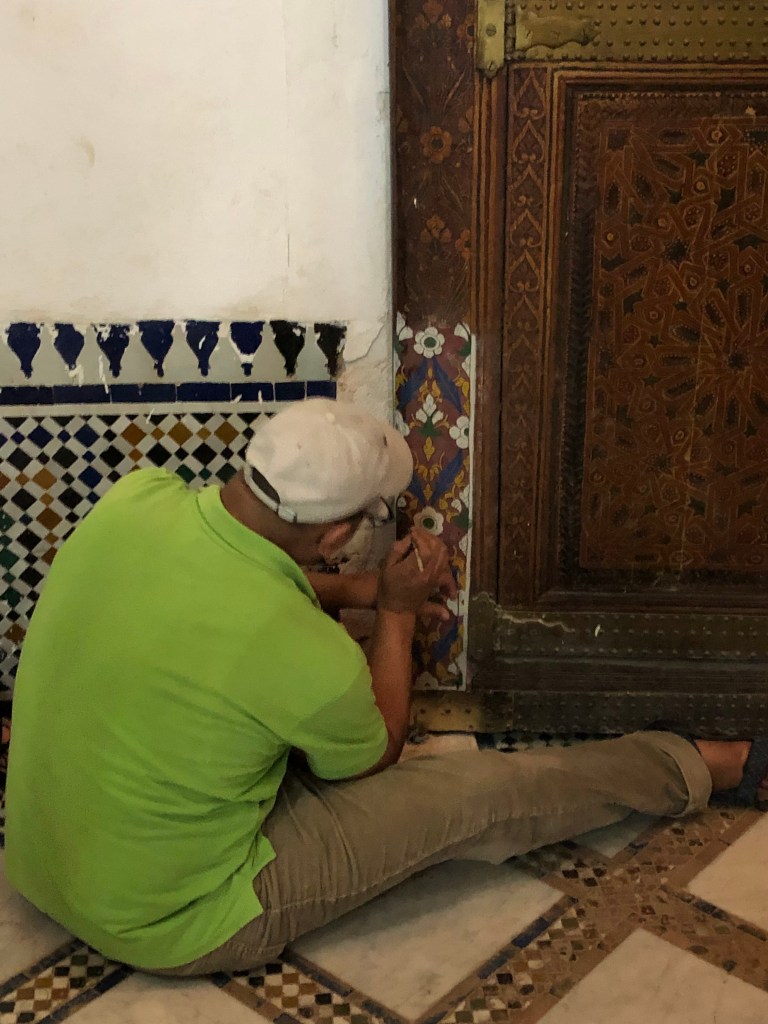
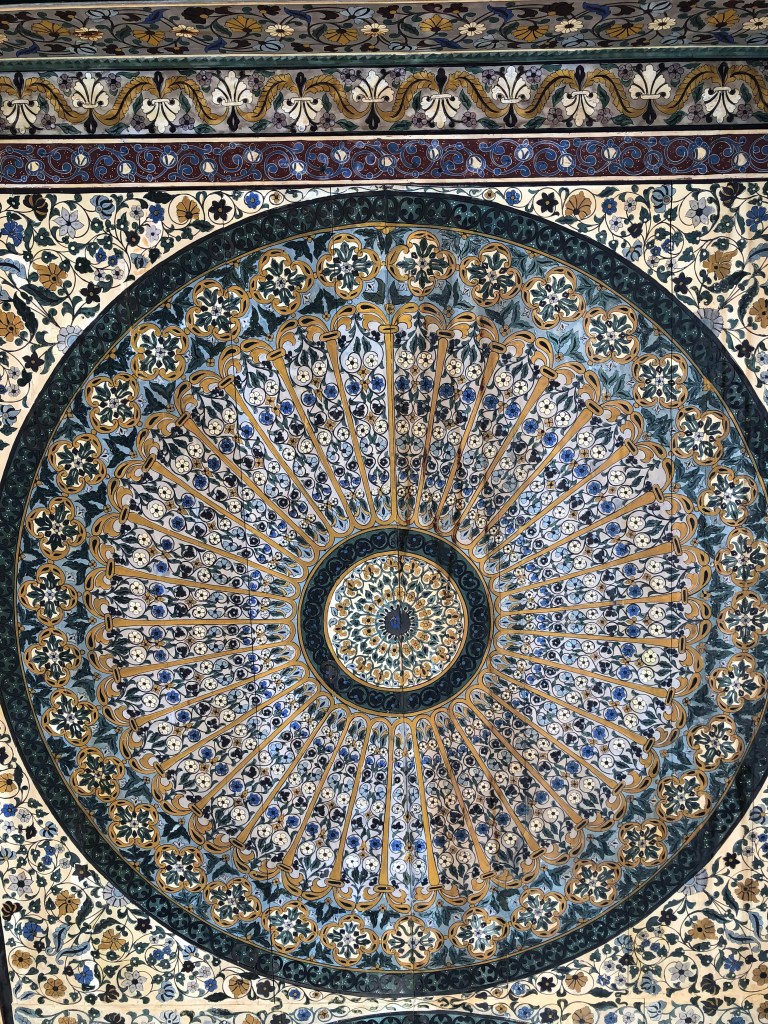
After we got settled in and refreshed a little, we headed out to explore the city. Just a few minutes away, outside the walls of the pedestrianised medina, is the Bahia Palace. Construction started in 1866 by Si Musa, a grand vizier of sultan Muhammad ibn Abd al-Rahman, and it was added to the collection of royal palaces in 1900 after the death of his son, Ba Ahmed. Nowadays the palace is one of Morocco’s most popular tourist attractions but is also still occasionally used by the king to host foreign dignitaries and hold events. The palace covers 37100m² and has 5 hectares of green spaces. The palace is loosely a series of courtyards with a number of rooms off to the sides. The final one is the Grand Riad, a garden within the walls of the palace and the oldest part of the palace, accessed through the Grand Courtyard. There isn’t a clear path through the palace because of the way that it was added to over the years, which can be a but confusing but also means that there are rooms to discover tucked around each corner. The tile work, the ceilings, the stonework, the paintings, the building were just beautiful. We actually saw some of the intricate patterns on the doors being repainted. It was in the Bahia Palace that I decided that one day I’ll come back to Morocco with my mum because I think it’s the kind of place that she would love, for the people, the energy and the beautiful buildings.

Just outside of the Bahia Palace compound but before Place des Ferblantiers is the Mellah market. The Mellah was the Jewish neighbourhood of Marrakesh (as well as in other Moroccan cities) although there is not now a large Jewish population there. At the entrance of the Mellah market is the spice souk with great towers of spices. You can also find tea merchants, fabric shops and even see argan oil being made.

From the Mellah market we walked further into the streets of Marrakesh, passing through Jemaa el-Fnaa which is one of the main squares of Marrakesh that comes alive in the evening with food sellers and other things. It was only mid-afternoon so things were still being set up but we had plans to come back later. Instead we were heading to one of Hiba’s favourite spots, Café des Épices. The food there is a little less traditional although there are still some Moroccan dishes and influences on the menu. I tried harira, a soup with tomato broth, rice, fava beans, lentils and chickpeas but the stand-out was the fresh strawberry juice. If none of that appeals to you, Café des Épices has a stunning rooftop where you can sit enjoying your food or drinks. After we had eaten, we relaxed there for a while because our morning of travel had caught up with us a bit. We were there around sunset which was the perfect time, watching the golden light spread over the rooftops of Marrakesh.

Feeling recharged, we headed back to Jemaa el-Fnaa for the night market which was in full swing by this point. Having already eaten, we weren’t looking at the food stalls too much but Hiba did spot one dish that she wanted me to try – the Moroccan version of escargot, snail soup. Now, the only bit I really like in escargot is the fact that it’s slathered in garlic butter. Not the case for babbouche. There are spices such as thyme, aniseed and mint involved but they don’t overpower the snails in the same way. Suffice to say I wasn’t a massive fan. Hiba also told me that she had a couple of other surprises for me but wouldn’t tell me what they were while we were walking around. There is so much energy in that square, so much hustle and bustle with sellers, henna artists, musicians, dancers and storytellers. All of a sudden, out of the incredible chaos, what appeared at my shoulder but a little monkey! Technically it was actually a Barbary ape and it wasn’t alone. You’ll find them and their handlers dotted around the square as well as snake charmers.

While doing some research I found out that Jemaa el-Fnaa is the reason for the creation of the UNESCO project ‘Masterpieces of the Oral and Intangible Heritage of Humanity’. The presence of the musicians and storytellers was being threatened by development encroaching on the square. The project was created to preserve their legacy and acknowledge the importance of this kind of cultural space. Just walking around, even without knowing this, you can feel the energy permeating throughout the square. The name of the square could have many translations ranging from ‘the gathering or congregation area’, ‘the assembly of death’ (possibly referring to the fact that executions used to take place there) or ‘the mosque at the end of the world’ (referring to a destroyed mosque nearby).

Jemaa el-Fnaa

At Hiba’s suggestion we decided to do one of the carriage rides that leave from next Jemaa el-Fnaa as a way to see more of the city in a short period of time considering we only had a few days there. It took us into the area of Gueliz, the old French district whose name comes from the French word for church, église. It has a lot of upscale restaurants and bars, including some where you can drink alcohol, as well as a large casino and some famous hotels including La Mamounia where a lot of celebrities and dignitaries stay when visiting Marrakesh.

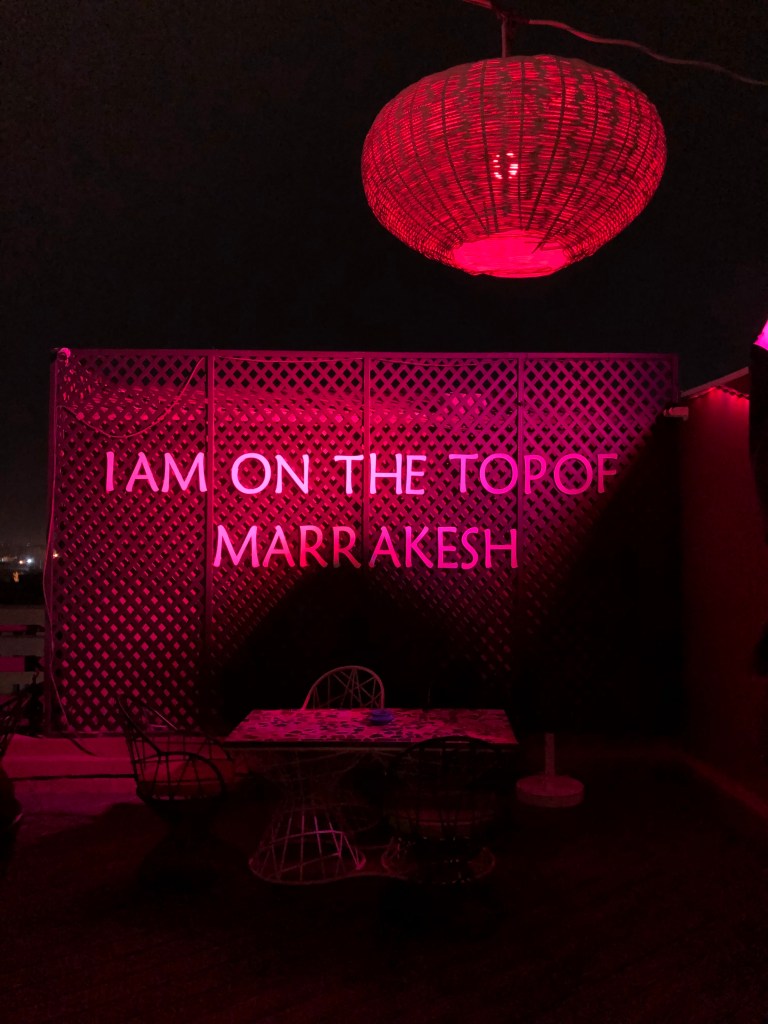
After we finished our tour we ended our night by going back to Gueliz to a place called Sky Bar, next to the famous Cafe Atlas, one of the oldest cafes in Marrakesh which has been open since 1940. Sky Bar is one of the limited places in Marrakesh and Morocco in general where you can drink alcohol. Alcohol is only allowed in certain licensed bars and drinking in public is illegal. We enjoyed a couple of drinks there, looking out over the lights of Marrakesh with some good music playing in the background. It was a nice chilled end to a busy day. It was lovely to get to know Hiba’s friend Rania more during the day but especially while we were at Sky Bar. After one day together it already felt like I’d known her for much longer. I knew that I would get along with Rania just by virtue of her being best friends with Hiba. Hiba is someone who attracts good people and keeps the best around her. I’m honoured and flattered to be one of them.

Sky Bar

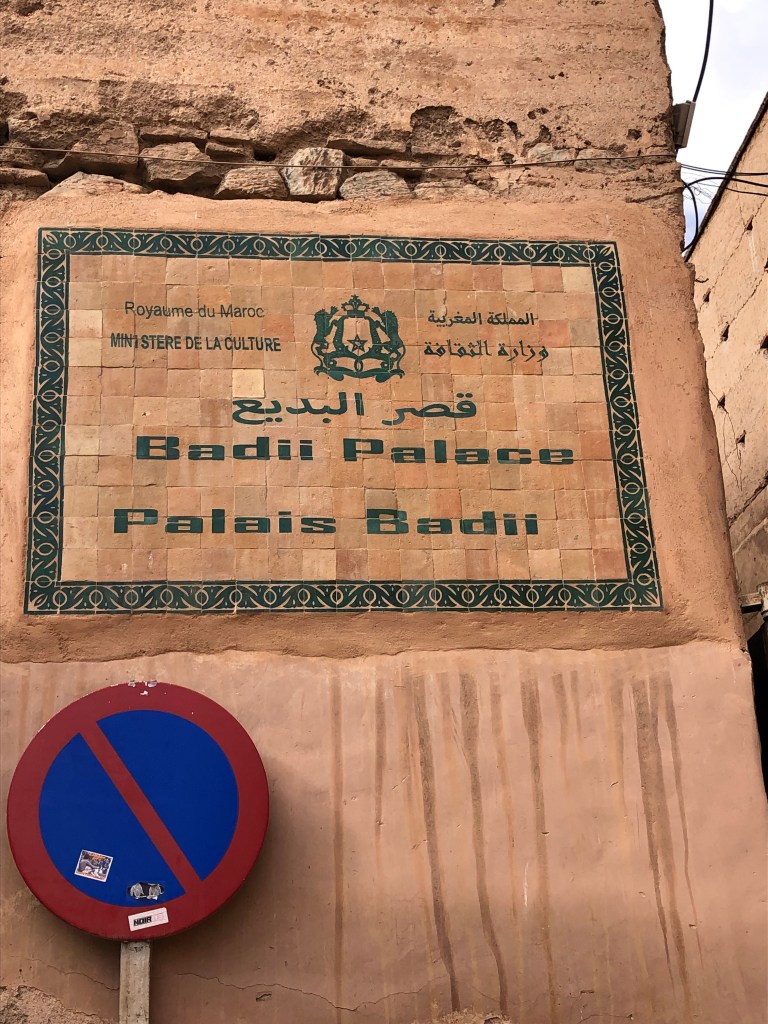
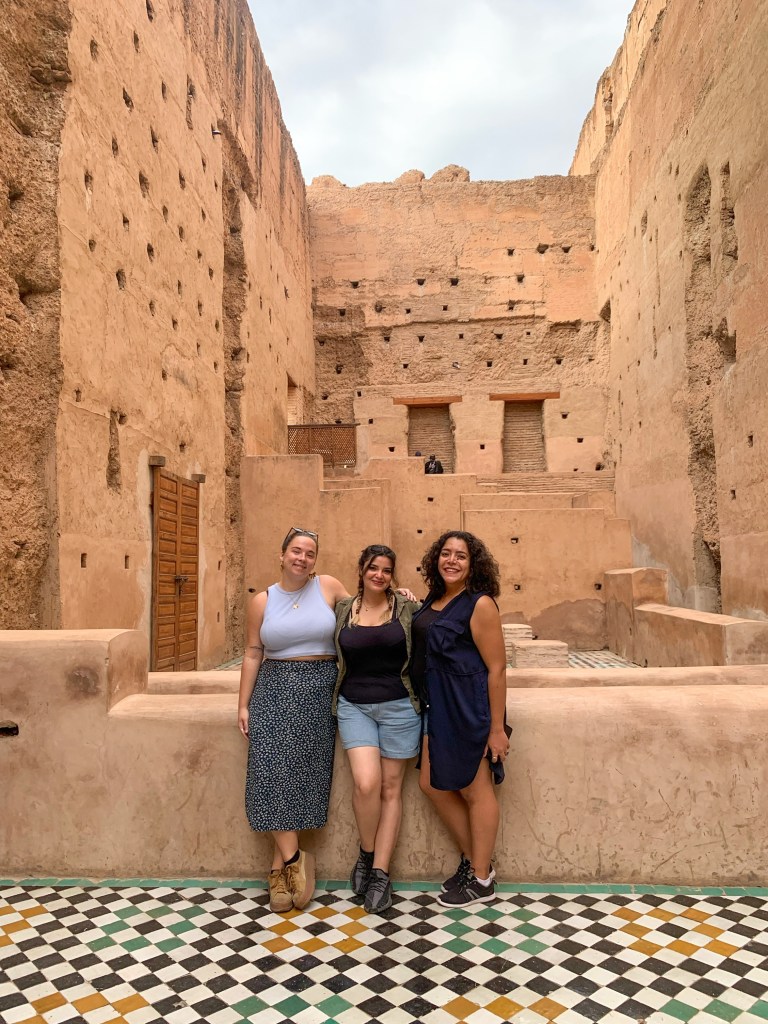
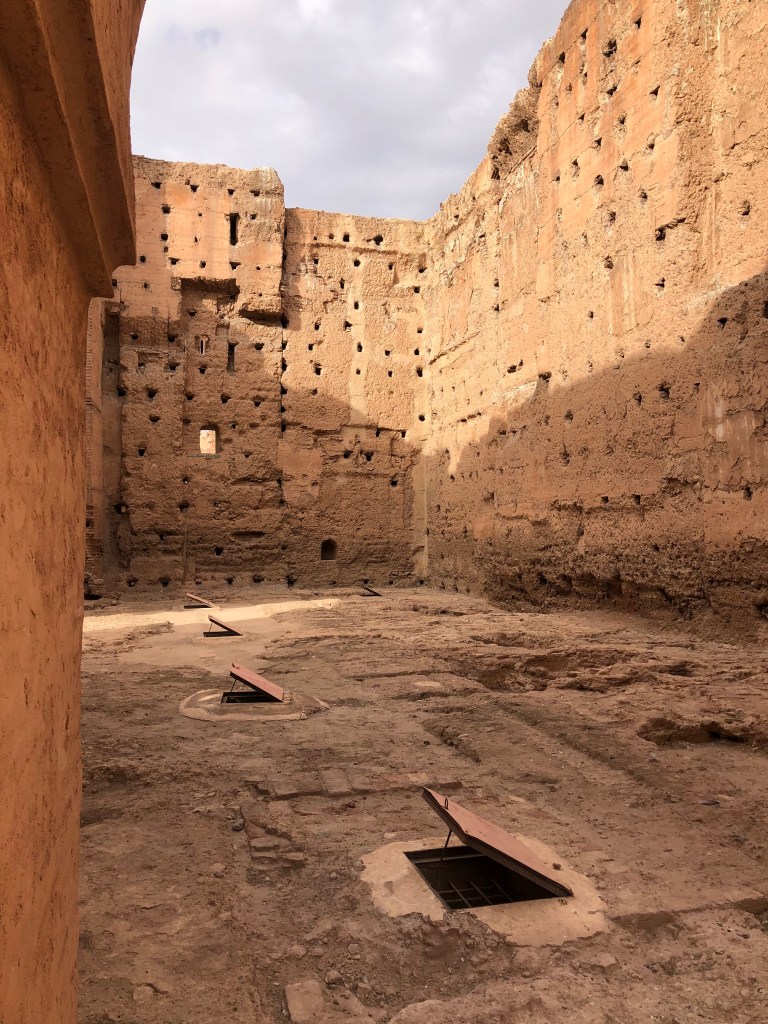
I was excited for day two in Morocco because we had the full day to explore the city and, as you’ll see, we made the most out of it. Our first stop was another of Marrakesh’s most popular attractions that also happened to be just a few minutes away from our riad – El Badi Palace. The name means the ‘Palace of Wonder or Brilliance’. The palace was where many celebrations and official events were held and was meant to show off the wealth of the sultan. It was built in the 16th century but fell into ruin just after the start of the 17th century after the death of sultan Ahmad al-Mansur, its creator. The palace is built around a large central courtyard containing four sunken pools that now contain orange orchards that you can smell while walking around which adds something a little special to the experience. The design of the palace was inspired by the Alambra in Granada, Spain. It was very different from the Bahia Palace that we visited the day before but really interesting. The space is often an exhibition space and notably has the Minbar of Kutubiyya Mosque, a piece of furniture similar to a pulpit, on display. It was very impressive! As you walk through various parts of the palace, you might notice that some of the walls have a system of square holes over them. Like many older buildings in Morocco, they are built with rammed earth, also known as pisé, which need scaffolding to support the building process. The holes are leftovers from the construction and used for renovation as well.

At this point I’m going to interrupt with a note about clothing. You might notice a bit of a difference between the outfits I wore in Casablanca and Rabat versus what I wore in Marrakesh. One thing in common is that all my clothes were light. Even though it was the start of November, temperatures were in the high 20s or low 30s. Saying that, it is better to go for bit more coverage even in the heat. Moroccans are genuinely more conservative in the way they dress, particularly in less touristy areas like Casablanca and Rabat. I wore long trousers both days and when I was wearing a sleeveless top, I also had a light linen shirt to put on top. In Marrakesh, it’s a bit of a different story. Because of the amount of tourists, it’s more common and accepted to see people, particularly women, in shorts, crop tops, lower necklines and with their arms and legs uncovered. Even Hiba and Rania, Moroccans themselves, dress differently when visiting Marrakesh than at home in Casablanca so it’s not just for tourists.

After the Bahia Palace we were going to go to the Saadian Tomb, a royal necropolis, but there was a fairly long line so we decided to skip it. I have to leave some things to come back for right? Instead we headed to the Menara gardens. It’s a big park on the edge of Marrakesh filled with olive trees and a pool with a small pavilion next to it that is considered an iconic image of the city. The Colombian singer Maluma and French rapper Gims actually filmed the video for their song ‘Hola Señorita’ here with a few jet skis in the pool!

We made a slightly unorthodox detour after the Menara Gardens to visit the Four Seasons hotel that is just a couple of hundred metres down the road. While we were in El Badi Palace, Hiba got a phone call from them inviting her for a job interview that afternoon. It just so happened that she was in Marrakesh and could do it in person! Rania and I were perfectly happy to relax in the shade on the cafe terrace, looking out on the most aesthetic pool I’ve ever seen. It was a great chance to get to know each other better while pretending to fit in at the fanciest hotel I’ve ever been to. Even better, the interview went well!

Four Seasons Marrakesh

It was finally time for lunch and we went to a place that Hiba knows to eat tangia, one of the last dishes I had to check off my Moroccan cuisine checklist. Tangia is a dish that is closely associated with Marrakesh. Like ‘tagine‘, the word refers to the terracotta cooking pot and the dish itself. It’s made of lamb shank, candied lemon, spices, garlic and water, left to cook for hours in the embers of a wood fire. They brought it out and poured it from the dish in front of us with a bit of a fanfare. It was some of the most tender meat I’ve ever eaten and really did melt in your mouth! We also had some wee salads and chips, bread of course and these amazing curried lentils. It was really good but a bit heavy, oily and greasy but in the best way. Having a smaller portion of the tangia with the sides to lighten things up is the way to go I think.

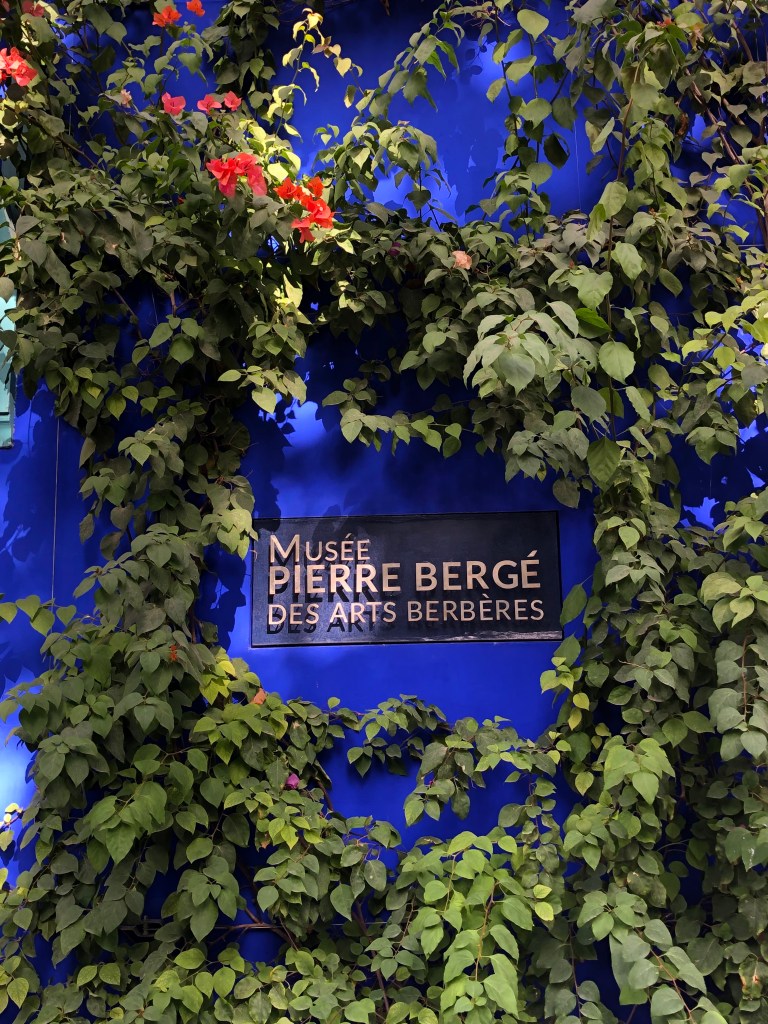
Last but not least, one of Marrakesh’s most well known attractions and one of the ones I was looking forward to the most. Even if you don’t recognise the name Jardin Majorelle, the Yves Saint-Laurent museum or some of the photos might ring a bell. The Jardin Majorelle is a small botanical garden created by Jacques Majorelle in 1923. It took 40 years to complete and also has the cubist villa in the iconic majorelle blue designed by Paul Sinoir. In the 1980’s the garden was bought by fashion designer Yves Saint-Laurent and his partner Pierre Bergé. They lived in the villa for many years until Yves Saint-Laurent’s death in 2008. His ashes were scattered in the gardens and there is a memorial there as well. There are a couple of museums on site, one in the old painting studio and villa dedicated to the culture of the Berber ethnic group and then the actual Yves Saint Laurent museum. Unfortunately it is closed on Wednesdays (when we were there) so something else to come back for. I would definitely recommend getting the combined ticket to visit the garden and the Berber museum, it was so interesting to learn about a different side of Moroccan culture. In general, it was absolutely stunning, definitely a must see in Marrakesh and Morocco at large. It was so peaceful just walking around the garden, enjoying the peace and quiet that permeates despite the large number of people visiting. Watch out for some little turtles swimming about the pool and sometimes wandering down the paths!

At this point, the three of us were flagging a bit. We had evening plans so we decided to head back to our riad for a little pit stop. Hiba had booked us a table at a pretty fancy bar for the evening to watch a live band. It also just so happened that a friend of mine that I met while volunteering in a hostel in Tenerife during the summer was also in Morocco! Syahira had been doing the same thing in hostels around Morocco but was on her last few days there and decided to spend one of her last evenings with us.

Épicurean is a bar and restaurant in Marrakesh’s casino. To reserve a table you have to be eating but it’s also a bit expensive so our plan involved a pre-reservation burger at McDonalds and then to share some starters and sides while watching the band. However, when we got there at 10pm we found out that the band wouldn’t be on for another two hours! Hiba, Rania and I had to be up early the next morning for the next and final part of our trip so after enjoying a drink at Épicurean we decided to head back to Sky Bar, where we had been the night before. Even if it wasn’t what we had originally planned, I had a great night catching up with Syahira who also immediately got along with Hiba and Rania. I’ve said it before and I’ll say it again, one of the best feelings is when your friends get along with each other.

And with that, part three of the Morocco series comes to an end. I’ll keep saying but I had such an incredible time. As much as I enjoyed seeing Casablanca and Rabat, the less touristy sides of Morocco, I understand Marrakesh’s appeal and charm. It definitely is touristy, full of people visiting from all over the world, which can be a bit overwhelming, but maybe part of the reason I liked it was seeing the contrast with where I’d already been. Even better, the next stop on the trip is somewhere else completely different as well!

Morocco: Rabat

After a fantastic first day in Morocco exploring my friend Hiba’s home city of Casablanca, day two brought a different city. The plan was to head to the nearby capital of Rabat, partly just to see it because why not and partly to visit another friend from China who lives there. While I was in Casablanca I was staying in her family home which was a really lovely experience. I already felt very welcomed in Morocco just by virtue of how warm and friendly the people are but there’s something about being in a family environment that adds an extra element to that. This is where I was really glad to be able to speak French as her parents don’t speak English and I obviously don’t speak Arabic (although I made an effort during the week to learn a few words). Hiba and her mum prepared us a lovely breakfast of bread, m’semen (the Moroccan pancakes), mini pastries and madeleines, eggs, coffee and orange juice.

Rabat is two hours from Casablanca by train (40-50 dirhams or about £4, 1 hour if you get the express train) so we went for a day trip from Casablanca. Rabat is the capital of Morocco (not Marrakesh like many people think, myself included). From 1912, Rabat was the administrative centre of the French protectorate and has been the capital since the country achieved its independence in 1955. It is further north along the coast from Casablanca but isn’t a particularly important port, relying more on tourism and the fact that all of Morocco’s embassies are situated there for its importance. It is also one of the four imperial cities in Morocco, the historical capitals of the country, along with Marrakesh, Fez and Meknes.

Bab er-Rouah

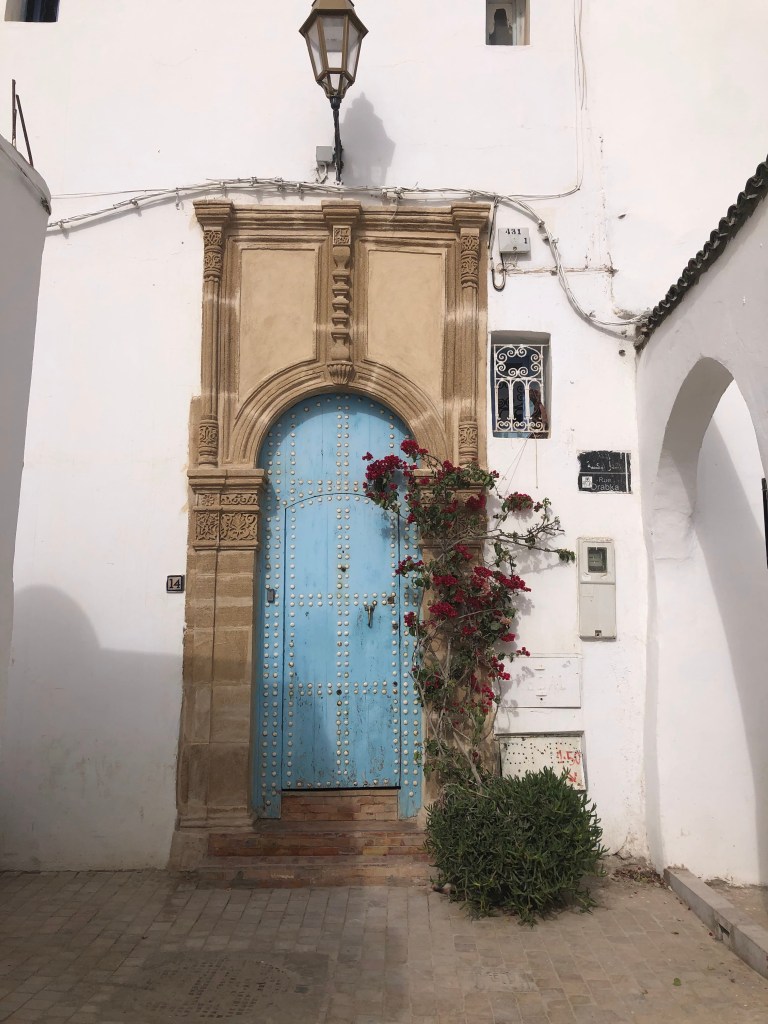
Our first stop was the Kasbah des Oudayas which is an old military fortress and the oldest part of the city built in the 12th century. It is now a residential district that overlooks the mouth of the Bou Regreg river which also acts as the division between Rabat and the neighbouring city of Salé. There are houses, shops, a gallery, food spots and a popular cafe within the walls and all the buildings are painted white and blue. Like elsewhere in Morocco, there are also cats roaming everywhere you look! We wandered through the streets, admiring the cute nooks and crannies and beautifully painted doors. Our aim was to find Cafe Maure, a well known spot where you can enjoy the panoramic views across the river. It is decorated in an Andalusian style and was renovated in 2021. The cafe is a little difficult to find, being tucked away in a corner of the Kasbah but it is well worth it. Just ask someone as you make your way through the streets or follow anyone who you think looks like a tourist and has a better sense of direction than you! Hiba and I were joined for our cup of very sweet mint tea by an equally sweet black cat that reminded me of my own. We had some biscuits with our tea, a selection of traditional Moroccan styles including cornes de gazelles or gazelle horns. These are crescent shaped parcels filled with cinnamon, almonds and orange blossom water and Hiba’s personal favourite. I don’t know what they were called but my favourites were some more lemony ones covered in icing sugar. After a while enjoying the view from Cafe Maure, we walked back out of the Kasbah via Bab er-Rouah, a gorgeous decorative gate whose name translates to ‘Gate of the Winds’ after the Atlantic winds that sweep through Rabat.

View of the Bou Regreg river and out to the Atlantic

The Kasbah des Oudayas is right next to the medina where we headed next. The medina in Rabat is actually a UNESCO World Heritage site. A friend from Rabat had been to a really interesting art exhibition the day before that we were trying to find. One of the streets at the edge of the medina had been transformed into Gal•Rue, a play on the French words ‘galerie‘ and ‘rue‘ which means street. There had been beautiful carpets laid down and the sides of the street were lined with a range of artwork displayed on easels. We walked from there, down through a market that was quieter than the one I had seen in Casablanca, and arrived at the marché central.

We wanted to go to Hassan Tower and the Mausoleum of Mohammed V, both contained within the same courtyard at the top of Rabat with guards on horses at the entrances and lots of flags lining the walls. Hassan Tower is the minaret of an incomplete mosque started near the end of the 12th century. The tower was intended to be the tallest minaret in the world and the mosque would have been the largest in the western Muslim world at the time. Instead the tower stands at 44m and only a few walls and 348 columns were constructed for the mosque. Apparently the beginnings of the mosque used to be a little more visible until the courtyard around them was built. On the other side of the courtyard from Hassan Tower is the Mausoleum of Mohammed V containing the tomb of King Mohammed V (1909-1961) and his two sons, including the previous king, Hassan II (1929-1999). It was designed by Vietnamese architect Cong Vo Toan and pays tribute to traditional Moroccan styles and techniques as well as Mohammed V’s efforts to promote this craftsmanship as part of Morocco’s sense of identity. We took some silly pictures with the tower and had a little peek into the mosque and then went in search of a taxi.

We had a quick stop at St Peter’s Cathedral, an art deco cathedral from the start of the 20th century in the centre of Rabat. We did a lap around the inside where we could hear a choir practising which was kind of surreal. The cathedral is right next to one of Rabat’s tram lines so we hopped on there to head to lunch in the Agdal neighbourhood. We were meeting another friend that Hiba and I know from our time in China, Cheima. She had suggested Dar Naji, a restaurant with traditional Moroccan food. One of Hiba’s friends, Rania, joined us from Casablanca for lunch and the rest of the afternoon as well. She would also be coming with us for the rest of the week’s adventures in Marrakesh and to the desert. It was great to see Cheima and catch up after a few years. On top of that, as soon as I met Rania I knew that we were going to get along and have a lot of fun over the next few days. I decided to order another Moroccan dish that I hadn’t tried yet, rfissa prestige. This was possibly my favourite dish that I tried in the whole week! It was chicken on shredded m’semen (the Moroccan pancake) with onions, boiled eggs, figs, prunes and a broth of ginger, coriander, saffron and ras el hanout, a common spice blend in North Africa. It was far too big a portion for me but I powered through as much as I could because it was so delicious!

With Hiba and Cheima

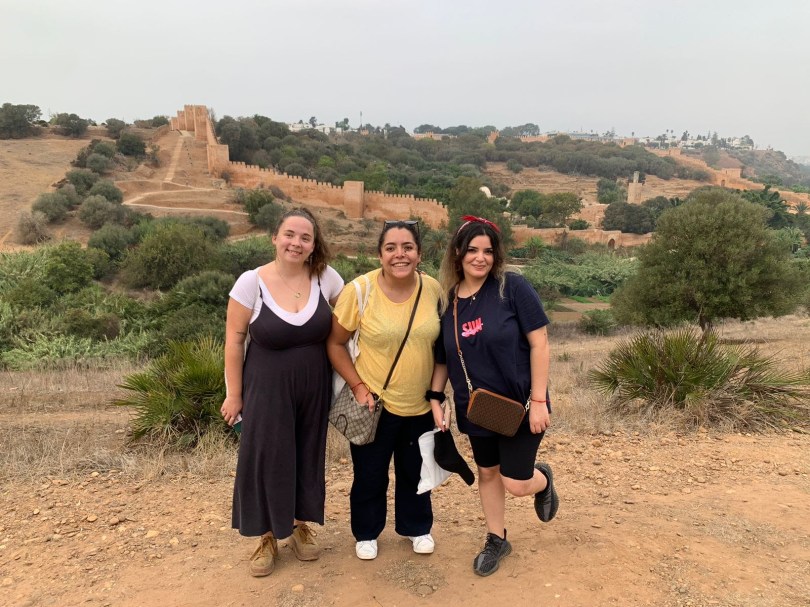
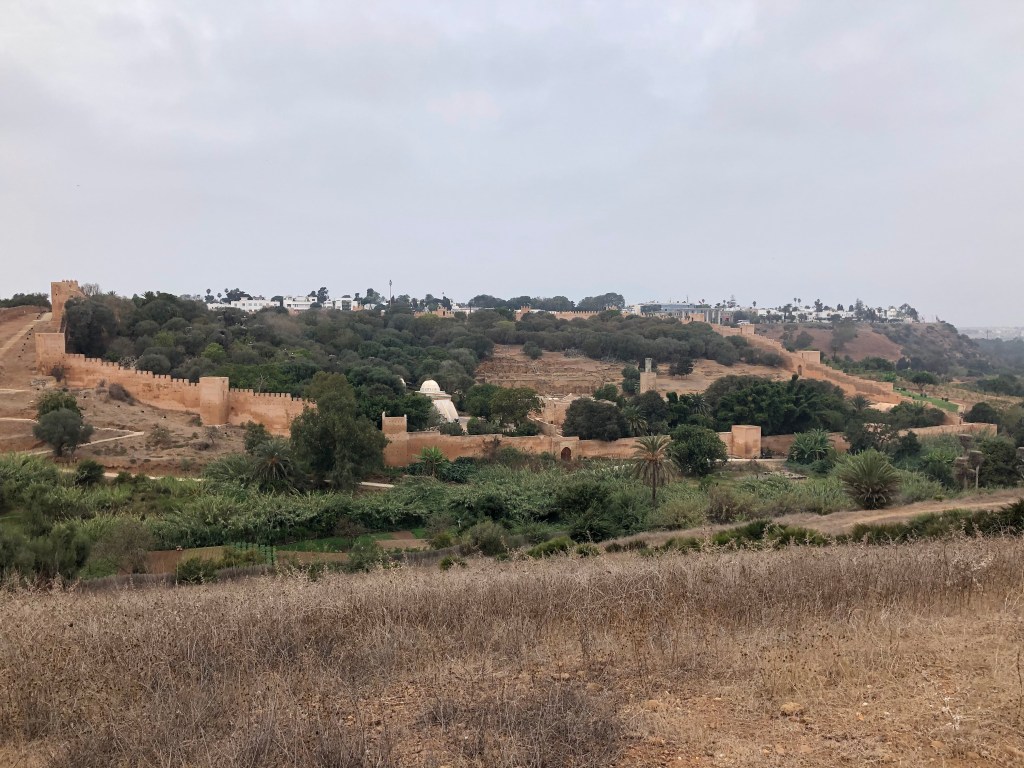
After a lovely lunch and a good catch up with Cheima, Hiba, Rania and I headed to our final stop of the day, the Chellah. A medieval, fortified, Muslim necropolis on the edge of the city, the Chellah was built in the first century BC by the Phoenicians of modern day Lebanon to serve as a trading post. It was later the Roman colony Sala Colonia and finally occupied by the Marinid Sultanate from the 13th century until it was abandoned in the 15th century. It was damaged by an earthquake in the 18th century and was left untouched until archaeological excavations uncovered the town in the 20th century. Today you can see the forum, the mosque, Roman baths and a cemetery.

It turns out that the Chellah has been closed since before covid so it’s no longer possible to enter the walls and have a look around. Hiba and Rania found this out by talking to one of the security guards and he told us that even if we couldn’t go into the compound, he could show us a spot around the back where we would be able to at least see within the walls. Once again, it’s one of those situations that’s not nearly as dodgy as it sounds. Hussein, the security guard, was actually lovely and as well as taking us around to the viewpoint and telling us some bits of history, he also insisted on being our photographer! He was directing, stopping us at all the best spots and taking multiple pictures. The walk up the hill was a little steep but not too long and definitely worthwhile seeing as you can’t see the Chellah properly. Hussein also pointed out quite a few stork nests around the site which I thought was a funny Alsace-Morocco crossover as storks are also a symbol of the region I live in in France!

At this point, we had been out all day and done lots of walking in the heat. The temperature was high 20s, low 30s most of the time I was in Morocco, slightly cooler in Casablanca and Rabat on the coast but at least Marrakesh wasn’t so humid if a bit hotter! Still, it all built up to the point that we were very tired. We got the train back to Casablanca and had dinner at Hiba’s, some soup and sausages, before buying our train tickets to Marrakesh the next day and crashing out to sleep!

This is a slightly shorter blog post by my standards although I’m still glad that I split it from the Casablanca post or that would have been an almost 5000 word behemoth! As a result I want to take this chance to talk a little bit about the language. I’ve already said that I don’t speak Arabic (I haven’t quite gotten around to it on my list of languages to learn!) but I obviously speak French pretty well at this point. Saying that, I didn’t have to use it that much. Seeing as I spent almost all my time with Hiba, other than getting myself from the airport into Marrakesh and Marrakesh to Casablanca, I relied on her Arabic to get me around which was actually a nice change from being the one in charge of the organisation and leading the trip. At the same time, I don’t like to go anywhere without being able to say a few words in the local language because I think not making the effort shows a lack of respect for where you are.

Now, if you know anything about Arabic you’ll know that as widely spoken as Arabic is, there is a lot of variation among its many speakers. Moroccan Arabic, more commonly known by Moroccans as Darija, is a particularly distinct form of Arabic. Because it is so different from standard Arabic, speakers from other countries tend to have more difficulty understanding Darija than most other versions of Arabic, although Moroccans don’t have the same problem understanding others. Much of Darija’s vocabulary is influenced by classical Arabic, Berber or Amazigh languages as well as some French and Spanish.

Now here’s a few words for you in Darija so that you are ready for when (not if) you go to Morocco!

Salam – hi/hello (سلام)

Besslama – goodbye (بسلامة)

3afak – please (عفاك)

  • The three is used to represent the letter ع which doesn’t have an equivalent in English. The sound it makes is similar to a nasal A or E. Other numbers are used for other letters that don’t have an English equivalent.

Chokran – thank you (شكرا)

Bezzaf – a lot (بزاف)

  • Chokran bezzaf – thank you very much

Ahh – yes (اه)

La – no (لا)

Bghit – I want (breet) (بغيت)

Atay – Moroccan tea (very important word in Morocco!) (اتاي)

Bghiti atay? – Do you want tea? (breeti) (بغيت اتاي)

I couldn’t believe how much we packed into each day when I was there but looking back and writing these blogs, I don’t know how my feet didn’t fall off! To be fair, I did finish these first two days pretty exhausted but so very, very happy. I felt a real attachment to Morocco from the moment I arrived. I have no doubt that much of that was to do with the people I met, those I knew as well as those I didn’t, but it also has this incredible energy that I loved! It’s a little chaotic, it’s not pristine, but it’s interesting and exciting! Hopefully that’s coming across in what I’ve written and what I’ve still got to share. Next up – Marrakesh!

Morocco: Casablanca

I barely know where to start when it comes to writing about the incredible week I spent in Morocco. Even though I was only there for a short amount of time I packed it full, managing to visit three cities and even the Sahara desert. Because of how busy I was and how much I have to write about, I decided to split the trip into bite size pieces so that you’re not sat for hours reading one blog about it. This first blog will cover the first city I visited – Casablanca.

Before we dive in, a little background about this trip. This trip has been in the works for a long time and most likely would have happened much sooner if it weren’t for covid. I have desperately wanted to visit Morocco for three years, ever since 2019 when I lived in China as part of my university degree. This may seem like a strange link but it is all to do with some of the friends that I made there. At least in my city, the northwesterly city of Dalian, there was a large number of Moroccans within the international student community due to the high number of scholarships that were available for them to go to China, particularly to study masters degrees. When I arrived in China, I only knew one person, another student from Edinburgh University who had also chosen Dalian for his study abroad city. Because of this, I was keen to meet as many people as possible. One of my first weekends there I headed out to a party at a bar with a few of the friends I had made in my class and it was here that I met Hiba. She had also just arrived in Dalian, a Moroccan student there for her masters. I originally messaged her to meet up because she had said that she would help me practise my French which I didn’t want to lose while in China. We hit it off and the rest is history. She became one of my closest friends while I was in Dalian and has stayed one of them since we parted ways. Through Hiba, I got to know a larger group of Moroccans, some of whom also became very good friends of mine.

With Hiba and Aymen in China

Unfortunately, the initial onset of covid meant that we all had to leave China, and each other, many months before we wanted or had planned but from the beginning it had always been my plan to visit my friends in their own country one day. I had other trips that fell into place during my holidays last year, as well as them being more accessible during the pandemic but I knew I would get to Morocco eventually. I had my eyes set on my October holiday this year as a good time to make it happen, with the temperature being slightly lower and more bearable for me at that time of the year and with covid restrictions being more relaxed this year than last. I contacted Hiba, found some flights and that was it! I was actually supposed to go with my friend Hannah but unfortunately the week we were supposed to leave, she was taken really unwell to the point that it would have been a really bad idea to travel. I was gutted that I wasn’t going to be able to share the experience with her as we’d really been looking forward to going but I guess it just means I’ll have to go back with her!

My journey to Morocco actually started with travelling to Paris as that’s where my flight was leaving from. Flights ended up being a bit of a pain to find. They were either €400+ for a direct return flight or a more affordable €100-200 but with a 13 hour layover somewhere in both directions. In the end I succeeded in finding two single flights in an affordable price range, direct from Paris Beauvais to Marrakesh and with a five hour layover in London Heathrow on the way back to Charles de Gaulle – not ideal but the best I could do. I had a little time to kill between my train to Paris and getting out to the airport so I was able to grab lunch with a friend that lives nearby.

I have only ever flown into Paris Beauvais, known for being the worst of the Paris airports, due to the fact that you can barely describe it as being in Paris and that the airport itself is as budget as the airlines that use it. I am of the opinion that flying into it is fine – the shuttle into the centre of Paris takes about as long as it would to get from CDG into the city and because it’s so small, pretty much only one flight arrives at a time meaning luggage and passport control queues are minimal. However, flying out of it was a nightmare and is something I will try to avoid as much as I can in the future. It was just chaotic with not enough space for all the people waiting and a very disorganised queue through passport control and security. To top it off, my flight was delayed by 50 minutes, meaning that my already late arrival time of 11.30pm local time was pushed back to 00.45am. Hiba had arranged a lot of the accommodation during my trip, including this first night in Marrakesh and thankfully I was able to arrange a €20 airport transfer through the riad I was staying in. Normally I’m all for using public transport to get from an airport into the city but not so much when it’s the middle of the night and I’m arriving by myself into an unfamiliar place. On Hiba’s recommendation, I also picked up a local sim card in the airport as my French one wouldn’t work in Morocco and we needed to be able to keep in touch until we met up. I would 100% recommend doing this as I got 20GB for €20, more than enough for my week-long stay and having access to internet data just makes everything easier, especially when travelling.

Despite the fact that it was the middle of the night, the streets of Marrakesh were surprisingly animated! I was dropped off by my driver as close to my riad as he could get. At the heart of Marrakesh is the medina, what could be considered the old, residential part of many north African cities. Marrakesh’s medina is pedestrianised, as are many others, so the small twisty streets can only be accessed by foot, bicycle or motorcycle. The owner of my riad, a French man called Bruno, met me where the driver dropped me off and walked me the final few minutes. But what actually is a riad? A riad is a house of several stories surrounding a central courtyard that is open to the fresh air. They were and still can be family homes but are also a popular, and slightly cheaper, alternative to hotels.

I was only there for a total of seven hours but I have nothing but kind words to say about Bruno’s Le Nid Bleu Riad. It was clean and comfortable and from what I could tell fairly well located although I wasn’t there long enough to go exploring. I was leaving the next day to head straight to Casablanca to find my friends but I felt so welcome. Bruno helped me arrange my airport transfer, met me on the street at 2am to walk me to the riad (nowhere near as dodgy as it sounds) and told me where to go for breakfast in the morning. I was served a lovely fresh breakfast of m’semen (a flat, square pancake) and honey, butter, jam, soft cheese, fruit, coffee and orange juice. I had already talked to Bruno about arranging a taxi to the station but I needed to get some cash out to pay him beforehand. Morocco has what is called a closed currency meaning that dirhams are not available outside of its own borders. In places like the airport or for my airport transfer I was able to use euros or you might be able to find a cash machine at the airport, I just didn’t look for one as it was already late enough. Bruno was kind enough to order me a taxi to the nearest cash machine, walk me there and even bought me a cup of Moroccan mint tea to drink together while we waited.

Breakfast at Le Nid Bleu

Even though Bruno himself isn’t Moroccan, he has been living there for a number of years and has a love for the country that was clear to me even in the short time that I spent with him. He told me that he just wants to help other people do the same and he definitely got me off on the right track. In just the short time that I was in Marrakesh (for now), I could already tell that the people are what make Morocco special (but let’s be real, I already knew that).

I got my taxi to the train station and had a very easy two and a half hour journey from Marrakesh to Casablanca. There is a pretty good train network that connects the major cities in Morocco. This trip cost 110 dirhams or about €11. Casablanca is on the coast of Morocco and is the largest city and economic centre of the country. Hiba met me at the station and it was like no time had passed since we last saw each other almost three years ago, eating ma la tang in Dalian. Those are my favourite kinds of friends, the ones who you pick up your conversation like no time has passed, even if lots has. Those are the friendships that last in my opinion and they are the friendships worth nourishing so that they do last.

The plan for the day was to try and see as much of Casablanca as possible. Hiba’s mum had driven her to the station and so drove us around a little to start with. Our first stop was potentially Casablanca’s most popular tourist attraction, certainly the biggest – Hassan II Mosque. The mosque is the second largest functioning mosque in Africa and the seventh biggest in the world. It has a capacity of 105,000 people, 25,000 inside and another 80,000 in the courtyard area outside. The minaret is 210m tall making it the second tallest in the world. There is a laser at the top that points towards Mecca! It was completed in 1993 after the king at the time acknowledged the lack of cultural or architectural landmarks in Casablanca. It was built by artisans from all over Morocco and funded in part by every family in Morocco. Hassan II Mosque is also one of the few mosques in Morocco that non-Muslims can visit but can only be done via a prearranged guided tour. At the moment, the area around the mosque is mostly closed but we happened to arrive right before prayer so we were able to walk around a little and even peer in. My favourite part was the fact that it is built half over the ocean!

On our way to our second stop we passed through an area of Casablanca called the Corniche. This is an area along the beach that has seen a lot of development in the last few years. It is now laden with resorts, luxury hotels, clubs and restaurants. It also features El Hank lighthouse, the tallest in Morocco. It played an important role in the mid-20th century in improving access to the previously dangerous harbour and therefore allowing Casablanca to develop into Morocco’s chief port. You used to be able to climb the 256 steps to the top of the lighthouse but it has been closed since before covid to preserve the stairs from further degradation. At the other end of the Corniche was our destination – Morocco Mall, the largest shopping mall in Africa! We stopped here for a bite to eat, choosing a Chinese place! Not the most traditional Moroccan food but it was a nice homage to where Hiba and I met.

We had a couple of short stops to see a few more things, passing through the United Nations Square and the Bab Marrakesh market filled with kaftans, shoes (traditional and fake designer), vases and wooden creations. Possibly the most unpleasant experience of the day was Mohamed V Square. It’s nickname might give you a clue as to why, it is known as Pigeon Square… Much more pleasant was Arab League Park. Previously a rather dirty and dangerous area of Casablanca, the park was recently renovated to the tune of €10 million and reopened in 2020. It’s like a little oasis inside the bustling city. We just had a little wander around, enjoying the coolness from the trees (even at the end of October it was around 30º most of the time I was there) but there is a lot to do in the surrounding area. On one corner of the park you’ll find the Sacred Heart Cathedral as well as a number of art museums.

We also met up with another dear friend, Aymen, that I met through Hiba while we were in China. He also lives in Rabat so joined us for the rest of the afternoon. Together we got a taxi to Quartier Habous, one of the older neighbourhoods of Casablanca. A quick note of gratitude to all my friends but particularly Hiba who handled all the taxis for my trip. Taxis in Morocco don’t often use meters although there is still an unofficial price guide depending on the city you are in, how far you are going and whether you have a big or small car. This of course doesn’t really apply to tourists who are less likely to have this information and less likely to be able to communicate with the drivers and so they often get ripped off. Having Hiba and Aymen, locals and Arabic speakers was invaluable and I had nothing to do except occasionally force Hiba to take some money to cover the taxi costs that she kept paying for.

Back to Quartier Habous, it was built in 1916 during the French occupation to be a new medina (the historical part of the city, usually walled with a maze of narrow streets). You can find a bustling bazaar with leather goods and carpets as well as a lot of bookshops specialising in Arabic books nestled amongst the twists and turns. There are also a lot of olive and spice stalls as well as the well known Patisserie Bennis Habous which has been open since 1930! We bought a mixed box of biscuits and took them round the corner to Cafe Imperial where you can enjoy them with a cup of Moroccan tea. I’m not the biggest tea drinker but I drank a lot of the very sweet, slightly bitter mint Moroccan tea over the week I was there. The traditional tea is green tea served with spearmint leaves and quite a lot of sugar. The further south you go, the stronger the tea is made by leaving it on the stove for longer.You’ll often see tea being poured into the glass from a great and ever increasing height as well. As well as being very impressive, this is done to add bubbles to the tea to improve the texture and flavour. It’s an important social custom and a big part of the culture. We happily sat in this cafe for ages, chatting, joking and laughing a lot, reminiscing about China and catching up on everything that’s happened since.

Just up the road from Cafe Imperial is the Makhma du Pacha, a building that used to be used by the king to meet with his people and hear their concerns. It was completed in 1952 and is a great example of the outstanding work of Moroccan craftsmen with carved wooden ceilings, intricate stonework and gorgeous tiles. As well as a parliamentary reception hall, the palace has also been a courthouse, a jail and the residence of the pasha (governor). I think it has been closed since covid but when we stuck our heads in, the guards let us have a little poke around. Hiba actually grew up a few streets away but had never visited it before.

It was nearing the end of the day so we started thinking about dinner. Hiba wanted to go to one of her favourite restaurants in Casablanca, Sqala. The restaurant is hidden away inside the ramparts of the old medina near the Casa Port train station. This is where I had my first taste of both Morocco’s most famous dish, tagine. The word tagine actually has two meanings, referring both to the clay or ceramic cooking pot, a round dish at the bottom and a cone at the top, and the type of dish that is cooked inside it. Tagine (the dish) is almost like a stew, usually made with meat or fish and some vegetables, although there are vegetarian tagines as well. The shape of the pot means that only a little water is needed to cook the meat or vegetables as the steam gathers in the cone and condenses back into the dish. It makes it a very practical cooking method in areas where water is in short supply. I tried a lamb tagine with artichokes and peas and we all shared a plate of briouates. These are small, triangular, puff pastry parcels filled with a variety of things, beef, octopus and chicken and almonds in our case. The chicken and almonds one in particular was a confusing but delicious combination. In a larger, round form, this is known as pastilla de poulet – extremely thin pastry called warqa filled with shredded chicken, ground almonds and cinnamon, dusted in icing sugar.

That pretty much brings us to the end of my first full day in Morocco! Originally my plan was to combine Casablanca and Rabat into the same blog post but we’re already sitting around three thousand words so I think we’ll leave it there. It just means more Morocco posts for you to enjoy! For now, I’ll finish with a few thoughts I had over my first few days in Morocco. First of all, I could barely believe that I was actually there! Being in Morocco also gave me a similar feeling to being in Honduras which might sound weird seeing as the two countries don’t have a lot in common on the surface. It was somewhere very different to a lot of the places I’m used to and I felt both out of place yet comfortable in the chaos and uncertainty at the same time. This trip really has been a long time in the making. I remember multiple conversations that Hiba, Aymen and I had together in China, envisioning this day three years ago and thousands of miles away! I feel so lucky to have found these people on the other side of the world, to have made such a strong connection with them and then be able to pick up as if we never left off, three years later, in their home and in a world that has been irrevocably changed since we first met. 

All that just from the first day and a bit! Lots more to come.

Reflections on Summer 2022

I’ve been back in Mulhouse for a couple of weeks now and it feels like life is back to normal. I’m back in the same apartment as last year, I’ve started teaching again and I’m back into a routine. There are some changes this year and some exciting things coming which I will fill you in on in due course but now I want to take some time to look back on the last few months. I had such an incredible time over the summer, with my travels, my time in Tenerife and being at home. I want to take a moment to reflect on that, the things I’ve learned and the things I’ve gained from it.

First of all I feel incredibly fortunate to have been able to spend my summer in the way that I did. Not everybody has the chance to potter about Europe in the way that I have, whether it is because of time, money or a whole host of other reasons. The perks of working at a university means that I benefit from the long holidays at Christmas and over summer. The benefit of being a lowly lectrice means that I don’t have to spend those holidays doing research or planning entire courses so I am free to use them exactly how I want to.

In terms of the cost of my travels here, there and everywhere, I have shared some spending breakdowns on various blogs (here for two weeks in Germany and Austria and here for seven weeks doing Workaway in Tenerife). I try to keep things pretty cheap, saving money wherever I can and having a bit of a budget. I didn’t always stick to the budget but things like staying in hostels, choosing free activities and cooking for myself instead of eating out all the time are some of the ways that I kept my costs down. All this was how I managed to afford this summer while I was on the go but how did I afford it in the first place? I’m not going to lie and pretend that I earn a ton of money as a lectrice. Don’t get me wrong, it’s enough to live comfortably on and is fair for the number of hours that I work but doesn’t leave a lot left over at the end of the month. With that in mind, I would say that I am a saver rather than a spender and always have been. I try to put aside a chunk of each of my paychecks and don’t spend a lot of money on myself. I would much rather save it and put it towards a future trip. Over time, this builds up!

Goofy outtakes with my sisters and cousins

I had a great time across the whole summer, chilling at home as well as spending a couple of weeks travelling in Germany and Austria but my favourite part was by far my time in Tenerife. I’ve spoken at length about how incredible it was working in La Tortuga through Workaway and after being on the road for almost three weeks before I got there, it was nice to slow down once I arrived. Overall I found it much more fulfilling being somewhere for longer and getting to know it better. It also felt like a more sustainable way to travel for me. Moving around places and cities every few days can be exciting but also exhausting!

Tenerife also added to my collection of friends around the world. I feel incredibly lucky to have made the connections that I have over the years with the people I meet along the way. Whether it’s my second family in Honduras, the friends I made while studying in China that I’m visiting in Morocco next month or my fellow volunteers and the guests from La Tortuga, I have met some very special people. The more people I meet, the more places I want to go so I can visit them!

Tortugeñ@s

Spending almost two months on a Spanish island was great not just because of the amazing things I got to do or the people that I met, but because I got to speak my favourite language. I’m really pleased with how much my French has improved since moving to France and Chinese is special to me because of how much effort I have put into it but I’ve always had a soft spot for Spanish as it was when I started learning it that my passion for languages really took off. It was also the first language I learnt fluently and is attached to so many memories that I hold close to my heart. It was great to be able to stretch those muscles again after five years without using them for more than a random conversation here and a long weekend away there. I also got to add to my very eclectic collection of vocabulary and phrasing that has its roots in Honduras and has influences now from mainland Spain, Chile, Argentina and a mish mash of other places. I love that my Spanish doesn’t conform to one regional accent or dictionary but instead is a patchwork of the people and places that have taught me.

I also feel more intrigued by Spain than I ever have before. Most of my interest in Spanish has been related to my time in Honduras and Central America and other than a week here and there I haven’t spent a lot of time in Spain. I will say here that although Tenerife is a Spanish island, the local culture is much more Canarian than Spanish. Saying that, it’s still the first time that I have felt drawn to Spain in this way. I will always feel pulled back to Tenerife now but I am also more intrigued by mainland Spain now. Who knows when it might happen but maybe I’ll end up living in Spain for longer than a couple of months at some point?

Ten weeks after leaving my home in Mulhouse, I finally made it back home-home. That is to say that I made it back to Scotland and back to Dunblane. I have previously written about my complicated feelings about coming home to Dunblane in general and specifically after a period of travels or living elsewhere. The concept of home and the feelings attached to it are often complex, and not just for me. I’m always happy to be back and able to see the people that I’ve missed more than anything but without those people in Dunblane I wouldn’t be going back to visit. There are other places in Scotland that I feel much more attached to, in particular Edinburgh.

For the first time, however, I had a real desire to be at home in Dunblane. Not just to visit my family and friends but to actually be at home, in that environment that I know so well, that feels familiar, that I grew up in. I hadn’t felt this before, even after a whole year in Honduras, even after being the furthest I’ve been from home while in China, even when I was last at home in February after missing Christmas because I got covid. It was an intense feeling and a new one for me. I still don’t know exactly what caused me to feel like that. I’ve always come away from an extended period living somewhere else wanting to stay longer but something felt a little different. As much as I loved my time in Tenerife, I was ready to come home at the end of it. As much as I enjoyed my first year in France, I was longing to go back to Scotland.

At this point I knew that I was coming back to France for a second year as a lectrice. I’m still not entirely sure why but lecteurs and lectrices can only stay in their position for a maximum of two years. I had decided not long after arriving in France and getting started that I wanted to stay a second year. I enjoyed the work, I like Mulhouse and I’d set up a nice life for myself there. I also wasn’t sure what it would look like if I didn’t stay for a second year. I graduated university with this idea that I wanted to move to France and get my French to the level that I wanted it. There was also an element of taking back what the pandemic had denied me because I didn’t get to spend any time in France during my year abroad. When I arrived, I had a vague idea that I might want to go to China after I finished my time in France for similar reasons. While I would still like to go back to China one day, I don’t think now is the time. There are still a lot of covid restrictions in place that make it hard to get a visa and that restrict life and travel once you are there. I also don’t want to continue being an English teacher (which I’ll expand on later) but I think that would be the easiest way to get back to China in the near future.

The combination of this desire to be back home in Scotland and the uncertainty of where I’m going after my second year in France is done had and still has me considering whether I want to move back to Scotland. I have always felt like a restless soul and have never seen settling down in one place as something I would do until much further in the future. Saying that, I’ve always had the feeling that if and when I do choose somewhere more permanently, it would most likely be in Scotland because that is my home. I’m not saying I’m ready to take that plunge and be in Scotland for the rest of my life. Even just in this blog post I’ve talked about potentially wanting to live in Spain at some point. But maybe the way I was feeling was a sign that moving home, even temporarily, should be in my future?

What made this more complicated was that when I first arrived back in Scotland just after the start of July, I wasn’t exactly looking forward to going back to France. Like I’ve already said, I don’t know where I’ll be after this second year in Mulhouse but it most likely won’t be France. I like the life that I’ve built here but it was never supposed to be long term in the first place. It’s not that I didn’t want to go back at all, I knew what I had signed up to when I agreed to stay on for a second year. I knew that all I needed was some time at home. I just needed to fill myself up again from being around my friends and family and also having some time to do nothing. Sure enough, after a couple of weeks I was already starting to look upon my return to France with more excitement.

HebCelt 2022

Another thing playing on my mind was my choice of job. I don’t and have never wanted to be an English teacher. That’s not to say that I don’t enjoy what I do and I actually think I’m quite good at it but it’s not my passion. I have been involved in teaching for years, ever since I became a swimming instructor at the age of 16, through my year teaching English in a primary school in Honduras, back into the pool through university and now finally in Mulhouse. At the same time, an unavoidable question when you choose to study languages as a degree is ‘So are you going to be a translator or a teacher?’. I have known since I first embarked on that path that I didn’t want to do either. I’m still not exactly sure what it is that I do want to do but I know it’s not English teaching. Knowing all this, and with all these other questions swirling around my head about what the future might hold, had me questioning what I was even doing going back for another year. I felt like it would be a waste of time.

I’ve since knocked myself out of that spiral. I think a lot of these thoughts came at a point where I was just feeling a little bit lost. I still don’t know where I’m headed but I’m secure in the knowledge of where I am. Yes, I don’t want to be an English teacher for the rest of my life but I am grateful for what this job has given me, allowed me to do and taught me. I enjoy teaching, I enjoy interacting with my students and I share their passion for languages, just for different languages. It’s not a waste of time at all because there are things to be learnt from any experience and it is what you make of it. For now, I’m focusing on giving my all while I’m still here and making the most of it. I’m sure there will be more updates down the line as I (hopefully) get closer to figuring out what I’m doing with my life!

Survival Guide: Travelling

It’s that time again. Another big milestone has passed and we now have as much time left in Honduras as we have spent here. That sparks a whole range of feeling, from anticipation for what’s still to come to excitement at going home and sadness at the thought of leaving a place that has become home too.

I’m trying not think about that yet so in the meantime, to mark this anniversary I am continuing what I started three months ago. I have gathered all the lessons I’ve learned from a hard three months on the road, ready to help any more intrepid adventurers on their way.

Survival Guide: Travelling

  • Cheap food, street food, never gonna eat food – the mantra of a traveller on a budget. Whatever is cheapest, that’s what you’re eating, street food is a necessary but also delicious risk that must be taken and when times are tough, two meals a day will have to do.
  •  Take free water wherever you can – the bane of my existence was having to buy water everywhere we went (apart from Costa Rica where tap water is safe), especially when the rest of Central America doesn’t sell bags of water as widely as Honduras does.
  • You can’t beat a chicken bus – don’t be enticed by the offer of a direct shuttle even if it has air conditioning. A/C’s not all its cracked up to be and you’ll have to pay an arm and a leg for it.
  •  Missing your bus is not the end of the world – there’s always another or at least another option and worst comes to the worst you spend one more night where you are. No use getting your panties in a twist, as I’ve learned.
  • Approach borders with care – don’t make any sudden movements and never show any signs of fear.
  • A portable charger is mans best friend, not your dog – a seven hour bus ride is a lonely thing with a dead phone. 
  •  Nothing is truly your own – when travelling in group all resources are communal. This ranges from food to headphones to socks. Be prepared to share.
  • Pack your bag and then take out a third of the clothes you have – I can promise your shoulders and your wallet will thank you when you neither have to carry it all or wash it all. 
  • 1 bag, I repeat, 1 bag – 4 bags is never a good idea no matter how essential they seem before you leave. 2 bags at most BUT NEVER 4 (not looking at anyone in particular, Lynch).
  • No daredevil stunts without medical insurance – that is unless you’ve got your own private plane to fly you to the nearest hospital.
  • The unexpected adventures are sometimes the best – case in point, we had a hitchhiking competition to a cheese factory in Costa Rica because we’re lazy and it ended up being one of my favourite things we did. 
  • Say yes to everything – ok, maybe not everything because that’s how you end up taking part in a Mayan human sacrifice ritual but in general good things happen when you take a chance. 
  •  Use whatever Spanish you have whenever you can – people will be pleased and possibly surprised but also much more likely to be friendly and help you out, even if you’re butchering their language.  
  • Talk to people – whether that be locals to make sure you’re not being ripped off when you go to buy your traditional Guatemalan poncho, the people who work in your hostel who might be able to help you with the next step of your trip or other travellers to share war stories. Remember, it’s the people that make the place.
  •  Be ready for the time of your life – I couldn’t have imagined how much I would love travelling when we started. I had hopes but thought they were almost too good to be true. And I never knew how much it would change me. I get less stressed, am more likely to go with the flow, say yes to the chances I get given, I’m more outgoing, more social, more adventurous. I mean, I got a tattoo, old Sara would never have done that but I have no regrets, about anything. I will always remember the amazing, crazy, surprising, unbelievable three months I spent backpacking around Central America.