Morocco: Rabat

After a fantastic first day in Morocco exploring my friend Hiba’s home city of Casablanca, day two brought a different city. The plan was to head to the nearby capital of Rabat, partly just to see it because why not and partly to visit another friend from China who lives there. While I was in Casablanca I was staying in her family home which was a really lovely experience. I already felt very welcomed in Morocco just by virtue of how warm and friendly the people are but there’s something about being in a family environment that adds an extra element to that. This is where I was really glad to be able to speak French as her parents don’t speak English and I obviously don’t speak Arabic (although I made an effort during the week to learn a few words). Hiba and her mum prepared us a lovely breakfast of bread, m’semen (the Moroccan pancakes), mini pastries and madeleines, eggs, coffee and orange juice.

Rabat is two hours from Casablanca by train (40-50 dirhams or about £4, 1 hour if you get the express train) so we went for a day trip from Casablanca. Rabat is the capital of Morocco (not Marrakesh like many people think, myself included). From 1912, Rabat was the administrative centre of the French protectorate and has been the capital since the country achieved its independence in 1955. It is further north along the coast from Casablanca but isn’t a particularly important port, relying more on tourism and the fact that all of Morocco’s embassies are situated there for its importance. It is also one of the four imperial cities in Morocco, the historical capitals of the country, along with Marrakesh, Fez and Meknes.

Bab er-Rouah

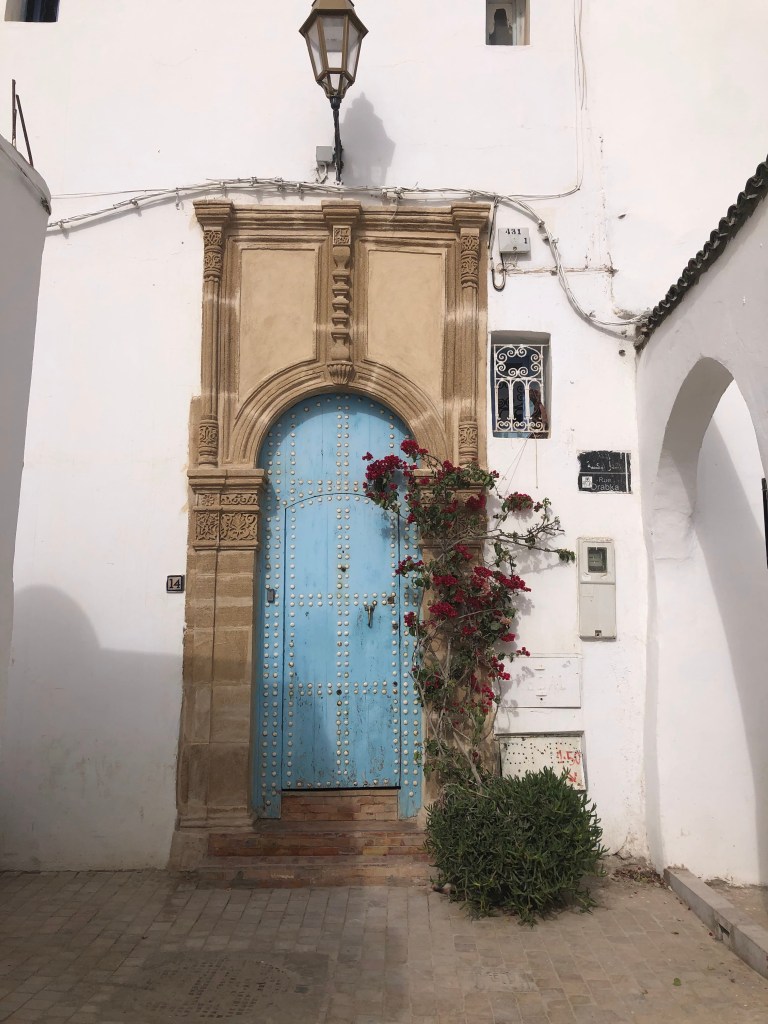
Our first stop was the Kasbah des Oudayas which is an old military fortress and the oldest part of the city built in the 12th century. It is now a residential district that overlooks the mouth of the Bou Regreg river which also acts as the division between Rabat and the neighbouring city of Salé. There are houses, shops, a gallery, food spots and a popular cafe within the walls and all the buildings are painted white and blue. Like elsewhere in Morocco, there are also cats roaming everywhere you look! We wandered through the streets, admiring the cute nooks and crannies and beautifully painted doors. Our aim was to find Cafe Maure, a well known spot where you can enjoy the panoramic views across the river. It is decorated in an Andalusian style and was renovated in 2021. The cafe is a little difficult to find, being tucked away in a corner of the Kasbah but it is well worth it. Just ask someone as you make your way through the streets or follow anyone who you think looks like a tourist and has a better sense of direction than you! Hiba and I were joined for our cup of very sweet mint tea by an equally sweet black cat that reminded me of my own. We had some biscuits with our tea, a selection of traditional Moroccan styles including cornes de gazelles or gazelle horns. These are crescent shaped parcels filled with cinnamon, almonds and orange blossom water and Hiba’s personal favourite. I don’t know what they were called but my favourites were some more lemony ones covered in icing sugar. After a while enjoying the view from Cafe Maure, we walked back out of the Kasbah via Bab er-Rouah, a gorgeous decorative gate whose name translates to ‘Gate of the Winds’ after the Atlantic winds that sweep through Rabat.

View of the Bou Regreg river and out to the Atlantic

The Kasbah des Oudayas is right next to the medina where we headed next. The medina in Rabat is actually a UNESCO World Heritage site. A friend from Rabat had been to a really interesting art exhibition the day before that we were trying to find. One of the streets at the edge of the medina had been transformed into Gal•Rue, a play on the French words ‘galerie‘ and ‘rue‘ which means street. There had been beautiful carpets laid down and the sides of the street were lined with a range of artwork displayed on easels. We walked from there, down through a market that was quieter than the one I had seen in Casablanca, and arrived at the marché central.

We wanted to go to Hassan Tower and the Mausoleum of Mohammed V, both contained within the same courtyard at the top of Rabat with guards on horses at the entrances and lots of flags lining the walls. Hassan Tower is the minaret of an incomplete mosque started near the end of the 12th century. The tower was intended to be the tallest minaret in the world and the mosque would have been the largest in the western Muslim world at the time. Instead the tower stands at 44m and only a few walls and 348 columns were constructed for the mosque. Apparently the beginnings of the mosque used to be a little more visible until the courtyard around them was built. On the other side of the courtyard from Hassan Tower is the Mausoleum of Mohammed V containing the tomb of King Mohammed V (1909-1961) and his two sons, including the previous king, Hassan II (1929-1999). It was designed by Vietnamese architect Cong Vo Toan and pays tribute to traditional Moroccan styles and techniques as well as Mohammed V’s efforts to promote this craftsmanship as part of Morocco’s sense of identity. We took some silly pictures with the tower and had a little peek into the mosque and then went in search of a taxi.

We had a quick stop at St Peter’s Cathedral, an art deco cathedral from the start of the 20th century in the centre of Rabat. We did a lap around the inside where we could hear a choir practising which was kind of surreal. The cathedral is right next to one of Rabat’s tram lines so we hopped on there to head to lunch in the Agdal neighbourhood. We were meeting another friend that Hiba and I know from our time in China, Cheima. She had suggested Dar Naji, a restaurant with traditional Moroccan food. One of Hiba’s friends, Rania, joined us from Casablanca for lunch and the rest of the afternoon as well. She would also be coming with us for the rest of the week’s adventures in Marrakesh and to the desert. It was great to see Cheima and catch up after a few years. On top of that, as soon as I met Rania I knew that we were going to get along and have a lot of fun over the next few days. I decided to order another Moroccan dish that I hadn’t tried yet, rfissa prestige. This was possibly my favourite dish that I tried in the whole week! It was chicken on shredded m’semen (the Moroccan pancake) with onions, boiled eggs, figs, prunes and a broth of ginger, coriander, saffron and ras el hanout, a common spice blend in North Africa. It was far too big a portion for me but I powered through as much as I could because it was so delicious!

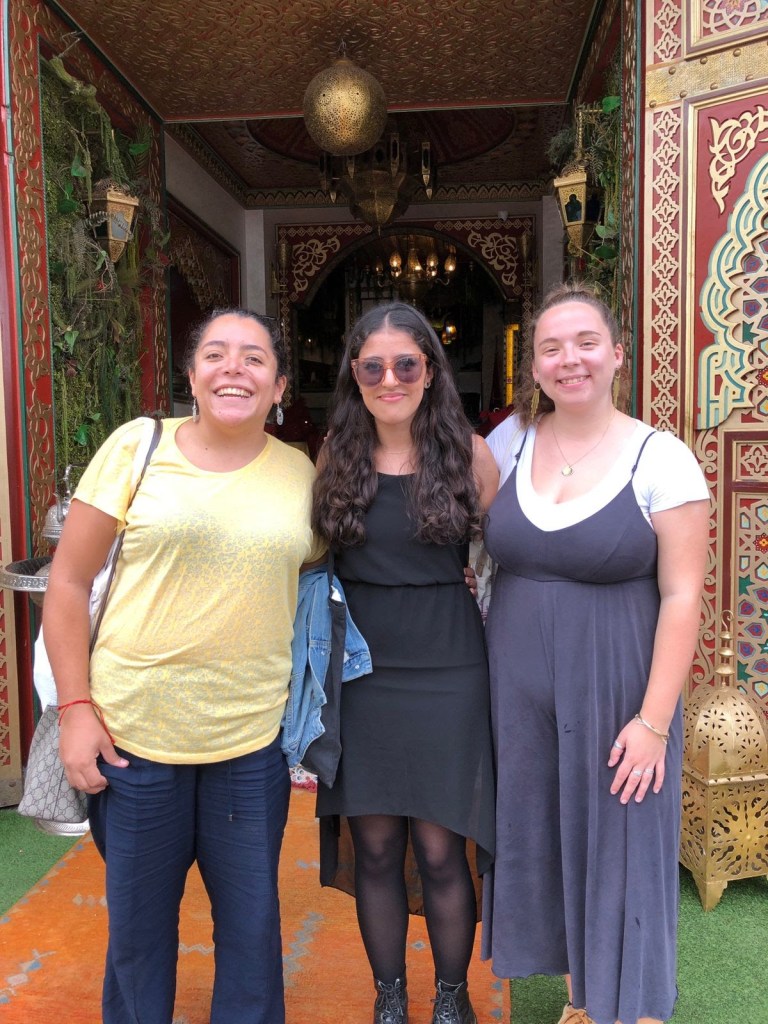
With Hiba and Cheima

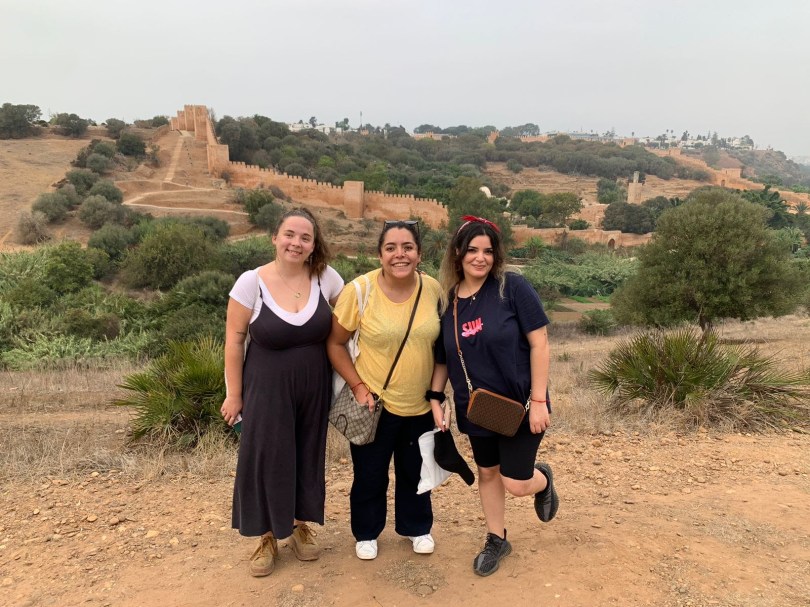
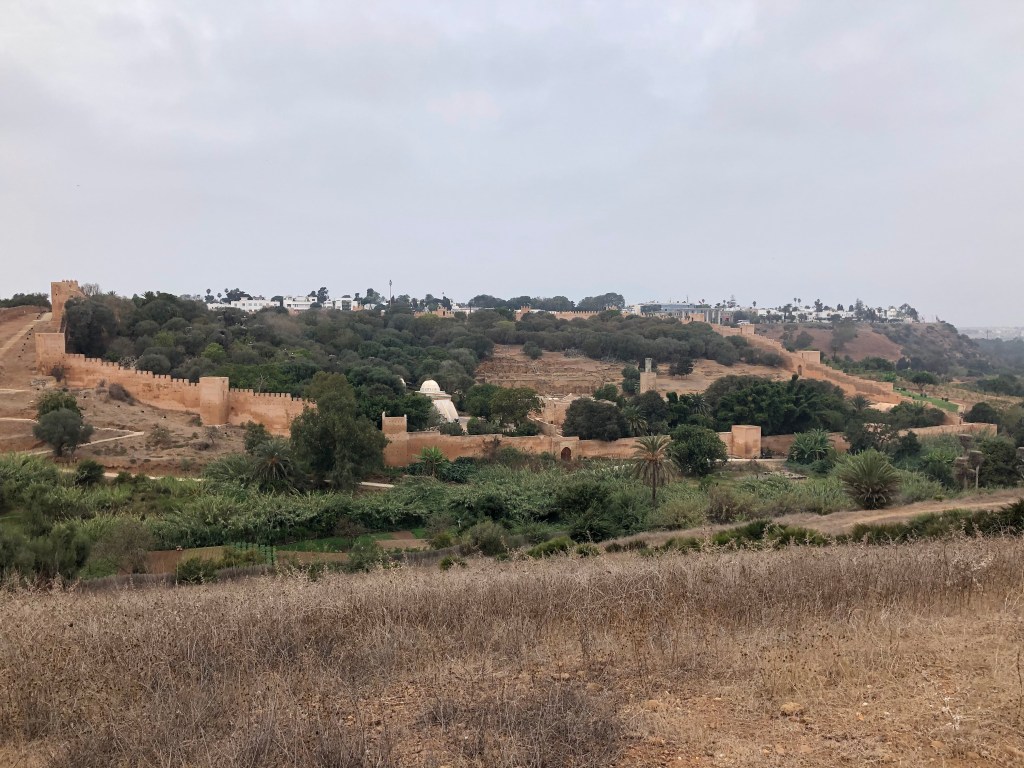
After a lovely lunch and a good catch up with Cheima, Hiba, Rania and I headed to our final stop of the day, the Chellah. A medieval, fortified, Muslim necropolis on the edge of the city, the Chellah was built in the first century BC by the Phoenicians of modern day Lebanon to serve as a trading post. It was later the Roman colony Sala Colonia and finally occupied by the Marinid Sultanate from the 13th century until it was abandoned in the 15th century. It was damaged by an earthquake in the 18th century and was left untouched until archaeological excavations uncovered the town in the 20th century. Today you can see the forum, the mosque, Roman baths and a cemetery.

It turns out that the Chellah has been closed since before covid so it’s no longer possible to enter the walls and have a look around. Hiba and Rania found this out by talking to one of the security guards and he told us that even if we couldn’t go into the compound, he could show us a spot around the back where we would be able to at least see within the walls. Once again, it’s one of those situations that’s not nearly as dodgy as it sounds. Hussein, the security guard, was actually lovely and as well as taking us around to the viewpoint and telling us some bits of history, he also insisted on being our photographer! He was directing, stopping us at all the best spots and taking multiple pictures. The walk up the hill was a little steep but not too long and definitely worthwhile seeing as you can’t see the Chellah properly. Hussein also pointed out quite a few stork nests around the site which I thought was a funny Alsace-Morocco crossover as storks are also a symbol of the region I live in in France!
At this point, we had been out all day and done lots of walking in the heat. The temperature was high 20s, low 30s most of the time I was in Morocco, slightly cooler in Casablanca and Rabat on the coast but at least Marrakesh wasn’t so humid if a bit hotter! Still, it all built up to the point that we were very tired. We got the train back to Casablanca and had dinner at Hiba’s, some soup and sausages, before buying our train tickets to Marrakesh the next day and crashing out to sleep!

This is a slightly shorter blog post by my standards although I’m still glad that I split it from the Casablanca post or that would have been an almost 5000 word behemoth! As a result I want to take this chance to talk a little bit about the language. I’ve already said that I don’t speak Arabic (I haven’t quite gotten around to it on my list of languages to learn!) but I obviously speak French pretty well at this point. Saying that, I didn’t have to use it that much. Seeing as I spent almost all my time with Hiba, other than getting myself from the airport into Marrakesh and Marrakesh to Casablanca, I relied on her Arabic to get me around which was actually a nice change from being the one in charge of the organisation and leading the trip. At the same time, I don’t like to go anywhere without being able to say a few words in the local language because I think not making the effort shows a lack of respect for where you are.

Now, if you know anything about Arabic you’ll know that as widely spoken as Arabic is, there is a lot of variation among its many speakers. Moroccan Arabic, more commonly known by Moroccans as Darija, is a particularly distinct form of Arabic. Because it is so different from standard Arabic, speakers from other countries tend to have more difficulty understanding Darija than most other versions of Arabic, although Moroccans don’t have the same problem understanding others. Much of Darija’s vocabulary is influenced by classical Arabic, Berber or Amazigh languages as well as some French and Spanish.

Now here’s a few words for you in Darija so that you are ready for when (not if) you go to Morocco!

Salam – hi/hello (سلام)

Besslama – goodbye (بسلامة)

3afak – please (عفاك)

  • The three is used to represent the letter ع which doesn’t have an equivalent in English. The sound it makes is similar to a nasal A or E. Other numbers are used for other letters that don’t have an English equivalent.

Chokran – thank you (شكرا)

Bezzaf – a lot (بزاف)

  • Chokran bezzaf – thank you very much

Ahh – yes (اه)

La – no (لا)

Bghit – I want (breet) (بغيت)

Atay – Moroccan tea (very important word in Morocco!) (اتاي)

Bghiti atay? – Do you want tea? (breeti) (بغيت اتاي)

I couldn’t believe how much we packed into each day when I was there but looking back and writing these blogs, I don’t know how my feet didn’t fall off! To be fair, I did finish these first two days pretty exhausted but so very, very happy. I felt a real attachment to Morocco from the moment I arrived. I have no doubt that much of that was to do with the people I met, those I knew as well as those I didn’t, but it also has this incredible energy that I loved! It’s a little chaotic, it’s not pristine, but it’s interesting and exciting! Hopefully that’s coming across in what I’ve written and what I’ve still got to share. Next up – Marrakesh!

Morocco: Casablanca

I barely know where to start when it comes to writing about the incredible week I spent in Morocco. Even though I was only there for a short amount of time I packed it full, managing to visit three cities and even the Sahara desert. Because of how busy I was and how much I have to write about, I decided to split the trip into bite size pieces so that you’re not sat for hours reading one blog about it. This first blog will cover the first city I visited – Casablanca.

Before we dive in, a little background about this trip. This trip has been in the works for a long time and most likely would have happened much sooner if it weren’t for covid. I have desperately wanted to visit Morocco for three years, ever since 2019 when I lived in China as part of my university degree. This may seem like a strange link but it is all to do with some of the friends that I made there. At least in my city, the northwesterly city of Dalian, there was a large number of Moroccans within the international student community due to the high number of scholarships that were available for them to go to China, particularly to study masters degrees. When I arrived in China, I only knew one person, another student from Edinburgh University who had also chosen Dalian for his study abroad city. Because of this, I was keen to meet as many people as possible. One of my first weekends there I headed out to a party at a bar with a few of the friends I had made in my class and it was here that I met Hiba. She had also just arrived in Dalian, a Moroccan student there for her masters. I originally messaged her to meet up because she had said that she would help me practise my French which I didn’t want to lose while in China. We hit it off and the rest is history. She became one of my closest friends while I was in Dalian and has stayed one of them since we parted ways. Through Hiba, I got to know a larger group of Moroccans, some of whom also became very good friends of mine.

With Hiba and Aymen in China

Unfortunately, the initial onset of covid meant that we all had to leave China, and each other, many months before we wanted or had planned but from the beginning it had always been my plan to visit my friends in their own country one day. I had other trips that fell into place during my holidays last year, as well as them being more accessible during the pandemic but I knew I would get to Morocco eventually. I had my eyes set on my October holiday this year as a good time to make it happen, with the temperature being slightly lower and more bearable for me at that time of the year and with covid restrictions being more relaxed this year than last. I contacted Hiba, found some flights and that was it! I was actually supposed to go with my friend Hannah but unfortunately the week we were supposed to leave, she was taken really unwell to the point that it would have been a really bad idea to travel. I was gutted that I wasn’t going to be able to share the experience with her as we’d really been looking forward to going but I guess it just means I’ll have to go back with her!

My journey to Morocco actually started with travelling to Paris as that’s where my flight was leaving from. Flights ended up being a bit of a pain to find. They were either €400+ for a direct return flight or a more affordable €100-200 but with a 13 hour layover somewhere in both directions. In the end I succeeded in finding two single flights in an affordable price range, direct from Paris Beauvais to Marrakesh and with a five hour layover in London Heathrow on the way back to Charles de Gaulle – not ideal but the best I could do. I had a little time to kill between my train to Paris and getting out to the airport so I was able to grab lunch with a friend that lives nearby.

I have only ever flown into Paris Beauvais, known for being the worst of the Paris airports, due to the fact that you can barely describe it as being in Paris and that the airport itself is as budget as the airlines that use it. I am of the opinion that flying into it is fine – the shuttle into the centre of Paris takes about as long as it would to get from CDG into the city and because it’s so small, pretty much only one flight arrives at a time meaning luggage and passport control queues are minimal. However, flying out of it was a nightmare and is something I will try to avoid as much as I can in the future. It was just chaotic with not enough space for all the people waiting and a very disorganised queue through passport control and security. To top it off, my flight was delayed by 50 minutes, meaning that my already late arrival time of 11.30pm local time was pushed back to 00.45am. Hiba had arranged a lot of the accommodation during my trip, including this first night in Marrakesh and thankfully I was able to arrange a €20 airport transfer through the riad I was staying in. Normally I’m all for using public transport to get from an airport into the city but not so much when it’s the middle of the night and I’m arriving by myself into an unfamiliar place. On Hiba’s recommendation, I also picked up a local sim card in the airport as my French one wouldn’t work in Morocco and we needed to be able to keep in touch until we met up. I would 100% recommend doing this as I got 20GB for €20, more than enough for my week-long stay and having access to internet data just makes everything easier, especially when travelling.

Despite the fact that it was the middle of the night, the streets of Marrakesh were surprisingly animated! I was dropped off by my driver as close to my riad as he could get. At the heart of Marrakesh is the medina, what could be considered the old, residential part of many north African cities. Marrakesh’s medina is pedestrianised, as are many others, so the small twisty streets can only be accessed by foot, bicycle or motorcycle. The owner of my riad, a French man called Bruno, met me where the driver dropped me off and walked me the final few minutes. But what actually is a riad? A riad is a house of several stories surrounding a central courtyard that is open to the fresh air. They were and still can be family homes but are also a popular, and slightly cheaper, alternative to hotels.

I was only there for a total of seven hours but I have nothing but kind words to say about Bruno’s Le Nid Bleu Riad. It was clean and comfortable and from what I could tell fairly well located although I wasn’t there long enough to go exploring. I was leaving the next day to head straight to Casablanca to find my friends but I felt so welcome. Bruno helped me arrange my airport transfer, met me on the street at 2am to walk me to the riad (nowhere near as dodgy as it sounds) and told me where to go for breakfast in the morning. I was served a lovely fresh breakfast of m’semen (a flat, square pancake) and honey, butter, jam, soft cheese, fruit, coffee and orange juice. I had already talked to Bruno about arranging a taxi to the station but I needed to get some cash out to pay him beforehand. Morocco has what is called a closed currency meaning that dirhams are not available outside of its own borders. In places like the airport or for my airport transfer I was able to use euros or you might be able to find a cash machine at the airport, I just didn’t look for one as it was already late enough. Bruno was kind enough to order me a taxi to the nearest cash machine, walk me there and even bought me a cup of Moroccan mint tea to drink together while we waited.

Breakfast at Le Nid Bleu

Even though Bruno himself isn’t Moroccan, he has been living there for a number of years and has a love for the country that was clear to me even in the short time that I spent with him. He told me that he just wants to help other people do the same and he definitely got me off on the right track. In just the short time that I was in Marrakesh (for now), I could already tell that the people are what make Morocco special (but let’s be real, I already knew that).

I got my taxi to the train station and had a very easy two and a half hour journey from Marrakesh to Casablanca. There is a pretty good train network that connects the major cities in Morocco. This trip cost 110 dirhams or about €11. Casablanca is on the coast of Morocco and is the largest city and economic centre of the country. Hiba met me at the station and it was like no time had passed since we last saw each other almost three years ago, eating ma la tang in Dalian. Those are my favourite kinds of friends, the ones who you pick up your conversation like no time has passed, even if lots has. Those are the friendships that last in my opinion and they are the friendships worth nourishing so that they do last.

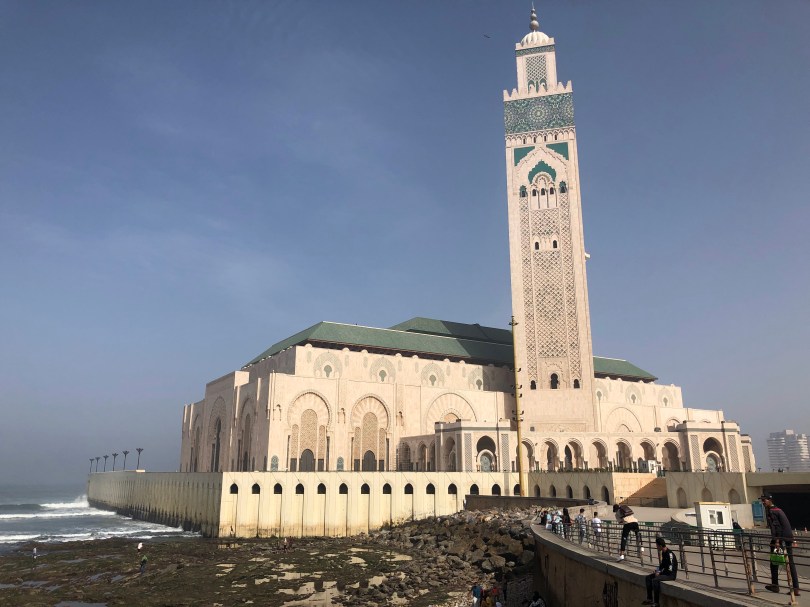
The plan for the day was to try and see as much of Casablanca as possible. Hiba’s mum had driven her to the station and so drove us around a little to start with. Our first stop was potentially Casablanca’s most popular tourist attraction, certainly the biggest – Hassan II Mosque. The mosque is the second largest functioning mosque in Africa and the seventh biggest in the world. It has a capacity of 105,000 people, 25,000 inside and another 80,000 in the courtyard area outside. The minaret is 210m tall making it the second tallest in the world. There is a laser at the top that points towards Mecca! It was completed in 1993 after the king at the time acknowledged the lack of cultural or architectural landmarks in Casablanca. It was built by artisans from all over Morocco and funded in part by every family in Morocco. Hassan II Mosque is also one of the few mosques in Morocco that non-Muslims can visit but can only be done via a prearranged guided tour. At the moment, the area around the mosque is mostly closed but we happened to arrive right before prayer so we were able to walk around a little and even peer in. My favourite part was the fact that it is built half over the ocean!

On our way to our second stop we passed through an area of Casablanca called the Corniche. This is an area along the beach that has seen a lot of development in the last few years. It is now laden with resorts, luxury hotels, clubs and restaurants. It also features El Hank lighthouse, the tallest in Morocco. It played an important role in the mid-20th century in improving access to the previously dangerous harbour and therefore allowing Casablanca to develop into Morocco’s chief port. You used to be able to climb the 256 steps to the top of the lighthouse but it has been closed since before covid to preserve the stairs from further degradation. At the other end of the Corniche was our destination – Morocco Mall, the largest shopping mall in Africa! We stopped here for a bite to eat, choosing a Chinese place! Not the most traditional Moroccan food but it was a nice homage to where Hiba and I met.

We had a couple of short stops to see a few more things, passing through the United Nations Square and the Bab Marrakesh market filled with kaftans, shoes (traditional and fake designer), vases and wooden creations. Possibly the most unpleasant experience of the day was Mohamed V Square. It’s nickname might give you a clue as to why, it is known as Pigeon Square… Much more pleasant was Arab League Park. Previously a rather dirty and dangerous area of Casablanca, the park was recently renovated to the tune of €10 million and reopened in 2020. It’s like a little oasis inside the bustling city. We just had a little wander around, enjoying the coolness from the trees (even at the end of October it was around 30º most of the time I was there) but there is a lot to do in the surrounding area. On one corner of the park you’ll find the Sacred Heart Cathedral as well as a number of art museums.

We also met up with another dear friend, Aymen, that I met through Hiba while we were in China. He also lives in Rabat so joined us for the rest of the afternoon. Together we got a taxi to Quartier Habous, one of the older neighbourhoods of Casablanca. A quick note of gratitude to all my friends but particularly Hiba who handled all the taxis for my trip. Taxis in Morocco don’t often use meters although there is still an unofficial price guide depending on the city you are in, how far you are going and whether you have a big or small car. This of course doesn’t really apply to tourists who are less likely to have this information and less likely to be able to communicate with the drivers and so they often get ripped off. Having Hiba and Aymen, locals and Arabic speakers was invaluable and I had nothing to do except occasionally force Hiba to take some money to cover the taxi costs that she kept paying for.

Back to Quartier Habous, it was built in 1916 during the French occupation to be a new medina (the historical part of the city, usually walled with a maze of narrow streets). You can find a bustling bazaar with leather goods and carpets as well as a lot of bookshops specialising in Arabic books nestled amongst the twists and turns. There are also a lot of olive and spice stalls as well as the well known Patisserie Bennis Habous which has been open since 1930! We bought a mixed box of biscuits and took them round the corner to Cafe Imperial where you can enjoy them with a cup of Moroccan tea. I’m not the biggest tea drinker but I drank a lot of the very sweet, slightly bitter mint Moroccan tea over the week I was there. The traditional tea is green tea served with spearmint leaves and quite a lot of sugar. The further south you go, the stronger the tea is made by leaving it on the stove for longer.You’ll often see tea being poured into the glass from a great and ever increasing height as well. As well as being very impressive, this is done to add bubbles to the tea to improve the texture and flavour. It’s an important social custom and a big part of the culture. We happily sat in this cafe for ages, chatting, joking and laughing a lot, reminiscing about China and catching up on everything that’s happened since.

Just up the road from Cafe Imperial is the Makhma du Pacha, a building that used to be used by the king to meet with his people and hear their concerns. It was completed in 1952 and is a great example of the outstanding work of Moroccan craftsmen with carved wooden ceilings, intricate stonework and gorgeous tiles. As well as a parliamentary reception hall, the palace has also been a courthouse, a jail and the residence of the pasha (governor). I think it has been closed since covid but when we stuck our heads in, the guards let us have a little poke around. Hiba actually grew up a few streets away but had never visited it before.

It was nearing the end of the day so we started thinking about dinner. Hiba wanted to go to one of her favourite restaurants in Casablanca, Sqala. The restaurant is hidden away inside the ramparts of the old medina near the Casa Port train station. This is where I had my first taste of both Morocco’s most famous dish, tagine. The word tagine actually has two meanings, referring both to the clay or ceramic cooking pot, a round dish at the bottom and a cone at the top, and the type of dish that is cooked inside it. Tagine (the dish) is almost like a stew, usually made with meat or fish and some vegetables, although there are vegetarian tagines as well. The shape of the pot means that only a little water is needed to cook the meat or vegetables as the steam gathers in the cone and condenses back into the dish. It makes it a very practical cooking method in areas where water is in short supply. I tried a lamb tagine with artichokes and peas and we all shared a plate of briouates. These are small, triangular, puff pastry parcels filled with a variety of things, beef, octopus and chicken and almonds in our case. The chicken and almonds one in particular was a confusing but delicious combination. In a larger, round form, this is known as pastilla de poulet – extremely thin pastry called warqa filled with shredded chicken, ground almonds and cinnamon, dusted in icing sugar.

That pretty much brings us to the end of my first full day in Morocco! Originally my plan was to combine Casablanca and Rabat into the same blog post but we’re already sitting around three thousand words so I think we’ll leave it there. It just means more Morocco posts for you to enjoy! For now, I’ll finish with a few thoughts I had over my first few days in Morocco. First of all, I could barely believe that I was actually there! Being in Morocco also gave me a similar feeling to being in Honduras which might sound weird seeing as the two countries don’t have a lot in common on the surface. It was somewhere very different to a lot of the places I’m used to and I felt both out of place yet comfortable in the chaos and uncertainty at the same time. This trip really has been a long time in the making. I remember multiple conversations that Hiba, Aymen and I had together in China, envisioning this day three years ago and thousands of miles away! I feel so lucky to have found these people on the other side of the world, to have made such a strong connection with them and then be able to pick up as if we never left off, three years later, in their home and in a world that has been irrevocably changed since we first met. 

All that just from the first day and a bit! Lots more to come.

Back To Reality

I cannot believe it’s almost Christmas and also that it’s been almost two months since my last blog. The last time I posted was just before I headed off to Morocco which I have so much to write about that I want to share with you. On coming home, I got caught up in a fairly busy time at work with exams and also had a fairly lively social life in the past few weeks as well. For now, I thought a little recap of my first few months back in Mulhouse and France after the summer should come first. It’s been a busy time, reconnecting with friends from last year, making new ones, getting to know my new flatmates, settling back into my routine and surviving my job. I’ve already spoken about how I’ve lost a little enthusiasm for my job, although there are always some highlights, good classes or weeks where my lesson plan worked particularly well. However, on the whole this means that I’m living even more for my life outside of work, packing it full of lots of activities and fun things to look forward to.

Let’s start with my first weekend back in France. I flew from Edinburgh to Paris at the end of August and straight into a long weekend at Rock en Seine, a music festival on the outskirts of the city. I was going with my friend Anna, fellow Edinburgh uni graduate and lectrice in France. We went to three out of the four days that the festival was running and had an amazing time. The location itself was really well set up, even once it got really busy there was still plenty of space for everyone. There were lots of food and drink stalls which did have very long queues around dinner time but we avoided these by eating a little earlier or later. The headliner on the Thursday was Arctic Monkeys, one of the big selling points of the weekend. I like the Arctic Monkeys, I know a handful of their more popular songs really well, but Anna is from the north of England so the Arctic Monkeys run through her veins. She had such a fantastic time watching them that it made me enjoy it even more! Just as the song I had been waiting for came on (I Bet That You Look Good on the Dancefloor), someone near me yelled ‘Do it for Yorkshire!’. Another highlight from our first day was a band called Inhaler, a group of Irish boys that includes Bono’s son, that I had never heard (of) before but have become a fan of! There was also a very serendipitous moment when Anna and I were queueing at one of the bars after eating dinner. I saw a girl walk past with a Scottish flag tied around her shoulders so I stopped her to talk to her. It turns out that she and her friend were from Falkirk, 30 minutes away from my hometown! And of course, because everyone in Scotland knows each other, we had a few friends in common.

We didn’t go to the festival on the Friday so we had a day to kill in Paris – oh no, what a shame! We filled it by just wandering around the city on a bit of an impromptu tour of bookshops. A lovely way to spend a day. We were back at it on the Saturday which was more of a chill day. The headliner was Tame Impala but they weren’t coming on until 11pm. We were both feeling tired and only knew a couple of songs each so we called it a night early and were in bed before they even came on stage! Highlights were a French singer called Mr Giscard and a chocolate and pistachio soft serve ice cream!

Finally Sunday – the big day! The headliner and the main reason we, and probably many other people, had bought our tickets was Stromae! For anyone unaware of the genius of Stromae, he is a Belgian singer who is a strong favourite of most high school French teachers. That’s how Anna and I were introduced to him anyway. In the run up to Stromae’s set, we enjoyed a lot of smaller acts that made the day as a whole my favourite of the weekend. The first act we saw that day was Olivia Deane who has since become a favourite of mine and later on we caught part of Joy Crookes. As a warm up for Stromae we went to the main stage to watch Parcels, an Australian group that are straight up vibey, that’s the best way to describe them. It was golden hour, someone near us was blowing bubbles and a spontaneous flash mob started in our area, it was great! And finally it was time. Stromae came on to Invaincu, the first song from his newest album. Listen to it and you’ll understand why this was the perfect choice. I swear I felt my soul leaving my body. The production value was through the roof and we even got treated to an a cappella version of one of his songs, Mon Amour, as the encore. Overall, it was the perfect end to a great weekend which itself served as a very satisfying ending to an incredible summer.

It wasn’t long before I was back in Paris. In fact, it wasn’t even a week! I had a trip planned with my best friend of twenty years. We had both been to Paris before and done the main touristy things so we were looking forward to doing a few more off-the-beaten-track type things. Unfortunately the trip did not get off to a great start as Kathryn’s flight was delayed by two hours. Originally we were supposed to arrive in Paris around the same time as each other and were going to meet in the centre. Instead I decided to make the most of the delay by going out to Charles de Gaulle airport to meet her off the plane. I figured that seeing a familiar face at arrivals might be a nice way to counteract the annoyance of being late. 

After dropping our things off at our hotel, handily situated right next to the Saint Lazare station, our first stop was the Catacombs! Neither of us had ever been here before but having done a history degree and her dissertation on Jack the Ripper’s London, the catacombs are right up Kathryn’s alley. The Catacombs of Paris house the bones of more than six million people in tunnels that were originally part of the city’s stone quarries. The bones were transferred from various cemeteries around Paris towards the end of the 18th century but only became a popular attraction after concerts and private events started being held there in the 19th century. If you visit today, prepare for a climb because it’s 131 steps down and 112 steps back up. Personally I thought they were a little uncomfortable but overall an interesting place. It was weird to be so close to the bones with nothing in between us. I’m not a squeamish person but there was something about it that just made me squirm. We had an audio guide included with our tickets which cost about €30. Without the audio guide you’re really just walking through some damp tunnels surrounded by bones and reading the occasional sign, not all translated from French either. I still thought it was a little expensive for just over an hour of walking through tunnels. We emotionally recovered with a cocktail in the sun near the exit of the catacombs (half a mile away from the entrance) and then went in search of food. We ended up at a pizza place in the Latin Quarter with the nicest bathroom ever. After our long day of travel, especially for Kathryn, that was about all we had in us so we headed back to the hotel. 

Day two started with a coffee and a croissant followed by a short metro ride and a walk through the Tuileries and along the Seine. We arrived at Sainte-Chapelle, one of my favourite tourist sights in Paris that I think goes a little unnoticed by lots of people. I really think it’s a must do and if you time it right, either earlier in the morning or later in the afternoon, the queue isn’t that long either. From there we wandered down towards the bookshop Shakespeare and Company and then found somewhere for lunch. It was hot and very humid in Paris so we headed back to the hotel for a little siesta. 

That evening we went out to Bouillon Chartier for dinner at Kathryn’s request. A bouillon is a traditional Parisian restaurant that serves quick, simple French food. Bouillon Chartier is is located in a 19th century cartridge factory in the 9th arrondissement and has only had four owners in its entire 100 year history. Kathryn had a steak and chips with pepper sauce and I had pork belly and sausage with lentils and some green beans on the side. All that, plus a bottle of white wine, the Chartier profiterole and a creme caramel was only €44! It was a great dining experience with good quality food for a great price and classic service! It’s a great option if you want to escape some of the more exorbitant pricing in Paris while still enjoying a great meal. 

And with that, our time in Paris was almost done. The next morning we dropped our luggage at the Gare du Nord and then went for a little wander through Montmartre. We had a very overpriced Coke which was worth it to enjoy one of the best views of Sacre Coeur. After a quick lunch I sent Kathryn off on the Eurostar and I headed back to Mulhouse. 

This was back at the start of September and it was only after this trip that I really settled back into life in Mulhouse. I still had a bit of time before I started teaching. I have a whole new set of flatmates this year. In fact, I knew one of them, Mahmoud from Tunisia, a little already as we had crossed over during my final month in Mulhouse before the summer. The new arrivals were Alexis, a French engineer from Haute-Savoie, and Lilly, a German teacher working in a nearby bilingual school. We’ve been getting along great since we’ve all been there, hanging out in the apartment, going on trips to Colmar, for drinks in Gambrinus and most recently doing a Christmas dinner. 

Eventually I did start teaching again and now I’m at the end of what felt like a long semester. I’m not going to go into it too much right now because I have some thoughts and feelings around this semester that I want to unpack in its own blog post. For now I’ll say that it was nice coming back and knowing two-thirds of my students already. The groups were different to last year which is a bit of variety. I get to see a new mix of people interact and it changes it up for them as well. I have to say though, never mind that it had been five months so I had forgotten a lot of names, it was also really difficult to place people without their masks on! When it came to my first years, they were all a bit shy which is understandable because they’re new to the university, to each other, to me. Because of that I had to put in a bit more energy and not be bothered when I didn’t get anything back. Progress has been slow but steady throughout the semester (with most groups at least) so hopefully that only continues after the holidays. 

This year’s flatmates!

It has been nice being back in Mulhouse for a second year because I already felt very at home here. Even so, there has still been lots to explore and discover in Mulhouse, new places to try. I went back to an old favourite, Nomad, where the cocktails are great and happy hour makes them affordable but this time to try some food. My advice – skip the nachos but try the crispy chicken and the croquetas. I also finally got myself to the Petit Marcel casse-croûterie to try the drool-worthy sandwiches. Petit Marcel has a rotisserie in Mulhouse as well that I have been to before for a staff dinner last December (the memory slightly tainted by the fact that I got covid the next day) but I’d never made it to the sandwich shop. I tried their version of a chicken caesar because I knew that the chicken would be from the rotisserie and therefore amazing and I wasn’t disappointed! A shoutout for their homemade, slightly minty lemonade! I haven’t made it back but I hope to at least a couple more times in my remaining months. Some other new spots that I tried have been Tilvist, a cute tea house full of nick-nacks and loaded pretzels that I want to go back and sample, and the patissier Dany Husser in Maison Engelmann where I had an interesting strawberry mojito tartelette. 

As well as trying new spots around Mulhouse, I’ve also branched out a bit in terms of activities. Mulhouse has a few sports teams that are well known and very strong, notably the women’s volleyball team, the men’s basketball team and the Scorpions ice hockey team. I haven’t gone to a volleyball match yet but it’s on the list. I went to one basketball match with a couple of friends and loved it! I’ve watched quite a few basketball matches in my time because my sister used to play but it had been a while. The real surprise is that I’ve now been to about four ice hockey matches! Part of this is because I’ve been surprised how much I enjoy it but also because I have a new friend who’s boyfriend is on the team. Sam found my friend Àine (also known as Une Bouchée A Day) through TikTok and we’ve all become fast friends, bonding over coffees, the highs and lows of moving abroad and cheering Tyler on during Scorpion games. 

I’ve been up to a few more interesting things in the past few months. I have attempted to more officially embrace France’s love for wine by doing a ‘dégustation de vin’ (a wine tasting) at the wine bar La Quille, run by the wine shop Clos 3/4. It was a little bit of an expensive attempt at becoming more cultured but it was something a bit different and Àine and I learnt a lot (even if I don’t remember most of it!). It was split into two sessions of about two hours each, one for white wine and one for red wine. I enjoyed the white wine session a lot because that is what I enjoy drinking. We were given a couple of wines at a time to compare them and talked through how to look at them, smell them, taste them and what we could tell about the wine from that. Red wine is less my speed but I learnt a little more about what I like which is what I wanted out of it. In general, La Quille is a lovely spot for a glass or two of nice (but not too expensive) wine and some nice nibbles. 

Also at the suggestion of Àine, I attended a talk between a psychoanalyst from Strasbourg, Jean-Richard Freymann, and a famous chef from Lyon, Michel Troisgros. It was called ‘Rencontres Épicées‘ and was about the link between pleasure and food. I was pleased with how much I was able to follow because it was all in French, even if some of the ideas went over my head. All in all, I wasn’t the biggest fan. I think it’s a really interesting topic but neither of the speakers seemed to know much about the other’s speciality which meant that it was almost two completely separate conversations. There were also some comments from the psychoanalyst that were… questionable at best. I also would have loved for one of the guests or even the mediator to have been a woman or for any of them to have acknowledged a woman, chef, psychoanalyst or otherwise, outside of them being a family member. I did appreciate the buffet afterwards though, with some excellent little tarts, beef bouillon and cakes. 

Last but not least on my road to cultural betterment, I attended a talk organised by a colleague and 47º Nord bookshop. Jan Carson is a Northern Irish writer whose most recent novel ‘The Firestarters’ uses magical realism to explore the post-Troubles environment in Belfast. I raced through the book and was really looking forward to hearing Jan talk about it. I actually got a little emotional hearing her speak so beautifully and powerfully about the unshared stories of the Troubles in Northern Ireland, from women, people of colour and the LGBTQ+ community, that are now getting the attention they deserve. Another theme in the book that really moved me looks at what happens when good people see or do terrible things. I’m a little bit obsessed with her now and can’t wait to read more of her books!

And that brings us to the halfway mark of the semester, marked by my week off and trip to Morocco. I want to really do justice to Morocco and the incredible experience I had there so I’m going to be taking my time writing those blogs. I managed to pack a lot into my week there during which time I really fell in love with the country. I want to convey that in what I write so it might take a little longer than normal. Or maybe I won’t be able to stop the words from flowing through my fingertips and onto the page, we’ll have to wait and see!

Useful French Phrases You Won’t Learn in School

Even though I came to France to practice my French, I felt pretty confident that I was starting from a good level. I have been studying it since I was 11 and have a degree in it so that had to count for something right?! I will say that I actually did manage pretty well when I arrived but there were still some phrases or ways of saying things that I just could not make out or understand. In cafes and restaurants, in reply to thank you or even just sounds littered into speech, there were lots of bits and pieces of language that took me by surprise. A year on, these are all phrases that I use daily and have helped my French feel so much more natural!

Pas de soucis

Meaning ‘no worries’, I have found this to be used much more often than ‘de rien‘. I like it because I feel like it rolls off the tongue easier than having to wrangle the French ‘r’, plus there’s a level of familiarity with ‘pas de soucis‘.

Je t’en prie / je vous en prie

This is the same phrase, just in second person singular and then second person plural or formal. It is another alternative for ‘de rien’ or ‘your welcome’. I had genuinely never heard this before moving to France and it took me a bewildered few weeks to figure out what it meant. It can be translated as ‘don’t mention it’ or ‘that’s alright’.

T’inquiète (pas)

‘Don’t worry!’ This simple and useful phrase confused me for a while because even though it is used to tell you not to worry, it is often shortened so much that both parts of normal French negation are removed, not just the ‘ne’ which I spoke about above. You can include the ‘pas’ if you wish but it’s not necessary and if someone says ‘t’inquiète’, they’re not ominously telling you that you have something to be worried about.

Ne … pas

Let me get a bit grammatical for a moment. The normal way of negating a verb in French means sandwiching the conjugated version of that verb with ‘ne’ before and ‘pas’ after, for example ‘je ne sais pas’ (‘I don’t know’). However in common French it is very common to skip the ‘ne’ entirely so ‘je ne sais pas’ becomes ‘je sais pas’. It goes a step further with this particular phrase where it gets all squished together to become ‘j’sais pas’.

J’arrive

One of the famous ‘false friends’ you’ll have heard your French teacher warn you about in high school. If you want to let someone know that you’re on your way, your first thought might be to reach for the verb ‘venir‘ (to come). But you would be wrong! You will still be understood but it’s very clunky and a native French speaker would never say it like that. Instead the right phrase to use would be ‘j’arrive‘.

Service!

You will hear this said in restaurants after you say thank you, if they have taken your order or delivered your food for example. It’s an abbreviation of the phrase ‘à votre service’ meaning ‘at your service’.

Ça a été?

Something else that you might hear in a restaurant, ‘Ça a été?’ is a rather informal way of asking ‘How was everything?’. You can respond with ‘oui’, ‘non’, ‘très bien’, depending on how your meal was. You won’t only hear it in a restaurant though, it can be used to ask about anything! For example, ‘ça été, ton examen?’ – ‘How was your exam?’

Ça sera tout?

Another common phrase, more likely to be heard in a boulangerie or a cafe, used to ask if you want anything else. It means ‘Is that everything?’ or ‘Is that all?’. If you don’t want anything else, the way to respond is ‘Oui, ça sera tout, merci‘ (‘Yes, that’s everything thank you.’).

Du coup

‘Du coup’ means ‘so’ or ‘as a result’ but it is used for much more than this, particularly in spoken French. Much like ‘so’ in English, you will often find it at the start of a sentence, just as a kind of soft introduction to what is being said. It’s used similarly to ‘alors’ in that way.

En fait

Similar to ‘du coup‘, ‘en fait‘ is often found at the beginning of a sentence. The meaning, however, is slightly different. ‘En fait‘ is used to indicate that what you are about to say is contradictory to what has just been fed, similar to saying ‘(well) actually’ or ‘in fact’.

Quand même

Quand même‘ is a miraculously versatile word that I did learn in school, despite the title of this blog post, but I did not appreciate all of its many, many uses. It ranges from ‘anyway’, ‘even so’ and ‘all the same’ to ‘nevertheless’, ‘really’ and ‘finally’ and even ‘how about that’! Honestly, my general attitude is if in doubt, sticking a ‘quand même‘ onto the end can’t hurt!

Interjections

You will quickly get used to the little sounds that French speakers make which aren’t exactly words, but still convey meaning. For example:

  • ‘Bah…‘ – ‘Uh…’ (when you are unsure about something, when something is obvious or when you don’t understand something)
  • Bof‘ – ‘Meh…’ (when something is average or just ok)
  • Bon‘ – ‘Right, well’ (to express satisfaction, impatience or, when combined with ‘ah‘ to become ‘ah bon‘, surprise)
  • Euh‘ – ‘Er, um, uh’ (for hesitation, uncertainty, doubt)
  • Hein?‘ – ‘Huh?’ (used when you don’t understand something or when you want to check that you or someone else has understood something)

Being Back in Mulhouse 

As I mentioned in my last blog, I’ve now been back in Mulhouse for more than a month. In that blog I was looking back, reflecting on an incredible summer but also looking to the future, but today I’m back to the present. It felt like the summer flew by, despite how much I managed to pack into it, but coming back to Mulhouse made me realise actually how long I had been away. In the end, I hadn’t been in Mulhouse for four months! That’s half as long as I was here last year! I had missed it and I was definitely looking forward to getting back into a routine and back into my own space. All the time away also gave me a fresh perspective on Mulhouse. It’s been a long time since I gathered my initial first impressions of Mulhouse, not knowing much about it at all. It’s been interesting coming back and noticing some new things this time or seeing things differently.

With my new flatmates!

First of all, and this one will sound obvious but I appreciated it a lot when I arrived back, everything is so much easier when you know how it works! There are obviously a lot of admin things I didn’t have to do on arriving back to Mulhouse – I already had an apartment, a bank account and a French phone number – but just going about day to day life here still requires some background knowledge. This is the case when you move to any new country, you just don’t have the built in knowledge that comes with having grown up somewhere. Even something like knowing where to buy a mouse trap (don’t ask!) becomes a mission. Another example I encountered was that I when had to go and sign the physical copy of my contract this year, I knew not to go to the office between 12pm and 2pm because everybody would be away for lunch. Just knowing stuff like that makes life a lot easier.

There are some other little things that I’ve noticed since coming back to France after some time away. Everytime you walk into a shop, pass someone on a walk by the canal, enter the gym, you say hello. It really is just a little thing but it’s something that makes me smile. Obviously there’s no way for someone just looking at me to know that I’m not French, but being included in this ritual makes me feel like I’m incognito and that I’ve assimilated well. I have also noticed (or been reminded because this is something I noticed way back when I first arrived) that the Alsatian people are very kind and welcoming. I can probably count on one hand the amount of bad experiences I’ve had with someone being rude to me, impatient with my French or just generally being unkind. Looking back, I think this is one of the main reasons I have become so comfortable here. Knowing that, more likely than not, I’m going to be met with kindness and warmth has made setting myself up and building my life here that much easier. It has no doubt contributed to the progression of my French as well. Confidence can be a massive benefit or a massive barrier when it comes to learning and improving a foreign language. Feeling that people are on your side and will support you, with patience, with understanding but most of all by giving you the space and time to try, fail and learn from it is crucial.

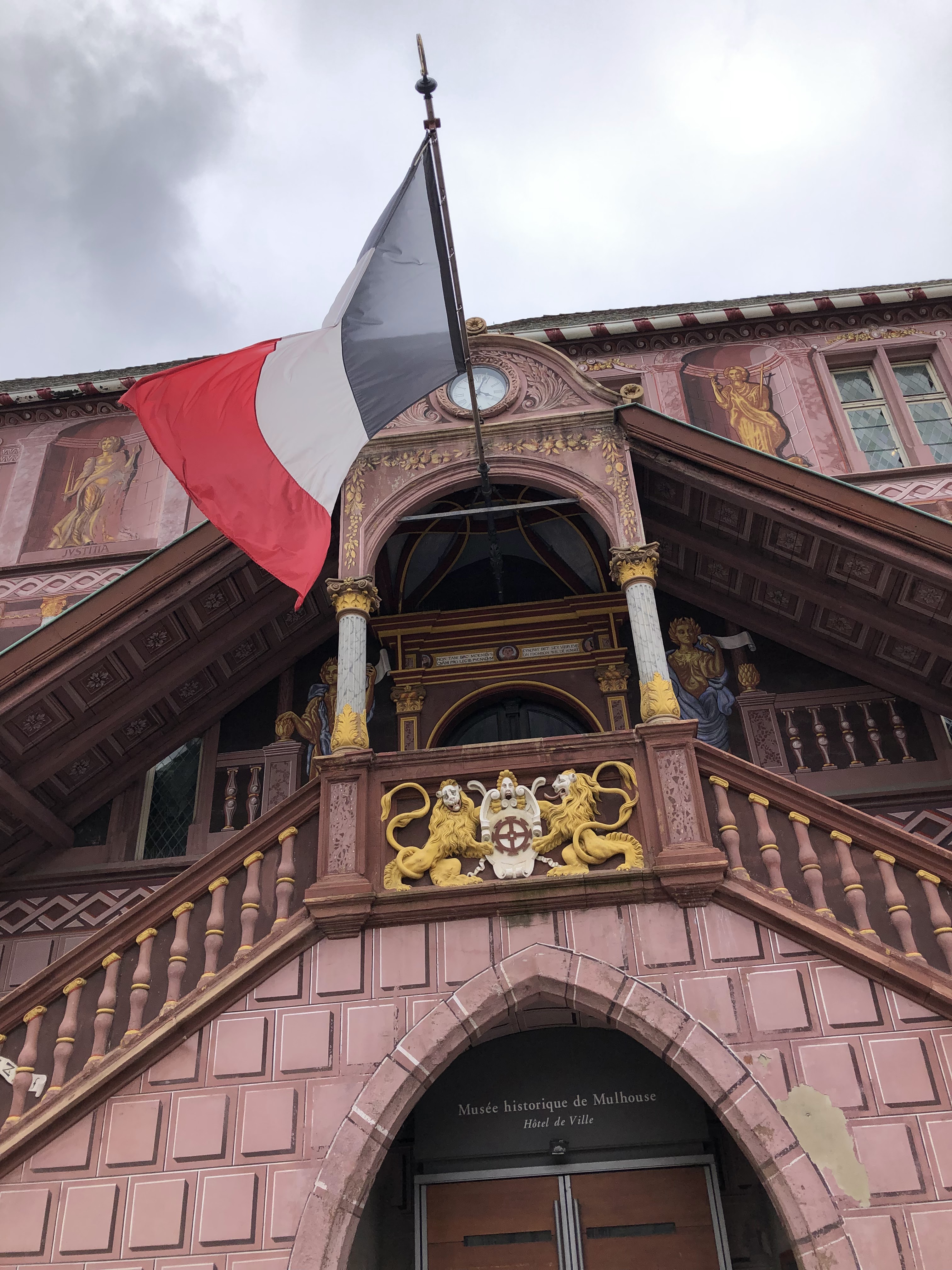
Temple Saint-Étienne

Sticking with language for a bit, I have been feeling really at ease in my French since I came back. I don’t quite know how or why that is the case seeing as I spent the summer 1. attempting to speak German (not succeeding), 2. immersing myself in as much Spanish as possible while working in a very multicultural hostel and 3. back at home able to understand everything going on around me for the first time in many months. I did get a little bit of French practice with some of the guests and other volunteers in La Tortuga but not that much. I think that either without realising it, or at least without giving myself credit for it, my French has gotten to the level that I want it to be at. I’m not and have never really been interested in speaking my languages like a native speaker. That is a close to impossible task and requires dedicating an inordinate amount of time and effort to it, and is even more difficult to do with more than one. Because there are multiple languages that I’m already passionate about and even more that I still want to learn, it’s not particularly realistic or feasible for me to do this. My goal has always been communication and ease. I don’t want to feel like I have to translate everything someone says to me into English to understand it and then do the reverse with my response. I want to be able to dedicate time to one language, leave it for a while to focus on another, and be at a good enough level that when I come back to it, it’s there waiting for me. This is what I feel like I achieved with my Spanish after spending a year in Honduras. I didn’t quite get there with my five months in China (I think a bit more than a year would be necessary as well) but I felt like I made some inroads. French has always been the more neglected and that’s what this time in France was supposed to fix.

The change this year compared to last is that I really have more confidence in myself. I don’t have to think about what I’m listening to or trying to say anywhere near as much as I had to last year. Everything just feels easier. However, one of my main struggles with speaking French, or any language for that matter, is getting my personality through. For so long after you start learning a foreign language, the focus is solely on communication. It’s difficult enough to make yourself understood that how you say it doesn’t really matter. I feel like I’ve gotten to the point now where I can express not just my meaning but my humour in French. Another aspect that shows my progress, to me anyway, is that I can swear more comfortably in French! In my professional opinion as a language teacher, swearing is actually an important sign of fluency. I’m not saying it’s something that I teach in class but it does make me smile when I hear my students dropping in a few curse words and it sounds natural!

A mural on campus

Speaking of being back in the classroom, coming back not just to Mulhouse but to my job as a lectrice with a year of experience already under my belt has been refreshing. I won’t pretend that I understand all the intricacies of the French higher education system (there are far too many acronyms for that) but I at least feel more comfortable in what I’m doing. The fact that I already know (and like) two-thirds of my students is also a comfort. Despite having this reassurance behind me though, since arriving back I have felt like I’m cycling through confidence in my abilities and that dreaded imposter syndrome. I don’t want to be an English teacher but I still think I’m pretty good at it. Sometimes though, my lack of formal training gets to me. For example when a student asks me a question and I can’t answer it or has an issue that I don’t know how to fix. There’s not too much I can do to fix it but I do what I can, whether it’s extra research in my free time, sharing resources with other lecteurs or asking my more qualified friends for advice and help.

Saying all that, I don’t feel like I have as much to prove this year, whether it be personally or professionally. In terms of work, last year I wanted to make a good enough impression that I would get asked or accepted to stay for a second year. I also wanted to get off on the right foot with my students as I knew that would help my confidence in the class. Personally, it wasn’t about anyone but myself. Last year I had this feeling of wanting to make the most out of my time here. When I arrived I wasn’t entirely set on staying for two years but even once I had decided that I was going to stay, there was still a feeling of pressure to do and see everything possible. This year I feel more like I’m just living my life. Of course there are still places I want to go and things I want to do, but I think the intention has changed. I’m just doing them because I want to, I want to take that trip or do that thing with my friends or try this restaurant. There are also days where I want to go to bed early or spend all of Sunday in my pyjamas without leaving the house. That’s ok too!

A blurry picture of Canadian Thanksgiving!

I do still have an idea of what I want to achieve in the next wee while though. I’ve got a few goals for this upcoming year and as a way of holding myself accountable for them, I’m going to share some with you.

  • Write a blog post in French – I have always wanted to write a blog post entirely in another language. I almost did it in Spanish right after getting back from Honduras, when my Spanish would have been at its best, but I never got round to it. I never quite got to the level with my Chinese where I felt like I could do it, at least not an entire blog and not to my usual standard. With French, I definitely think I’m at the level where I could, I’m just waiting for the right blog.
  • Integrate different kinds of blog posts – I have a lot of different things that I want to write about in the coming months. There’s still so much that I want to talk about when it comes to Mulhouse, Alsace and living in France but there’s also lots from the summer that I haven’t written about yet. There are other ideas that have been in the back of my mind for a while as well that I would love to finally get out. Have a look below to see some of my upcoming ideas!
  • 3-4 posts a month – This has been a goal of mine since the start of the year. Preferably I wanted to be writing a blog a week but some months that’s not quite possible. I haven’t always hit 4 posts a month, sometimes not even 3 but I still like having that aim in the back of my mind. I’m going to keep it going forward, at least until the end of the year.
  • Keep my classes fresh and interesting – When it comes to work, my only real goal is to keep my classes varied and exciting. I might be feeling a little less enthusiastic about teaching English this year but that’s my problem, not my students’, so I don’t want them to feel any of it. So far this semester we’ve had some really interesting discussions about the monarchy, reality TV and cancel culture to name a few. If I can keep them engaged and improving for the rest of the year, I’ll be happy.

As well as goals for this year, I also have a little bucket list of destinations that I would like to make it to before I finish my time in France. I already have some of these scheduled into the holidays that I know I will have and some are achievable in a day trip or for the weekend. There’s definitely too much here to fit everything in before April or May, my likely endpoint in Mulhouse, but I’d rather aim high and see how much I can fit in.

  • Morocco – All booked and happening in under three weeks!
  • Liechtenstein – After visiting Andorra last year, I want to visit more of these microstates, including Liechtenstein on the eastern border of Switzerland.
  • Madrid – I have the start of my February break earmarked to tick this one off. I’ve been wanting to go for a while and I have some friends there that I want to visit. I think I’ll also visit another city or two, maybe somewhere new, maybe back to Barcelona which is somewhere that I really like.
  • Dijon and Lyon – Two cities not far from Mulhouse so definitely doable over the course of a weekend.
  • Villages in Alsace – I still haven’t seen that many of the smaller villages in Alsace. They are supposed to be beautiful and have held onto a lot more of the traditional Alsatian culture than Mulhouse. They’re a little more challenging to get to without a car but not impossible with some planning.
  • South of France road trip – I think this will be something to keep for springtime, to avoid both the height of the heat and tourist season. I’ve never been down to the south of France so there’s lots of places I want to see!
  • More of Germany – I’ve ventured to Freiburg and Munich so far but while I’m right next door I would love to see more of Germany. This is a little bonus though, not top priority but if I have enough time and the stars align then we’ll see.
  • Skiing in Andorra – This would be another little Brucey bonus. Ever since I was in Andorra last year and I saw how much the country is clearly set up for skiing, I’ve wanted to go back. I’ve since talked to people that have been skiing there and they said it was great!

And finally a little sneak peek at some of the blogs that I would like to write soon (in no particular order)!

  • An intro to Mulhouse
  • My favourite cafes
  • The museums of Mulhouse
  • Alsatian food
  • The Alsatian language
  • Why I’m learning Gaelic
  • A week on the isle of Lewis
  • More Tenerife blogs
  • Travel tips
  • Useful French phrases
  • Lesson plans 

If there’s anything else you want to see me write about, let me know! As for this more reflective kind of blog, I used to write them to mark an anniversary, like one month, three months or six months. I feel like I’m a little beyond tracking these monthly milestones now but I will still be writing these, just based more on when I feel the want or need to get something off my chest and onto the page.


Reflections on Summer 2022

I’ve been back in Mulhouse for a couple of weeks now and it feels like life is back to normal. I’m back in the same apartment as last year, I’ve started teaching again and I’m back into a routine. There are some changes this year and some exciting things coming which I will fill you in on in due course but now I want to take some time to look back on the last few months. I had such an incredible time over the summer, with my travels, my time in Tenerife and being at home. I want to take a moment to reflect on that, the things I’ve learned and the things I’ve gained from it.

First of all I feel incredibly fortunate to have been able to spend my summer in the way that I did. Not everybody has the chance to potter about Europe in the way that I have, whether it is because of time, money or a whole host of other reasons. The perks of working at a university means that I benefit from the long holidays at Christmas and over summer. The benefit of being a lowly lectrice means that I don’t have to spend those holidays doing research or planning entire courses so I am free to use them exactly how I want to.

In terms of the cost of my travels here, there and everywhere, I have shared some spending breakdowns on various blogs (here for two weeks in Germany and Austria and here for seven weeks doing Workaway in Tenerife). I try to keep things pretty cheap, saving money wherever I can and having a bit of a budget. I didn’t always stick to the budget but things like staying in hostels, choosing free activities and cooking for myself instead of eating out all the time are some of the ways that I kept my costs down. All this was how I managed to afford this summer while I was on the go but how did I afford it in the first place? I’m not going to lie and pretend that I earn a ton of money as a lectrice. Don’t get me wrong, it’s enough to live comfortably on and is fair for the number of hours that I work but doesn’t leave a lot left over at the end of the month. With that in mind, I would say that I am a saver rather than a spender and always have been. I try to put aside a chunk of each of my paychecks and don’t spend a lot of money on myself. I would much rather save it and put it towards a future trip. Over time, this builds up!

Goofy outtakes with my sisters and cousins

I had a great time across the whole summer, chilling at home as well as spending a couple of weeks travelling in Germany and Austria but my favourite part was by far my time in Tenerife. I’ve spoken at length about how incredible it was working in La Tortuga through Workaway and after being on the road for almost three weeks before I got there, it was nice to slow down once I arrived. Overall I found it much more fulfilling being somewhere for longer and getting to know it better. It also felt like a more sustainable way to travel for me. Moving around places and cities every few days can be exciting but also exhausting!

Tenerife also added to my collection of friends around the world. I feel incredibly lucky to have made the connections that I have over the years with the people I meet along the way. Whether it’s my second family in Honduras, the friends I made while studying in China that I’m visiting in Morocco next month or my fellow volunteers and the guests from La Tortuga, I have met some very special people. The more people I meet, the more places I want to go so I can visit them!

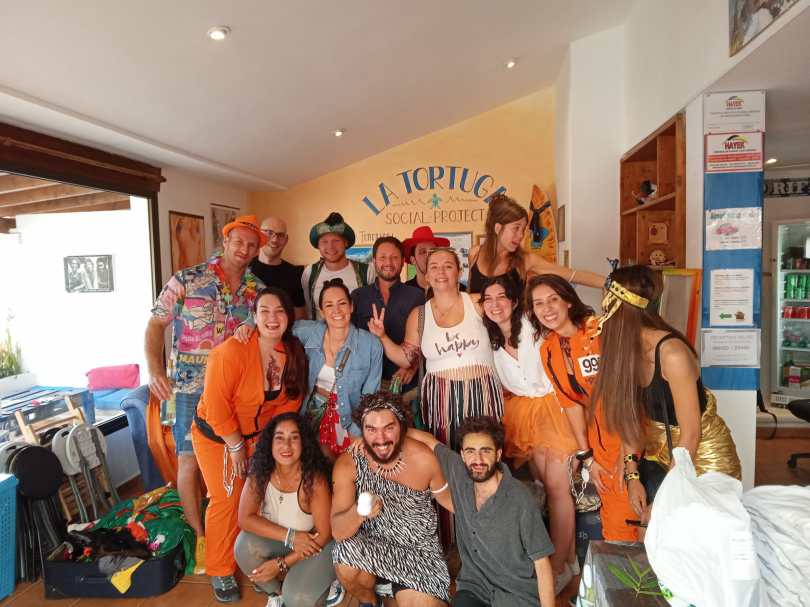
Tortugeñ@s

Spending almost two months on a Spanish island was great not just because of the amazing things I got to do or the people that I met, but because I got to speak my favourite language. I’m really pleased with how much my French has improved since moving to France and Chinese is special to me because of how much effort I have put into it but I’ve always had a soft spot for Spanish as it was when I started learning it that my passion for languages really took off. It was also the first language I learnt fluently and is attached to so many memories that I hold close to my heart. It was great to be able to stretch those muscles again after five years without using them for more than a random conversation here and a long weekend away there. I also got to add to my very eclectic collection of vocabulary and phrasing that has its roots in Honduras and has influences now from mainland Spain, Chile, Argentina and a mish mash of other places. I love that my Spanish doesn’t conform to one regional accent or dictionary but instead is a patchwork of the people and places that have taught me.

I also feel more intrigued by Spain than I ever have before. Most of my interest in Spanish has been related to my time in Honduras and Central America and other than a week here and there I haven’t spent a lot of time in Spain. I will say here that although Tenerife is a Spanish island, the local culture is much more Canarian than Spanish. Saying that, it’s still the first time that I have felt drawn to Spain in this way. I will always feel pulled back to Tenerife now but I am also more intrigued by mainland Spain now. Who knows when it might happen but maybe I’ll end up living in Spain for longer than a couple of months at some point?

Ten weeks after leaving my home in Mulhouse, I finally made it back home-home. That is to say that I made it back to Scotland and back to Dunblane. I have previously written about my complicated feelings about coming home to Dunblane in general and specifically after a period of travels or living elsewhere. The concept of home and the feelings attached to it are often complex, and not just for me. I’m always happy to be back and able to see the people that I’ve missed more than anything but without those people in Dunblane I wouldn’t be going back to visit. There are other places in Scotland that I feel much more attached to, in particular Edinburgh.

For the first time, however, I had a real desire to be at home in Dunblane. Not just to visit my family and friends but to actually be at home, in that environment that I know so well, that feels familiar, that I grew up in. I hadn’t felt this before, even after a whole year in Honduras, even after being the furthest I’ve been from home while in China, even when I was last at home in February after missing Christmas because I got covid. It was an intense feeling and a new one for me. I still don’t know exactly what caused me to feel like that. I’ve always come away from an extended period living somewhere else wanting to stay longer but something felt a little different. As much as I loved my time in Tenerife, I was ready to come home at the end of it. As much as I enjoyed my first year in France, I was longing to go back to Scotland.

At this point I knew that I was coming back to France for a second year as a lectrice. I’m still not entirely sure why but lecteurs and lectrices can only stay in their position for a maximum of two years. I had decided not long after arriving in France and getting started that I wanted to stay a second year. I enjoyed the work, I like Mulhouse and I’d set up a nice life for myself there. I also wasn’t sure what it would look like if I didn’t stay for a second year. I graduated university with this idea that I wanted to move to France and get my French to the level that I wanted it. There was also an element of taking back what the pandemic had denied me because I didn’t get to spend any time in France during my year abroad. When I arrived, I had a vague idea that I might want to go to China after I finished my time in France for similar reasons. While I would still like to go back to China one day, I don’t think now is the time. There are still a lot of covid restrictions in place that make it hard to get a visa and that restrict life and travel once you are there. I also don’t want to continue being an English teacher (which I’ll expand on later) but I think that would be the easiest way to get back to China in the near future.

The combination of this desire to be back home in Scotland and the uncertainty of where I’m going after my second year in France is done had and still has me considering whether I want to move back to Scotland. I have always felt like a restless soul and have never seen settling down in one place as something I would do until much further in the future. Saying that, I’ve always had the feeling that if and when I do choose somewhere more permanently, it would most likely be in Scotland because that is my home. I’m not saying I’m ready to take that plunge and be in Scotland for the rest of my life. Even just in this blog post I’ve talked about potentially wanting to live in Spain at some point. But maybe the way I was feeling was a sign that moving home, even temporarily, should be in my future?

What made this more complicated was that when I first arrived back in Scotland just after the start of July, I wasn’t exactly looking forward to going back to France. Like I’ve already said, I don’t know where I’ll be after this second year in Mulhouse but it most likely won’t be France. I like the life that I’ve built here but it was never supposed to be long term in the first place. It’s not that I didn’t want to go back at all, I knew what I had signed up to when I agreed to stay on for a second year. I knew that all I needed was some time at home. I just needed to fill myself up again from being around my friends and family and also having some time to do nothing. Sure enough, after a couple of weeks I was already starting to look upon my return to France with more excitement.

HebCelt 2022

Another thing playing on my mind was my choice of job. I don’t and have never wanted to be an English teacher. That’s not to say that I don’t enjoy what I do and I actually think I’m quite good at it but it’s not my passion. I have been involved in teaching for years, ever since I became a swimming instructor at the age of 16, through my year teaching English in a primary school in Honduras, back into the pool through university and now finally in Mulhouse. At the same time, an unavoidable question when you choose to study languages as a degree is ‘So are you going to be a translator or a teacher?’. I have known since I first embarked on that path that I didn’t want to do either. I’m still not exactly sure what it is that I do want to do but I know it’s not English teaching. Knowing all this, and with all these other questions swirling around my head about what the future might hold, had me questioning what I was even doing going back for another year. I felt like it would be a waste of time.

I’ve since knocked myself out of that spiral. I think a lot of these thoughts came at a point where I was just feeling a little bit lost. I still don’t know where I’m headed but I’m secure in the knowledge of where I am. Yes, I don’t want to be an English teacher for the rest of my life but I am grateful for what this job has given me, allowed me to do and taught me. I enjoy teaching, I enjoy interacting with my students and I share their passion for languages, just for different languages. It’s not a waste of time at all because there are things to be learnt from any experience and it is what you make of it. For now, I’m focusing on giving my all while I’m still here and making the most of it. I’m sure there will be more updates down the line as I (hopefully) get closer to figuring out what I’m doing with my life!

Hiking in Tenerife

As a Brit, hiking is certainly not the first thing that comes to mind when I think about Tenerife. It’s definitely known more for resort holidays and Brits abroad. While this type of holiday or tourist dominates the south of the island, it is still possible to find pockets of hiking. Elsewhere on the island you are much more likely to find people that have come to Tenerife for outdoor adventures. For example, 3 million people visit the volcano each year. The north of the island is also a hotspot for hiking because of the Anaga rural park. This part of the island is particularly popular among Germans, to the point that you will find a lot of the signs in Anaga in Spanish, English and German. While hiking isn’t the top of my list of activities, I did a fair bit while I was in Tenerife and enjoyed it a lot! I’m here to share some of my wisdom, both from personal experience and from what I picked up while working in the hostel. For example, I didn’t climb Mount Teide in my time on the island but I gathered lots of information from the people that did.

Mount Teide

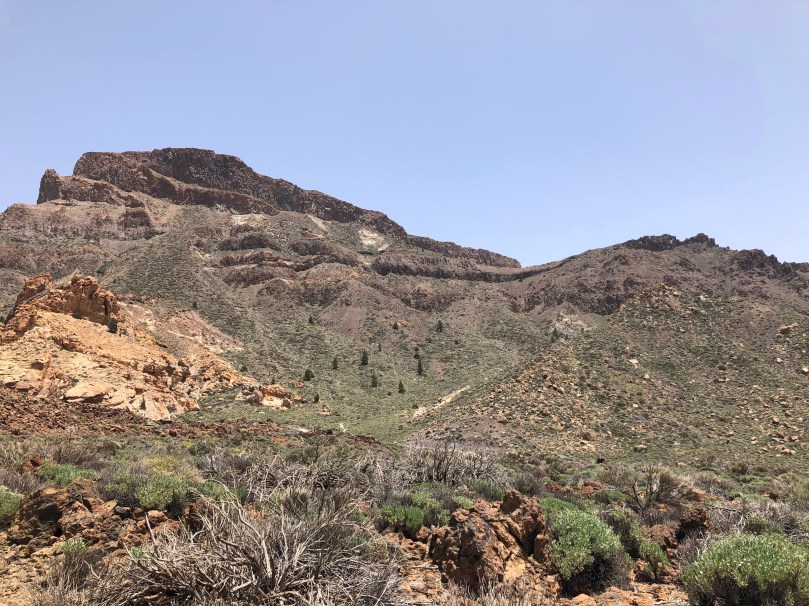
The view of Teide from the foot of Montaña Guajara

Mount Teide is the dormant volcano at the centre of the island of Tenerife. It is the highest point in Spain and also the highest point in the islands of the Atlantic. It has been a UNESCO World Heritage Site since 2007. It is the most visited natural attraction in all of Spain as well as the most visited national park in Spain and Europe and the eighth most visited in the world! It’s a popular place! Because of that there are certain restrictions around climbing to the peak that I’ll get into. There are also some controversial plans to restrict entry to the national park as a whole. The aim is to improve conservation by restricting cars and instead implementing guided tours by bus, similar to the situation in Timanfaya national park in Lanzarote. However, there is some resistance which I think is very valid, especially when it comes to restricting access for Canarians as well as just tourists.

The main Mount Teide hike via Montaña Blanca is just under 9km long and takes most people 5-6 hours. It has some very steep stretches but the main difficulty comes from the altitude change, starting from 1,367m and finishing at 3,718m. There are a couple of different options when it comes to climbing Mount Teide.

Teide with the Boca Tauce lava field in the foreground

By day: 

  • Mount Teide is in a national park and for conservation reasons the number of people allowed to summit per day is limited to 200. Because of this you need a permit to reach the very top between the hours of 9am and 5pm. It is free to reserve but needs to be applied for 2-3 months in advance as slots fill up fast.
  • You can still climb Teide without a permit but will have to stop 200m from the peak. There are a lot of hiking trails around here so if you want to hike the volcano but don’t have the permit it can still be worthwhile, as long as you don’t mind missing out on the last little bit!
  • Climbing by day in the summer can be very hot and the sun is very intense without many areas of shade during the ascent. 

By night: 

  • Because of the permit needed to summit during the day, many people choose to climb Teide by night. Starting around 2am will get you to the summit for around 7am in time to watch the sunrise over the clouds, an incredible experience. 
  • Compared to hiking during the day, it gets very cold on the volcano at night. You will need lots of layers and a head torch to light your way. 
  • You must have left the summit by around 8am to start your descent. This is when you will get to actually enjoy the views now that there’s daylight to see them!
  • Some people stay at Hotel Parador near the start of the trail so that they are nearby for starting to climb in the middle of the night. There is also the option of staying the night at the Refugio Altavista at an altitude of 3260m. You climb to this point the day before (the refuge opens at 5pm) and then set out for the summit in the morning. It takes less than two hours to reach the top from the refuge. Note that there is a kitchen but you must bring your own food and there are toilets but no showers.

Teide also has a cable car that will take you up to less than 200m below the peak. It starts from La Caldera de las Cañadas (the crater surrounding Teide) at 2356m. There is always the option of climbing up and taking the cable car down or vice versa, or taking it both ways if you want to maximise your time on the island. It takes 15 minutes and costs €38 for a return ticket. A few things to note when it comes to the cable car. If the wind is too strong, they will close the cable car. I have also heard of some people having more difficulty with the altitude when taking the cable car. Issues with altitude are something to be cautious about in general as it can make the climb more challenging than it would be otherwise but there is less time to acclimatise when taking the cable car.

A few notable attractions on Teide are its shadow and the observatory. The shadow that Teide casts on the sea is the largest of its kind in the world. It is projected more than 40km from the summit, reaching all the way to the islands of La Gomera in the morning and Gran Canaria in the evening. Because of Teide’s height and position above the clouds most days, it is also the perfect place to have an observatory. Teide is a great place in general for stargazing.

Montaña Guajara

Next up is an alternative to hiking Teide itself. Montaña Guajara is a much smaller mountain on the other side of La Caldera de las Cañadas that looks over to the volcano. It has some of the best panoramic views in all of the Teide national park, in my humble opinion. If Teide seems a bit intimidating, as it did to me, if you don’t have the time or if you have any other hesitation about hiking Teide, Montaña Guajara is a great option. Some of the other volunteers and I were looking for a hike to do near Teide and this was recommended to us by our all knowing receptionist Karen.

The full Montaña Guajara trail is a roughly 10km loop and takes 5-6 hours to complete. The hike is rated as medium difficulty but has some very steep sections and is generally covered in scree so can be a bit slippy. I wouldn’t say you need any fancy shoes though, even specific hiking shoes. I just had trainers and one of my friends did this hike in a pair of chunky Filas (not your average hiking shoes for anyone that doesn’t know). Montaña Guajara is a peak of 2,718m but the ascent starts from 2,100m at the Cañada Blanca visitor centre. There is very little chance for shade on your way up so take a hat, sunglasses and lots of suncream. Don’t forget to reapply! Also take more water than you think you’ll need, generally a good strategy for hiking in hot weather. There is a small cafe at the visitor centre but we brought our own picnic lunch of sandwiches and salad to keep us going.

Hiking buddies!

On the practical side of things, the easiest way to access this hike is if you have your own car. Drive up to the Cañada Blanca visitor centre and there is a car park there. This is also the place to head if you want to go to the Roques de Garcia, another popular area to hike around but not one I’ve been to. But fear not! If you have no car this is still very doable as I was in this situation. Coming from the south of the island, bus 342 leaves from Costa Adeje bus station at 9.15am and will take you up to the Teide national park. There is only one of these buses a day so be there a little early to make sure you get a seat. It will take about 1h40 to get to El Parador where you should get off, right by the Cañada Blanca visitor centre. There is also only one return bus that will reach El Parador around 15.40, giving you about three and a half hours to enjoy the hike. Unfortunately this isn’t long enough to complete the whole loop but we worked our way up, taking lots of breaks and stopping to eat and enjoy the view. We still made it to the ridge below the peak itself before we had to head back down and the views are unparalleled. It’s hard to imagine that they could get much better from further up.

I would recommend heading into the visitor centre before getting started. They are able to tell you exactly which trails you need to follow to get to Montaña Guajara. There are lots of routes that start from this same area so better to ask and be sure that you don’t start off on the wrong one. From what I remember (but take this with a pinch of salt), to go anti-clockwise round the loop you start on trail #4 (Siete Cañadas), join #31 briefly and then #5 will take you to the top. If you do want to carry on down the other side, follow #15. During the climb you will be able to see over to Teide in all her glory. Those with eagle eyes can spot the cable car, as well as the Roques de García below and the lava field at Boca Tauce off to the side. Depending on the weather you might also see the ‘sea of clouds’, when the cloud line sits at 1600m which is well below the altitude of Montaña Guajara. 

Masca

Looking down on the starting point of the Masca Gorge hike and the gorge itself

Possibly the most famous hike on the island other than Teide, the Barranco de Masca hike is another one that I have not personally done but gathered plenty of information on during my time on Tenerife. Masca is a hamlet with a current population of 90 nestled in the Teno hills on the north west coast of Tenerife. The town is a popular attraction in its own right and somewhere I visited more than once for its incredible scenery. It is known as the ‘lost’ or ‘forgotten’ village by some which you will understand when you see how well it has assimilated into the hillside. It is accessible by car down the treacherously steep and winding road down from Santiago del Teide or from Garachico in the north via Los Silos. Favoured by bus tours, it is best to visit the town earlier in the morning or late in the afternoon. 

Masca’s main attraction is the Barranco de Masca (Masca Gorge). The gorge is 5km long and descends to the ocean and then returns back to the town, a hike of 10km in total. In total it should take no more than 7 hours although it is possible in less. Previously you could hike down the trail to Masca beach and take a ferry to Los Gigantes, past the cliffs of the same name. I think this would be so cool and you would get the best of both worlds, the downhill part of the Masca hike and then the chance to see the incredible Los Gigantes cliffs from a new angle. Unfortunately this is no longer possible as the Masca jetty is currently closed to the public. It has been this way since the start of the pandemic but there is hope that it will be open in the near future!

If you want to hike the gorge, you will need to book a slot. Currently the barranco is only open on Saturdays, Sundays and bank holidays, from 8.30am to 11am March-Oct and 8.30am to 10.30am Oct-March. The trail closes at 6pm all year so you must have returned to the start point by this time. Because of the limited opening times, spaces book up well in advance. The trail can also be closed due to adverse weather in which case you can change the date of your reservation or get a refund. You will need to arrive 30 minutes before your reserved slot and have a piece of ID with you.

The hike has a fairly high difficulty with rocky ground and slippery sections along the narrow path which means there are certain restrictions for hikers before you are allowed to enter. You must wear closed toe hiking boots with ankle support and deep lugs, indentations that improve grip. If you arrive wearing normal trainers or open toed shoes you will be denied access to the trail. You will also be given a helmet by trail staff. Currently it is free to hike the Masca trail but soon tickets will be €8 for residents of Tenerife and €16 for visitors. The money will go to conservation and safety of the gorge. 

Barranco del Infierno

Last but not least, we have Barranco del Infierno. Just as Montaña Guajara is a good alternative to hiking Teide, this is a great and much less popular alternative to Masca. Barranco del Infierno means Hell’s Gorge and is located in the town of Adeje in the south of Tenerife. Adeje is an interesting town to visit because other than the barranco, there are no other tourist attractions so it’s filled with locals. If you want a slice of every day Tenerife, Adeje can give you some insight.

The total route there and back is about 6.5km with minimal ascent or descent. It takes about 2.5 hours to complete at a very leisurely pace or as little as 1 hour if you really pace it. Like Masca, you must reserve a slot in advance. However, because it is a less popular trail it is possible to do this the day before or even the day of. You can enter the trail between 8.30am and 11.30am and it closes at 2.30pm at which time you must have exited the trail. Barranco del Infierno is also a protected area so tickets cost €11 for visitors and €4.50 for residents. 

Made it to the waterfall!

Because the level of difficulty is low for this hike, you don’t need to have proper walking boots. Trainers are fine but they cannot be open-toed. You will also be given a helmet to wear. The hike ends at a waterfall but don’t hold your breath. It isn’t anything too impressive, especially in summer when it is rather dry. The real views are as you make your way down the gorge. A top insider tip, end your hike like I did at the Restaurante Otelo right next to the starting point. Try the chicken or the rabbit for some typical Canarian food! 

Bonus – Anaga Rural Park

This photo doesn’t do justice to the spectacular scenery in the park!

Anaga Rural Park makes up the most north eastern part of the island, what could be described as the panhandle if looking at Tenerife on a map. It is also the oldest part of the island, having been created 8 million years ago from a volcanic eruption. It is full of craggy peaks and deep valleys covered in lush green vegetation. This will really show you the stark differences between the north and the south. In the north you need jumpers and a rain jacket while the south is shorts and flip flops!

Because Anaga is the furthest point on the island from where I was staying down in Costa Adeje (still only an hour by car but closer to three by bus) I only got to visit once. It was combined with a visit to a nearby beach so I didn’t have a lot of time to spend there. Because of this I sought out a pretty short hike just to get a feel for Anaga. I was recommended to head to Cruz del Carmen which is a viewpoint with some trails around it. On a clear day you can see all the way to Teide as well as the towns of La Vega Lagunera and La Laguna. This is a good place to visit in general, not just for the views but also because there is a visitor centre where you can get a lot of information on the park.

The view from Cruz del Carmen

There is a trail loop that leaves from Cruz del Carmen called El Sendero de los Sentidos (the Trail of the Senses). There are a few options of different lengths and difficulties but I decided to do the longest one because it was still only supposed to take an hour. I say supposed to because, even with a group of six people, we could not figure out the right route to take. We ended up doing the same section two or three times thinking we were missing a turn to get on to the rest of the trail but that turned out to be all there was and it was just shorter than we expected! If you don’t have a lot of time to do one of the longer hikes in the park, this is a good option so that you can still get a taste for it.

El Sendero de los Sentidos

While I was in Anaga I also visited the viewpoint of Pico del Inglés that has a view across the capital of Santa Cruz de Tenerife, the mountains of Anaga and Mount Teide. Unfortunately, the clouds and rain had closed in the day I was there so you could not see very much at all! We also ventured down from the mountains to the northern coast with the aim of reaching Playa Benijo, supposedly one of the most beautiful beaches on the island. However, I was the one driving and being on the right hand side was difficult enough but then the road got a little too narrow and challenging for my liking! Instead we stopped by Playa Almaciga and ate in Casa Pepe where I had the best octopus I’ve ever had in my life. I still think about it to this day…

Anaga Rural Park covers 140km² so there is plenty more to discover. The town of Taganana, on the road down to Benijo, has preserved its traditional Canarian culture better than many towns on the island and is also home to Las Vueltas de Taganana, a hiking loop of moderate difficulty that takes just under 4 hours to complete. There is also a hiking loop that will take you from the hamlet of Taborno to Roque de Taborno, known as ‘Tenerife’s Matterhorn’, which takes about 2 hours. There is El Pijaral, Tenerife’s Enchanted Forest (Bosque Encantado), a laurisilva or laurel forest in the south of Anaga. It is a protected area so you will need a permit to enter and while it is free, only 45 people are allowed to enter each day so spaces fill up fast.

Hopefully this has shown you a new side to Tenerife and given you itchy feet to get out there and go hiking! As I’ve said, some of these hikes I have already done but the rest are still on my to do list!

Natural Pools in Tenerife

Welcome back to another Tenerife blog! There’s so much to share from here so there will be a few more coming up soon and then probably some littered throughout the rest of the year and maybe even beyond, who knows? Today we’ve got a guide to some of the natural pools around the island which were some of my favourite things to visit while I was there. I’m starting in reverse order and finishing with my favourite but that’s not to say that I didn’t enjoy the others too!

Garachico

The Garachico natural pools are probably the most famous in Tenerife. The town of Garachico is a lovely town in typical Canarian fashion with picturesque streets and a lovely central plaza. It used to have one of the most important ports on the island, exporting Malmsey wine and other produce. This was until Teide, the volcano at the centre of Tenerife, erupted for several weeks in 1706. Lava flowed down into Garachico, partially destroying the town and decimating the port. However, it was this lava flow that created not just one but a series of natural pools which are now the most popular attraction and draw a lot of tourists to the town.

Garachico is in the north west of Tenerife, about an hour driving from Costa Adeje in the south (where my hostel was) and the same from Santa Cruz, the capital, in the east. The pools are in an area of the town called El Caletón and are well sign posted but if in doubt, just head towards the sea!

The pools

The pools are actually ‘natural’ (you’ll see what I mean when I talk about the next pool), being formed out of the lava that flowed down from Teide through the town. They have the look of rock pools but bigger and a bit more sheltered at times. It obviously depends on the tide and the weather as to the condition of the pools. It was overcast when I went and I would say the tide was at a medium level which is supposedly the best time to see the pool. Even if the sea was a little choppy, the arrangement of the rocks meant that the pools were much calmer, there being no tide in them. Because they are the most well known pools on the island they can be quite busy, especially the area closest to the parking and restaurant. If you take the time to head a bit further in, you can find some smaller but much quieter pools all to yourself!

Facilities

The pools are near enough to the town itself to be within a few minutes walk from plenty of restaurants, cafes and shops. There is also a restaurant and bar on the lava itself, right next to the pools. While the pools themselves are natural, paths have been created that wind through them so it’s easy to walk around. You don’t have to risk life and limb scrambling over slippy or spiky rocks just to find a good spot. A set of metal steps have been added to the sides of the bigger pools so that you can enter and exit gracefully, should you so wish.

Advice

A little bit of advice now, based on my experiences here. I didn’t see any changing facilities, not to say that they don’t exist, but it might be a good idea to come ready for a dip or with a good towel for a quick poolside change. Like I said before, if it seems busy, carry on a little to find a quieter spot. Also beware of the weather. There are some lifeguards near the larger pools and if the water is too rough, which it can be in autumn or winter, the pools might be closed. One more thing, and maybe the most important! After swimming in one of the smaller, quieter pools for a while, a local guy went in and pulled a sea urchin from right where we’d been swimming! There were several more around so be careful!

Other info

A really nice idea would be to combine a visit to the natural pools at Garachico with some of the other towns in the area. If you are coming from Santa Cruz, you could stop at San Cristobal de La Laguna, considered the cultural capital of the Canaries, and La Orotava, a stylish town known for Casa de los Balcones. If you are coming from Costa Adeje or the south in general, combine a trip to Garachico with a slight detour to see the cliffs at Los Gigantes and drop by Masca, a picturesque hamlet nestled in the mountains.

Los Gigantes

Los Gigantes is the name of both the huge cliffs that tower along a portion of the west coast of Tenerife and the town that sits below them. Los Gigantes, or ‘the Giants’, reach a height of 500-800m but are not the only attraction around the town. Los Gigantes also has its very own natural pool, officially called Charco de Isla Cangrejo (Crab Island Pool) but more colloquially referred to just as Los Gigantes, where you can enjoy a spectacular view of the cliff. Los Gigantes is about a 40 minute drive north of Costa Adeje and could easily be combined with a trip to Garachico if you wanted to make a day, or even just an afternoon, of it! 

The pool

I really like this pool despite it being the least ‘natural’ of the three on this list. What I mean by that is that even though the formation of the pool itself is natural, as is the area surrounding it, there is a concrete wall that has been put up to shelter it from the waves. To be fair, this is what makes it accessible in the first place so I can’t complain too much! There is a small car park near the entrance but also plenty of street parking around as well. It’s a short descent down some steps to get to the pool but from the top you get the most magnificent view of the cliffs of Los Gigantes as well as your first peek at the pool down below. The pool is super fun because at certain times and in certain spots it is super calm so you can just chill but if you go closer to the wall that I mentioned, you can wait for the waves to come crashing in! While in general I’m pretty satisfied with everything I got to do while I was in Tenerife, if there was one thing I wish I had done, it’s go to this pool to watch the sunset. The sun comes down right by the cliffs so it can be a really beautiful spot to spend the evening.

Imagine having views of these cliffs while swimming!

Facilities

Something to bear in mind is that there are no facilities at this pool. There are steps to get you down to the level of the pool but after that there are no special paths or anything. There is nowhere to buy food or drinks either so bring snacks and water (and maybe beer?) with you. Shade is also limited depending on the time of day and flat spots are few and far between. Think about bringing an umbrella but at least a cap and lots of suncream as well as a thick towel to sit on and flip flops or water shoes for walking about.

Advice

If I have some advice for this pool, it’s be careful! There are a few more risks here in terms of safety. For one, the entrance into the pool is very slippery and rocky so like I said above, water shoes are a good idea unless you can just tough it out. On a more serious note, the waves crashing over the wall into the pool can be fun but also dangerous. If the tide is high and particularly powerful, it’s advisable to avoid that side of the pool. There have been several accidents and tragically even a few deaths so this is something to take seriously. If the weather isn’t great, by all means go and enjoy the view which will still be spectacular but maybe give the swim a miss. 

Los Abrigos

Last but not least – Las Piscinas Naturales de los Abrigos! This is the least well known of these three pools. There’s not even a sign on the main road, just a lay-by for those in the know. This means that it’s much quieter as well and there’s nowhere near as many people as Garachico and even Los Gigantes. To find the pool get yourself to the town of Los Abrigos, towards the southern tip of Tenerife. From there take the road out of the town towards El Médano until you see a layby just before a banana plantation. It will take just a couple of minutes in a car or less than 15 minutes by foot. From this layby you head towards the ocean and you’ll find the pool!

The pool

The pool is actually pretty rectanglular shaped but it’s completely natural, nothing man-made about it! It’s very deep, although the exact depth depends on how high the tide is. When it’s low tide, the pool is full and some waves will make it over the barrier of rocks and slip inside. However when the tide is high, the water swells to the point that it crashes in and significantly raises the level of the water every few seconds. It was super relaxing just watching the water flow in and out, like watching the ocean breathing. This is my favourite pool that I visited. There’s something about the way that the water moved that kept me entranced. Whether I was actually in the water or just watching from the side, I found it captivating.

Facilities

To keep it short – there are none. Other than a set of metal steps to help you in and out of the pool, there is nothing there. Bring towels, water, snacks, whatever you might want for your afternoon at the pool. Saying that, you aren’t far from Los Abrigos and if you are walking from the town centre you will pass a supermarket where you can pick things up. There’s also a great arepa restaurant in Los Abrigos called Arepera Maracay!

Advice

Some advice for this pool now. I have been both when the tide is really high and the water level raises and lowers massively with every wave and also when the tide is lower and the water level is much more stable. Personally I prefer it when the tide is high because I think the sensation of the water lifting and lowering you is really fun and unlike anything else I’ve experienced. However, with that you have to be more careful. If you aren’t a strong swimmer or aren’t that comfortable in the water then it might be better to go at low tide. I would also suggest taking some goggles so that you can dive down into the depths of the pool. There is a fun little tunnel into a smaller pool to the side that you can try to swim through if you dare (although better in low tide or you will get thrown into the roof of the tunnel as the water rises at high tide). There are also plenty of fish to see in the pool because it is filled with water that has crashed in from the ocean just a few metres away and there are crabs scuttling up and down the rock walls of the pool!

Other info

As you descend from the roadside to the pool itself, you will pass a series of caves in the rocky hillside as you make your way down to sea level. There are more caves if you take a walk along the coastline and the more eagle eyed among you might spot signs of life in them. Towels hanging outside, handmade signs and even some of the people that live there! I don’t know a lot about this community but it seems to be made up of some people that live there more permanently and some who come to experience it for a short time. It also seems to be a choice for most people living in the caves, rather than any kind of economic necessity. From the outside looking in, it has a very bohemian, hippy energy. The caves near Los Abrigos are not the only inhabited caves on the island, there are also people living in caves near the town of La Caleta, further north along the western coast from Los Abrigos.

While you are in the area, you could combine a visit to las piscinas naturales de Los Abrigos with spending a few hours in the town of El Médano, just a ten minute drive from Los Abrigos. On Tenerife, El Médano is synonymous with windsurfing. You will feel why the second you arrive in the town. It is noticeably windier than anywhere else I’ve been on the island (except from one random stretch of highway on the way to Santa Cruz. I have no explanation for this but I always hated driving on that stretch of road). El Médano is a popular spot for tourists but a different breed of tourists than you will find saturating the resorts and British pubs of Costa Adeje or Las Americas. It is a laid back place that welcomes people who would consider themselves travellers rather than tourists. There are plenty of hostels, unique bars, cute cafes and independent shops. Try windsurfing, visit La Tejita beach or make your way up the Montaña Roja, a hill on the edge of town at the end of Tenerife’s longest beach.

Other pools

There are of course other natural pools in Tenerife. I didn’t even scratch the surface of them. A quick Google search will reveal them to you but some of the names I’ve come across most frequently are Charco de los Chocos in Los Silos and Charco de la Laja in San Juan de la Rambla (charco being a Spanish word for pool). Wherever you go, it’s sure to be incredible!

Rijeka, Croatia

I’m taking a brief break from Tenerife related content to fill you in on my recent trip to Croatia! Now that we’ve covered the basics of how I found my Workaway and what it was like, I’ll be back soon with more specific posts on the island itself. Think beaches, think hiking, best activities and road trip itineraries. But for now we’re taking a brief holiday to Croatia, much like I did!

This trip really was miraculous. Not because where we went was breathtaking or because I had a great time amongst friends, even if both are true, but because it even managed to get out of the group chat phase in the first place. I took this trip with my university flatmates. We all met in halls in first year and then lived together for our remaining three years in a flat in Edinburgh. We have thrown out many ideas for trips or adventures over the years but very few have actually come to fruition. I don’t really know what was different this time but the idea for this group trip was thrown out and really gathered momentum.

We started by finding some dates that worked for everyone in our very mixed group. We have two people with ‘big boy jobs’ as I call them, proper 9-5s down in London, two students finishing their final year or masters and myself, the English teacher who would be floating around Europe all summer. We settled on the weekend straddling the end of July and the start of August that coincided with a bank holiday. Next we threw out places that we would be interested in. Croatia was in there from the beginning as was Budapest. Once we started looking at flights, we were actually quite fixed on Milan because we found flights for something ridiculous like €20! In the end we swerved away from that because Milan in the height of summer would be packed for one and boiling for another. We found slightly more expensive but still very cheap flights to Zagreb in Croatia and that was it! Zagreb is a city in the centre of Croatia and we wanted something on the coast so we decided on Rijeka as a final destination, just a couple of hours on the bus away from Zagreb.

The view over Rijeka

Because some of the group are working full time while others are students or on holidays, we made our way to Rijeka in dribs and drabs. I travelled from London with Lizzie, one of the students. Luckily we were both there already, Lizzie spending some time with her family while also doing research for her master’s thesis and me doing the rounds of my friends that are down there. Our flight was at silly o’clock in the morning but we were hoping that this would help us avoid the worst of the airport chaos that has been plaguing the British travel industry this summer.

Our journey was pretty plain sailing (or should it be flying) until we landed in Zagreb, if very crowded along the way. We made it out of the airport just in time for the 1pm shuttle bus from the airport to the bus station. It took about half an hour and cost 45 kuna. It had to be paid in cash but you could also use Euros which would come out at €7. The issue here was that we were booked on a bus to Rijeka at 1.30pm. We pulled into the bus station at exactly 1.30pm and then couldn’t find the right platform so no luck in trying to jump on our bus at the last minute. Luckily there was another one with the same company at 2.15pm that we were able to use our tickets on so just a short wait. It cost an extra 10 kuna to put our wee suitcases in the luggage area below the bus. After our early start I slept away most of the two hours to Rijeka but the glimpses that I caught of the Croatian countryside were beautiful.

At this point we all know that I’m a big fan of staying in hostels but we had booked an AirBnB for our stay so that we could make the most of our time all together again. The AirBnB was literally 30 seconds away from the bus station which was great because the last thing you want to do after a day of travelling is trek to your accommodation. The apartment was really nice, plenty of space for the five of us with a nice living room and most importantly – air con!

Because it was just the two of us for our first night, we had a pretty chill one. We grabbed some groceries and made pasta for dinner and then took a little siesta before heading out for a wander. We made our way down the main street of Korzo and found a cute square through the arch under the city clock tower. Fun fact, the clock face on the tower has remained unchanged since the 1600s! After an early start and a long day we decided to call it quits early.

The clock tower on Korzo

We were joined the next morning by Georgia who had already been travelling in the Balkans for a few weeks and arrived in Croatia on an overnight bus. After taking Georgia to the apartment and catching up a little we decided we wanted to spend the day at the beach until the last two arrived in the afternoon. We grabbed a taxi from the bus station to take us to Sablićevo beach, just outside the centre of Rijeka. We hadn’t done much research into good beaches in the area other than a quick Google search but it did the job. It was small and very crowded as well as pebbled which was a bit annoying but there was a cute little beach cafe and space to swim and lie in the sun. The water was so beautiful, bright blue, warm on top and then freezing down below. We chilled on the beach a little and then moved into the cafe for a beer and an ice cream. Classic holiday behaviour.

Dina and Pippa were arriving at the bus station at around 4pm so we walked back from the beach with plenty of time to spare, grabbing some groceries on the way. Finally all together, we celebrated by making pesto pasta and taking a collective nap. Just kidding, we did do that but we also sat around a lot, catching up and enjoying each other’s company. Speaking for myself, I’ve seen each of them since we finished university but this was the first time that we had the five of us all in the same place since we moved out of our apartment in Edinburgh in May 2021.

We headed out for a few more drinks that evening, back to one of the bars that Lizzie and I had found the night before and then onto a place Georgia discovered. Here I have to admit that the nightlife in Rijeka is not exactly the most lively. However we did stumble upon a cool spot by accident, Klub Mladih. It was a youth bar and we pretty much stuck there for the rest of the weekend. It boasted something like 60 cocktails so we had a great time sampling as many of them as we dared!

The next day we all gradually surfaced from the night before, starting the day at our own paces. Dina and I were up a little before some of the others and decided to go out in search of coffee. Me and Lizzie had found a cafe just around the corner the day before that was literally called a book cafe. Is there any better place? We sat there for a bit and then headed back to make a nice brunch of scrambled eggs and avocado on toast. The plan for this day was to explore a bit more of the actual city of Rijeka. We started wandering back down the main street of Korzo in the daylight this time and found ourselves by St Vitus Cathedral. This is one of the well known symbols of Rijeka and actually appears on the 100 kuna banknote! Just beyond the cathedral we stumbled upon a tunnel that was built by the Italian military in WW2 as an air raid shelter. It’s 330m long and snakes beneath the old town, coming out by a primary school back in the direction of our apartment. It was free entry so we decided to go on a little adventure, even just to enjoy the much cooler temperatures underground!

St Vitus Cathedral

Continuing on, we passed by the Maritime and History Museum of the Croatian Coast and then carried on down towards the river. Our eventual aim was to walk up to Trsat Castle that sits above Rijeka but we stopped for a drink and a rest at a cute cafe called Bar Striga right by the river before embarking on the 128m climb. Now here I have a tip for you. If you follow Google Maps or even just the signs in Rijeka for the castle, you will be taken up a brutally steep set of stairs and you’ll be so dead by the time you get to the top that you won’t be able to enjoy it. Instead I suggest searching Križanićeva in maps and taking this windy road up the hill to the castle. Not only is it a much gentler incline but you will also be taken down this passageway filled with incredible street art. I mean, just look at that!

Bar Striga

About halfway up the more languorous route, you can actually cut onto the steps heading up which is what we did. Stairs in 30º+ heat are as bad as they sound but the views back down across Rijeka and out to the Adriatic sea are (maybe) worth it. Thankfully, you are welcomed to the top of the trek by a water fountain so you can replenish all the moisture you’ve just aggressively sweated out of your body. A couple of hundred metres more (along flat ground) will take you to the castle itself. Again entry is free which I think is good because it’s quite small and there’s not really much to see. The real benefit are the views, again back down over Rijeka and out to sea but also out the other side and over the hills that back the city. We had the obligatory photo shoot and then explored the parts of the ramparts that you can climb up before our stomachs demanded we find some food.

There are a selection of bars and restaurants at the entrance to the castle, and even one inside the main building, but none of them were serving food. We walked on a little more and tucked away next to sleeker, more modern establishments, we found Konoba Papalina. It was the rustic charm that drew us in and the warm welcome of the server that made us sit down. There were only a few specialty dishes on offer, no menu, and all fish or seafood. A couple of people went for the seafood risotto and a couple for the fresh mussels but I asked what our waiter would recommend. He refused to tell me but promised that it would be good so I sat back to wait for my surprise dish! It turned out to be the grilled sea bass served with blitza, a traditional Croatian side of chard and potatoes. The sea bass was delicious but I had to share with everyone because a whole fish proved to be a little too much for just me!

We headed back home, all ready for a shower and a nap, not necessarily in that order. We returned to our old faithful Klub Mladih where highlights of the night included a strawberry mojito and a dog! When you can pet a dog in the bar, a night out immediately gets better.

The plan for our last full day in Croatia was to head back to the beach! The initial plan was to head further afield to a new beach but after a later start than anticipated, we ended up back at Sablićevo. It was a great place to waste away the day. It was even more packed than Thursday, if that was even possible, but we marked out a spot and settled there. Rotating between lying on the beach and reading, a little swim and chilling in the shallows and chatting was exactly what we all needed. After a while, I had had my fill of sun and moved to the cafe again. I managed to get one of the deckchairs that faced out onto the water and sat there with a coke and a Nutella crepe – perfection. I even had a little kitten dancing around to keep me company. After we’d had enough of sun, sea and sand we got the bus back into town. We didn’t have it in us for another night on the town so we ended our time in Rijeka with a MacDonalds and a showing of Freaky Friday.
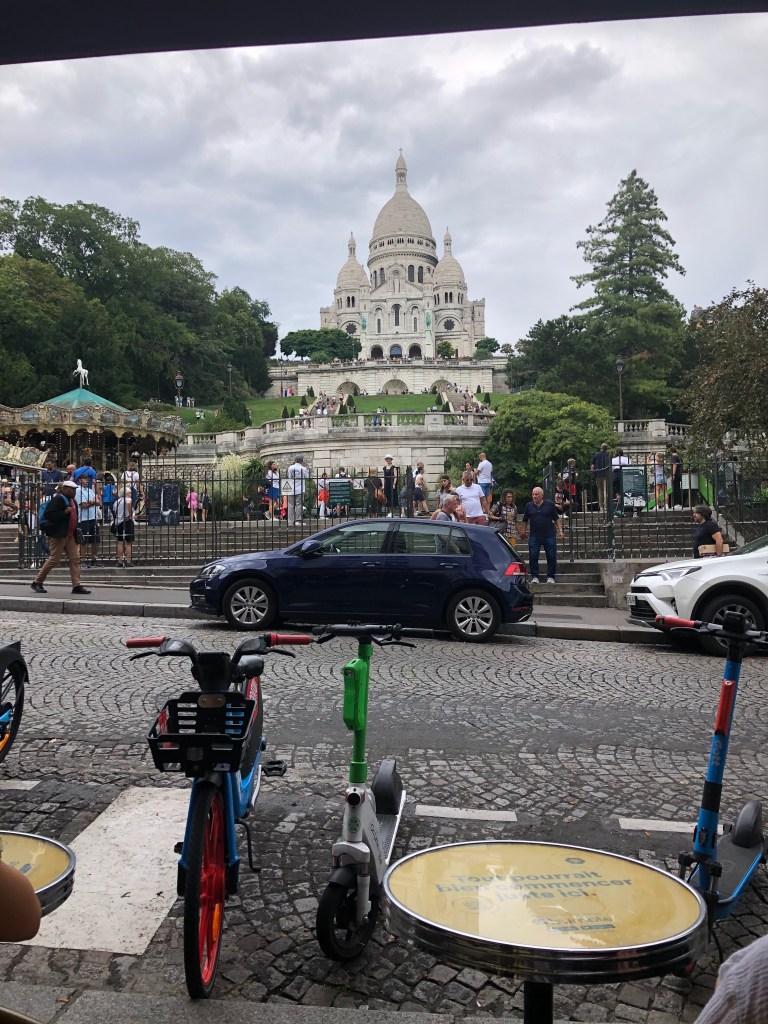
Monday morning meant that it was time to leave Rijeka. We weren’t actually leaving Croatia until the next day but our flight was from Zagreb and super early so we had decided to spend the night there. We got the bus again from Rijeka to Zagreb but all together this time. We had another AirBnB about 20 minutes from the bus station in Zagreb. We ended up chilling there for a while before heading into the centre of the city to explore a little and get dinner. The centre of Zagreb was cute, with some beautiful colourful buildings and churches. Dinner was ramen followed by ice cream for dessert, one last holiday treat. It was an early night because we had a taxi booked for 4am the next morning.

Main square in Zagreb

And now some final thoughts on Croatia. It’s a beautiful country that I definitely want to see more of. It seems like everyone I know was in Croatia this summer but in the more popular spots like Dubrovnik, Split or some of the islands. While I would definitely like to make it to those places one day, I’m glad that I avoided both the crowds and the heat for now. I think Croatia in the off-peak season is the way to go. Getting to know somewhere a little less popular like Rijeka was a nice taster. Even in that area, there’s now more places I want to go like the island of Krk or Pula, a town just around the coast known for ancient Roman buildings including the Pula Arena, one of the best preserved Roman amphitheaters.

Something I was so impressed with was the level of English everywhere. Even in a less touristy place like Rijeka, everyone we spoke to had a great level of English. We had attempted to learn a few words in Croatian, like hello and thank you, but there were limits on how much we could communicate. I really hate not being able to talk to people in their own language but I still felt really welcomed by everyone we spoke to, taxi drivers, waiters, people we met in a bar. It really made me think about how bad the British system is. It is impossible to learn a foreign language to fluency just through the British school system without some kind of outside help or experience yet it seems that in Croatia, the language skills do primarily come from school. It’s not just in Croatia that this is the case either.

Finally, just being amongst such good friends was so refreshing. I had been in London for a few days before we left and was really tired from that. I love visiting London because I have so many friends there that I love to catch up with but I find the city really draining. I was a little worried about going on a trip immediately after that as my social battery was already feeling depleted from a few days running across the city. I would describe myself as an extroverted introvert, in that I love being social and seeing friends and meeting new people but I then need to recharge with some alone time. Despite having lived together for four years, this was actually the first trip that the five of us had taken together and you never quite know how that many personalities are going to mesh together in a different situation like travelling. Despite all this, I came away from a busy five days feeling refreshed. My university flatmates are friends that feel like family and after being surrounded by them for a few days, they actually did fill my energy up again. Thank you ladies for a lovely few days!

Workaway: Expectation vs. Reality

This feels like a good point to compare what I experienced in La Tortuga with what might have been expected from the Workaway profile. I’ve explained to you what both parts involved, how I found the hostel on Workaway and what it was actually like working in La Tortuga. I will preface this by saying that I wasn’t disappointed in any part of the experience and this isn’t because anything was different from how it was advertised. I just think it would be useful to compare the two. It might help anyone thinking about using Workaway in the future to set their expectations when reading hosts’ profiles so they can find the right one for them.

Hostel

‘If you’re looking for fun, comfort and relaxation, then we are the place for you!’ This is the opening line of La Tortuga’s profile on Workaway and I think that’s a perfect encapsulation of what it is all about. The hostel is depicted as a harmonious place of gathering for all people from all places and that checks out. It also says that this ‘is not a party hostel, instead, wants to offer our helpers and travellers a comfortable, homely place to relax in where they can meet other like-minded people and as a base to explore the rest of the island.’ It’s definitely not a party hostel in the sense that people are not getting drunk, blasting music and partying every night. There are definitely a lot of fun times, especially on Wednesdays for the weekly trip to the flamenco bar, and in the evening the terrace is often filled with people chatting over a few beers. You are more likely to find someone strumming away on guitar than techno being blasted from a speaker. However there is a strict rule of no noise after 11pm, whether that comes from people or music.

Hammocks > all other seating

Duties

When it comes to the duties and responsibilities for volunteers there was a little bit of conflicting information on the profile. At one point it says volunteers are expected to work five hours a day, five days a week and elsewhere it says 25 hours over the week with three days off including one at the weekend. While neither of these is exactly accurate the second description is closer to what I ended up doing. During the time I was at La Tortuga volunteers worked four days a week which usually amounted to around 25 hours in total, give or take a few. However we weren’t guaranteed a day off at the weekend. I would say that this doesn’t really matter much though. When everyone else around you is on holiday, weekdays and weekends have less meaning. If there is a specific day you want off, all you have to do is ask! For example, my sister came to visit Tenerife for a few days and I was able to request not to work on those days, I just had to do it before the end of the week before.

The duties themselves were described as ‘cleaning (to a good standard), help with guests/reception and help with internet/computers.’ As I’ve said, not everyone will get trained on reception and I didn’t really have to do anything with the internet or computers other than trying (and failing) to get a livestream of a football match onto the TV. I wasn’t sure what cleaning ‘to a good standard’ meant and in my interview with the manager, Ale asked me if I cleaned to a British standard or not. I had no idea what that meant so I replied that I would clean to whatever standard he wanted me too! Turns out this was a good answer because the British are apparently not known for their high cleaning standards, unlike the Germans for example. Also unmentioned on the profile were some of the alternatives to the normal shift, where you might be tasked with the gardening for the week or asked to lead a group trip to the flamenco bar or to watch sunset on the beach.

Not too bad when going to a flamenco bar is part of the job!

Living Conditions

All that is mentioned on the profile about accommodation is that it will be in a 4-bed shared staff dormitory. This is accurate. The volunteer quarters in La Tortuga are in the main house and take up the lower level floor, basically the basement. There are two rooms here, one with an en suite bathroom as well as the storage room for cleaning products and kitchen supplies. Both rooms have two sets of bunk beds each so four people to a room, eight volunteers in total. Even though only one of the rooms has a bathroom, all the volunteers share it. It might sound like a lot, eight people sharing one bathroom, but it was nice to have one that was only for volunteers. One thing about La Tortuga is bathrooms were not plentiful so not having to share with guests was a blessing. I was in the room that wasn’t attached to the en suite so I had to go in and out of the other room to use it. At times this was annoying because if it was late at night after some people were already asleep or in the morning before a shift, I worried about waking people up. In those situations and when I didn’t need a shower, I would take my stuff to the toilet by reception and get ready there. Other people were less bothered and would just quietly go into the other room to use our bathroom. Even if I had to navigate that situation, I still preferred being in the other room because being in the basement, the rooms were warm enough as it was, I didn’t need the heat coming off the shower as well. We did have a fan in each room but after a certain point it’s just moving the hot air around.

Bathroom inconvenience aside, the rooms are clean because they are part of the morning cleaning routine. Whether they are tidy is more up to you and your roommates. There is plenty of space to unpack your clothes and there are also small lockers if you want a secure place for your valuables. In general, I didn’t actually spend a lot of time in my room other than sleeping. Obviously all the socialising happened upstairs in the common areas and even when I was just chilling, I would use the common areas when they were quiet in middle of the day when all the guests were out. Saying that, it was nice to hide downstairs for those times when things got a little too much or you just needed an hour without someone asking you a question.

Food

Often Workaway volunteers are compensated with accommodation and maybe some food. When it comes to food, La Tortuga’s Workaway profile is a little vague. ‘Breakfast and BBQ night included.’ That’s all it says. In reality it’s so much more. Breakfast refers to what we put out for guests at the start of a shift – we can also help ourselves to the tea, coffee and cake. Volunteers also have their own fridge in the storage room that is filled with vegetables provided by the hostel as well as a stockpile of rice, pasta, bread and sliced cheese and ham. The kitchens are already stocked with things like oil and spices for cooking. Volunteers are also able to have free beers from the little bar behind reception, definitely a big money saver for us!

If you wanted to, you could survive entirely on the food that was provided for us and not spend any money on food at all. However it does get a bit repetitive. If I could only eat one thing for the rest of my life it would be a cheese toastie but even I got a little sick of them after almost two months (shoutout to our daily sandwichito, as we would call them). Because of this, most people would supplement with their own groceries. I would buy things like yoghurt and granola bars for breakfast, fresh bread, crisps, hummus and nuts for snacking and then some things to pad out our meals like sweetcorn, chickpeas or tins of tuna. We had a volunteer-only fridge in the area off the kitchen that also held the washing machines and we could keep our personal food here. When people were cooking and wanted something extra, it wasn’t uncommon for them to raid the baskets of the other volunteers. Ask for forgiveness, not permission I guess? But in all seriousness, it just worked like that. Everyone was always happy to offer up whatever they had and it was all contributing to a shared meal for everyone.

As for the BBQ night, this was unfortunately a casualty of covid. It used to be that every Wednesday the weekly trip to the flamenco bar was prefaced with a big barbecue in the garden. It was stopped due to the pandemic and was still on hold while I was there. However, for anyone looking to stay at the hostel in the future, it has since started up again! Just because the organised barbecue was on hold, doesn’t mean that the grill didn’t get dusted off by guests and volunteers alike in a more informal way. We had a great fish and squid barbecue one night and even without involving the barbecue there were some great group meals involving the whole hostel. The photo below is actually from my very first evening when everyone ate together (yes, that is a watermelon filled with sangria) and one time a guest cooked tacos for everyone!

You as a Volunteer

Finally, La Tortuga is obviously looking for a certain type of person to come and volunteer with them. According to their Workaway profile ‘helpers should be friendly and enjoy meeting and dealing with people. To be part of our team, you definitely need a positive attitude to life!’ I would say that this is more important than any skills in cleaning or relevant experience. Those kinds of things can be taught but if you aren’t an outgoing person who is happy to talk to anyone and everyone and willing to go the extra mile to help and make people feel welcome, you might not be the right fit. They also specify that they want ‘helpers who can stay for at least for 1 month, ideally someone with a high level of English and medium level of Spanish.’ This comes from a more practical point of view. If someone only wants to stay for a week or two, it’s barely worth training them. By the time you feel comfortable with your duties and know what you’re doing, it would be time for you to leave.

As for the languages, despite the hostel being on a Spanish island, English is definitely more important. My main goal in working there was to improve my Spanish but I did that mostly through speaking with the other volunteers. There were a couple of weeks in the middle of my stay when the whole group spoke Spanish and English so we would default into Spanish when working or eating meals together. I loved it because the Spanish that we were speaking was not homogenous at all. Obviously there were a lot of people for whom Spanish was a second language but even among the native speakers it varied wildly from Castilian Spanish to Argentinian Spanish to Chilean Spanish. If you want to learn or practise your Spanish the volunteers are your best bet, although it does just depend on the people that are there at the same time as you. There are some Spanish or Latin American guests but you are actually much more likely to speak English than Spanish with the majority of people staying in the hostel. I did also get the chance to speak quite a lot of French and even Chinese a few times! Other languages are not a necessity though. Speaking Spanish to some level is obviously an advantage but there were volunteers who spoke their own language and English, no Spanish at all, who still were great members of the team!

Costs

Now I want to break down my spending while I was there, just as I did for my travels in Germany and Austria earlier in the summer. If you are thinking about doing something like Workaway, this can give you an idea of the funds you need to be able to do it. Workaway is a great way to save money on long term travel but that’s not to say that you don’t need some to keep you going. Obviously it might differ depending on what is on offer from your particular hosts but this could be a starting place when trying to figure it out.

  • Transport – €271.85 (mostly €1-6 taxis but also car hire for four days, €150 total. This also doesn’t include flights on and off the island.)
  • Eating out – €227.95
  • Drinking – €127 (going out once a week, mostly €2 beer and €6 mojitos)
  • Groceries – €214.67
  • Activities – €375 (6 scuba dives, paragliding and entrance to a hike)
  • Miscellaneous – €71 (small souvenirs and petrol for car hire)

Total – €1282.47

To give you an idea of the amount of money I saved doing this through Workaway, the price for the accommodation I stayed in would have been €1173! That’s 51 nights in a €23/night dormitory with a shared bathroom at La Tortuga. And that’s without speaking about the money saved on food. You can see that I still spent a good bit of money on groceries and while I wasn’t eating out a lot, a couple of meals a week, I wasn’t being super stingy with it either so it would be possible to spend less on these two categories. Exchanging work for accommodation and food worked out exactly as I’d hoped. I saved so much money on accommodation and food that I was able to spend more on activities and eating out. There’s no way I would be able to spend almost two months in Tenerife any other way!

A beautiful watercolour painting of the garden done by one of the volunteers, Laura!